

HYM Drive Systems Opens Manufacturing Facility for Electric Drive Units in Ludhiana
- By MT News
- December 16, 2022
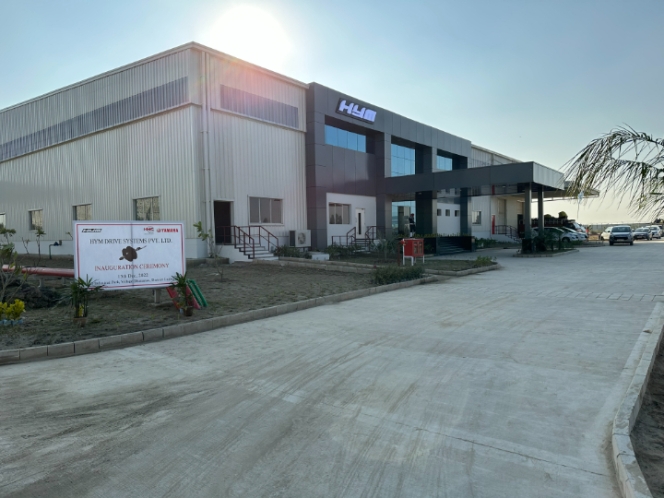
The inauguration of the manufacturing facility of HYM Drive Systems, a joint venture between Hero Motors Ltd and Yamaha Motors Co (Japan), took place on Thursday at Hero E-Cycle Valley in Ludhiana. Pankaj Munjal, Chairman of Hero Motors Company, inaugurated the new facility in the presence of senior executives from Yamaha Motor Co, strategic partners and other stakeholders.
HYM Drive Systems has a state-of-the-art facility that includes a hi-tech motor assembly line, along with an in-house motor winding and end-of-line testing equipped with ODIN software system for 100 percent traceability. HYM states that it will start production in Q1 2023 with a capacity of 300,000 motors per annum in phase one (capacity expansion plan to 10,00,000 or one million in phase two). The product would be sold to the global markets through Hero and Yamaha’s OEM network and will also be used in the Hero and Yamaha branded e-cycles.
HYM claims that Hero Motors and Yamaha Motor Co (Japan) entered into an agreement in October 2021 to create a global e-cycle (electric) drive unit company at Hero E-Cycle Valley in Ludhiana. According to the company, the Hero E-Cycle valley is an integrated, high-end plant that manufactures premium push bikes for the global market. This joint venture is the next step in the strategic alliance forged between Hero and Yamaha in September 2019 to work together in the e-cycle product segment.
Sharing his thoughts, Pankaj Munjal, Chairman of Hero Motors Company, said, “This manufacturing facility is a key component of our joint strategy with Yamaha to design, validate and manufacture electric drive units for global e-cycle markets in India. HMC envisions India to be a global manufacturing hub for e-cycles and the drive systems. The EU e-bicycle market has been growing in double digits for more than a decade and expected to grow at a similar rate in the near future. The set-up of this facility has brought us one step closer to fulfilling our ambition to be the first fully integrated player in India for global markets. To take it a step further, Hero Motors is planning to set up a technical centre in 2023 to design the complete electric drive units, which will include motors from HYM and other components like battery, controller, charger, display, sensors and connect applications from automotive suppliers in India and the EU.”
Adding to this, Okubo Shingo, General Manager, Yamaha Japan, remarked, “We are delighted today to set up this facility and see our partnership with Hero start so efficiently despite pandemic challenges. This partnership is in line with our ambition of advancing into e-cycle and meet the needs of e-cycle customers in a better way. We are excited to achieve this milestone.”
Tata Power, Tata Passenger Electric Mobility Expand Charging Hub Network Across India
- By MT Bureau
- September 10, 2026
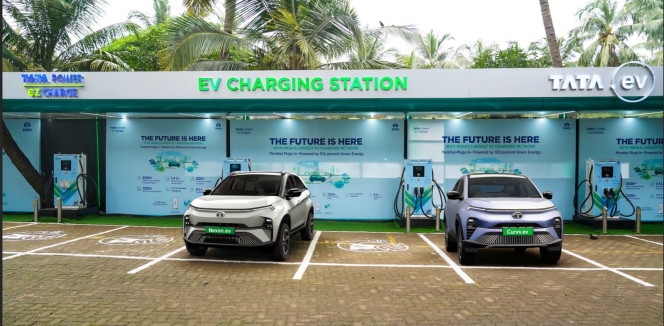
Tata Power and Tata Passenger Electric Mobility have expanded their co-branded charging network across four states, with 10 charging hubs logging over 70,000 charging sessions and 85,000 charging hours.
The infrastructure has delivered 2.7 megawatts of total power capacity, supporting over 7.5 million electric kilometres and offsetting 6,690 tonnes of carbon dioxide emissions.
The network spans Maharashtra, Telangana, Andhra Pradesh and Uttar Pradesh, operating 25 fast chargers and 56 charging guns with hub capacities ranging between 180 kilowatts and 600 kilowatts. The locations include four sites along the Yamuna Expressway between Greater Noida and Agra, three stations along the Hyderabad–Vijayawada corridor, one location on the Bengaluru–Tirupati route and one hub along the Pune–Bengaluru highway. Additional hubs operate within urban zones in Mumbai and Hyderabad.
The facility at The Leela near Mumbai Airport serves as the flagship site, providing 600 kilowatts of capacity across 16 charging guns, comprising six 60-kilowatt and two 120-kilowatt units. The location supports private vehicles, commercial taxis and fleet operations near transit corridors.
The installations form part of Tata Power's total footprint, which includes over 6,700 public and captive charging points, 250,000 home chargers and 1,200 bus chargers across 690 cities. The company aims to operate 10,000 public charging points and 750,000 home chargers by 2030, with hub management integrated into the Tata Power EZ Charge application.
Telangana Tops HERE-SBD EV Index 2026 As India Adds 31,500 Public Chargers
- By MT Bureau
- September 10, 2026
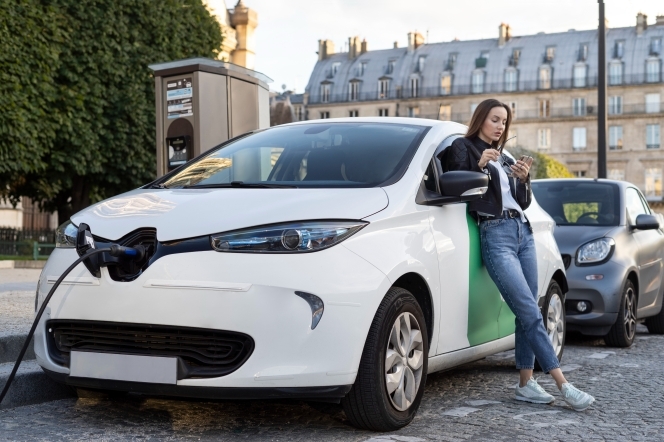
HERE Technologies and SBD Automotive have published the India edition of the HERE-SBD EV Index 2026, which tracks electric vehicle readiness and charging infrastructure deployment across 34 Indian states and union territories. The report indicates growing consumer interest alongside an expansion of public charging networks.
The report finds that Telangana secured the top rank in the 2026 study, rising from 25th position in the previous edition due to infrastructure additions and updated vehicle fleet data. Andhra Pradesh advanced from 13th to second place, while Chandigarh ranked third, followed by Haryana and Rajasthan tied in fourth position.
Delhi dropped from fourth place in 2025 to 17th position, as infrastructure additions and vehicle adoption rates lagged behind other regions.
Interestingly, India added more than 31,500 public charging points over the past year, increasing total public charging capacity by 1.65 gigawatts. The average public charger power increased from 32 kilowatts to 45 kilowatts across the network.
A companion survey of drivers in India revealed that 87 percent of respondents are more likely to consider purchasing an electric vehicle than a year ago, with 46 percent citing fuel costs as a primary factor. However, operational challenges persist, with 77 percent of current electric vehicle owners reporting encounters with non-functional charging points and 46 percent citing charger availability as a primary barrier to adoption.
Abhijit Sengupta, General Manager for India and Southeast Asia, HERE Technologies, said, "India's EV ecosystem is evolving rapidly. Consumer confidence continues to grow, charging infrastructure deployment is accelerating and several states are demonstrating strong progress in building the foundations for electric mobility. More than 31,500 chargers were added in the past year alone, underscoring the momentum across the industry. As adoption accelerates, the focus must increasingly shift from simply expanding infrastructure to ensuring drivers can confidently discover, access and use charging infrastructure whenever they need it."
Robert Fisher, Senior Consulting Manager, SBD Automotive, said, "India continues to stand out as one of the most optimistic EV markets globally. The rapid growth in charging infrastructure is encouraging, but consumer feedback shows that reliability remains a key challenge. The next stage of market maturity will require balancing infrastructure scale with infrastructure quality, ensuring the charging experience keeps pace with the growing number of EVs on the road."
The index ranks regions out of a maximum score of 100 based on four criteria: charger density per road length, average charger power capacity, vehicle fleet share, and the ratio of registered electric vehicles to public charging points.
Bgauss Unveils C12 MaxR Electric Scooter With 178km Range
- By Sharad Matade
- September 09, 2026
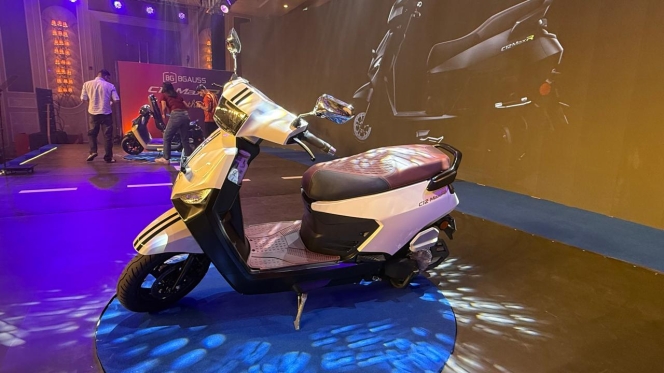
Mumbai-headquartered electric vehicle company Bgauss, part of RR Global, has launched the C12 MaxR, an electric scooter which comes with a certified range of 178km and a top speed above 75kmph. The launch is part of the company’s plan to make further inroads into India's competitive two-wheeler market.
Underpinning the new model is what Bgauss calls its WSA platform, an architecture built to take different combinations of motor, battery and wheel size rather than being locked to one configuration. The company says the platform, made from high-tensile micro-alloy steel and assembled through robotic manufacturing, is rated for up to 150,000km of use — a figure aimed squarely at buyers who use their scooters for daily commuting rather than occasional trips.
The C12 MaxR draws power from a 3.8kWh lithium iron phosphate battery, rated IP67 for water and dust resistance and enclosed in aluminium to help manage heat. Bgauss says the pack's battery management system tracks 110 separate safety and performance parameters, feeding into the certified 178km range.
Drive comes from HyperZen, a newly developed in-wheel motor that produces 4.2kW of peak power. Unlike a conventional setup, the motor houses its own gear transmission, braking hardware and control unit together, which Bgauss says does away with a belt or chain and cuts down on wiring.
Riders get a choice of Eco, Ride and Sport modes, plus reverse gear, cruise control and regenerative braking. Bgauss rates the scooter's hill-climbing ability at 18 degrees, give or take two degrees either way.
"Over the last six years, we have been focused on building electric mobility around the Indian consumer, and the C12 MaxR brings that philosophy together in one product," said Hemant Kabra, founder of Bgauss. "We wanted to create a scooter that delivers on the fundamentals of range, performance and reliability, but also recognises that today's consumer expects much more from their vehicle. Space, design, lighting, technology and pride of ownership are equally important. The C12 MaxR is our expression of what a complete electric scooter should be. It is engineered for everyday India, while designed to make every ride feel special."
Storage was clearly a design priority. Under the seat is room for two helmets, while riders also get a pop-out umbrella holder, a lockable compartment for documents and a wallet, wireless phone charging, a bottle holder and a spot for a cleaning cloth. There is additional space on the floorboard for a medium-sized bag or piece of luggage.
Visually, the scooter is built around a front light unit Bgauss calls the Krystal Lamp, paired with full LED lighting at the tail and indicators, and a quilted seat the company has branded Seat of Pride.
A 5-inch TFT screen handles turn-by-turn navigation, call alerts, ride and charging data, user profiles and document storage, with a choice of display themes. Other functions include a distance-to-empty readout, a fall-detection feature called FallSense, automatic motor cut-off when the side- or main-stand is down, service reminders, a mode-memory setting and home-location guidance. A companion app adds parental controls, a security lock, adjustable speed limits, firmware updates, vehicle health checks, an SOS alert and DigiLocker access.
Mechanically, the C12 MaxR runs on 12-inch alloy wheels with tubeless tyres, stopped by a 220mm front disc and a combined braking system at the rear. Suspension is handled by a hydraulic telescopic front fork and a five-step adjustable Nitrox gas-emulsion rear unit, with 160mm of ground clearance and a payload rating of 150kg.
The scooter goes on sale in four colourways — Sparkling Wine with Champagne Gold, Terra Green with Champagne Gold, Pearl White and Satin Black — through Bgauss's dealer network across India.
Hindustan Zinc Deploys 30 Electric Trucks For Mine-to-Smelter Logistics
- By MT Bureau
- September 09, 2026
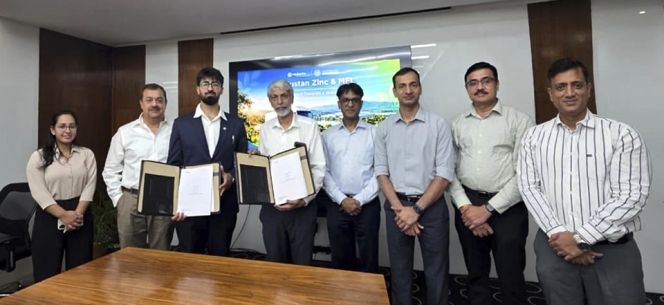
Hindustan Zinc has signed a 6-year transportation contract with MFL India for the deployment of 30 electric trucks to transport concentrate, expanding the electrification of its industrial logistics network in Rajasthan. The agreement includes an option to extend the term by an additional two years.
As per the contract, the electric trucks will replace diesel vehicles used for moving zinc and lead concentrate from the Rampura Agucha underground mining site to the company's smelting facilities. MFL India will establish and operate dedicated EV charging infrastructure along the transit route to support fleet operations and maintain transport schedules. The agreement incorporates a phased transition plan to integrate local drivers into the electric fleet operations.
Amarendu Prakash, CEO and Whole-time Director, Hindustan Zinc, said, "The future of mining will be defined not only by the metals we produce, but by how responsibly and efficiently we produce and move them. The contract for deployment of EV trucks for concentrate transportation is yet another step towards that future, demonstrating how industrial decarbonisation can strengthen competitiveness while creating an ecosystem in which our partners and communities grow with us."
Anil Thukral, Chairman and MD, MFL India, said, "We are proud to partner with Hindustan Zinc in advancing the transition to cleaner industrial logistics. This deployment demonstrates how electric mobility can be effectively integrated into large-scale transportation networks, supported by the right charging infrastructure and operational planning. Together, we are building a scalable model for sustainable logistics that delivers both environmental benefits and long-term operational value."
In FY2026, Hindustan Zinc added 42 electric vehicles to its operational fleet, bringing its alternative-fuel logistics inventory to 232 vehicles, comprising 52 electric vehicles and 180 LNG-powered vehicles.
The company previously introduced battery electric vehicles for underground operations at its Sindesar Khurd Mine in Rajpura Dariba. The fleet conversion forms part of Hindustan Zinc's target to achieve net-zero emissions by 2050, alongside increasing its renewable power consumption share to nearly 22 per cent.
Comments (0)
ADD COMMENT