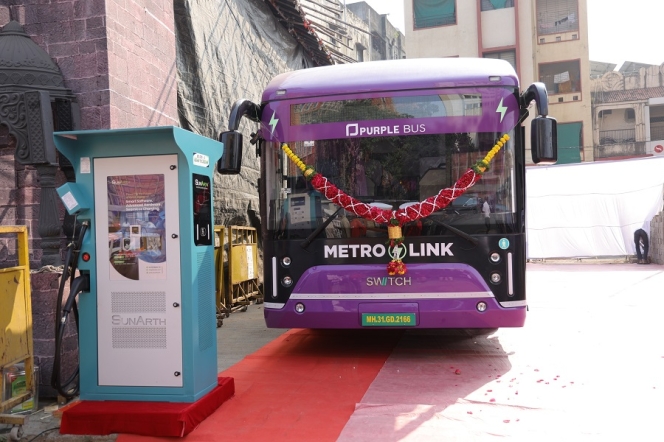
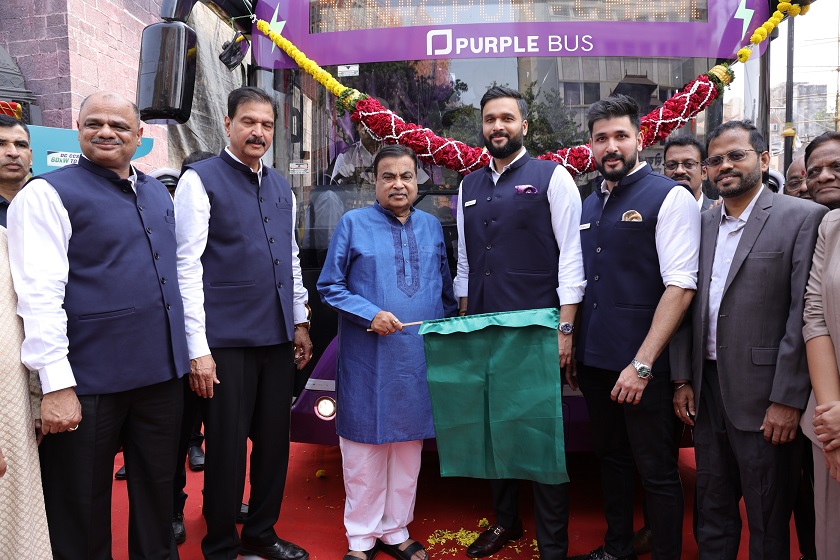
SWITCH Mobility Ltd, a global leader in electric buses and light commercial vehicles and part of the Hinduja Group, has joined forces with intercity operator PURPLE BUS to roll out the region's first electric bus service linking Nagpur and Chandrapur, widening the operator's Vidarbha footprint. Union Minister of Road Transport and Highways Nitin Gadkari oversaw the ceremonial dispatch of the inaugural six units, drawn from a 50-bus EiV12m intercity electric order placed by Purple Bus for deployments across Vidarbha.
Organisers chose Dussehra, a festival traditionally viewed as favourable for fresh ventures, as the launch date, a nod to the manufacturer's continuing push for safe, dependable and sustainable public transport in the region. Travellers between the two cities stand to gain better connectivity along with a safe, comfortable and eco-friendly way to travel.
The Nagpur–Chandrapur service is the third intercity project this year between SWITCH Mobility and Prasanna Purple Mobility Solutions, building on electric coach launches along the Mumbai–Pune and Dombivli–Pune corridors in April 2026 and October 2026, respectively. The recurring tie-up points to rising operator confidence in electric buses for high-frequency intercity routes and to SWITCH Mobility's growing part in India's shift towards sustainable intercity travel.
The new route strengthens the partnership with Prasanna Purple Mobility Solutions and furthers the company's wider aim of making zero-emission public transport accessible in Indian cities and towns. Linking key Vidarbha centres, the service is expected to ease daily commutes, boost local economic activity and speed the move towards cleaner intercity mobility. The EiV12m coach, engineered for long-distance journeys, pairs 45 pushback seats and a 350 km per-charge range with fast-charging capability, advanced safety systems, a quiet ride and SWITCH iON connected technology for real-time monitoring.
Ganesh Mani, Chief Executive Officer, SWITCH Mobility, said, “Nagpur and Chandrapur share a close economic and cultural relationship, and strengthening this corridor with our partner Prasanna Purple Mobility Solutions is an important step in our mission to build future-ready public transport across India. Following our deployment on the Mumbai–Pune route earlier this year, we are glad to extend this partnership to Vidarbha and to contribute to the region’s growth by supporting the everyday movement of the people who depend on it. This launch reaffirms our commitment to sustainable, people-first mobility solutions in Maharashtra and beyond.”
Saurabh Patwadhan, Director, PURPLE BUS, said, “At PURPLE BUS, our goal is to make electric the default way people travel between cities, not the exception. We are building that future route by route, from Mumbai–Pune, one of India’s busiest corridors, to Nagpur–Chandrapur, where we now bring Vidarbha its first electric bus service. Our fleet has already covered more than one million kilometres (1,000,000 km) in electric intercity operations, and the data shows what many operators doubted: electric coaches deliver a lower total cost of ownership and a lower cost per passenger-kilometre than diesel. Our partnership with SWITCH Mobility has been central to proving that, and it gives us the confidence to scale sustainable intercity mobility across Maharashtra.”





Comments (0)
ADD COMMENT