

- Bharat Mobility Global Expo 2025
- Auto Expo The Motor Show 2025
- Bharat Construction Equipment Expo
- Urban Mobility Infrastructure Show
- The Components Show
- Urban Mobility & Infrastructure Show
Bharat Mobility Global Expo 2025 Officially Opens For The Public
- By MT Bureau
- January 20, 2025

The third day of the ongoing Bharat Mobility Global Expo 2025 witnessed a massive turnout of enthusiastic attendees at Bharat Mandapam, New Delhi, as the Auto Expo – The Motor Show 2025 was officially opened for the public. Visitors can register via the Bharat Mobility mobile app, DMRC App or the District (by Zomato) app.
With over 10 new product releases and top firms like Amara Raja showing its future giga corridor for lithium-ion battery and cell manufacture, the Bharat Battery Show, which had over 88 exhibitors, also started on the third day. In order to stimulate conversations about creative approaches to road safety, SIAM successfully hosted the inaugural Summit for Automotive Future Advancement in Road Safety (SAFAR) at Bharat Mandapam on the third day. With the topic ‘United Efforts for Road Safety: Safer Roads, Our Responsibility’, the event sought to promote teamwork in enhancing road safety in India via thought-provoking conversations, engaging exercises and creative projects.
With its exhilarating drift performance, BMW India's outdoor exhibit at the Bharat Mobility Global Expo 2025 attracted a sizeable crowd. A committed professional driver demonstrated exceptional competence by doing doughnuts around a little track that was particularly created. Every session included a different car out of three and a brand-new set of drift tyres, guaranteeing an exciting performance show. Additionally, at their Arena of Desire, Mercedes Benz India showcased the Concept CLA-Class, which represents the future of luxury and performance.
Honda Motorcycle and Scooter India Ltd's ‘Value Life, Ride Safe’ campaign reaffirmed the company's dedication to traffic safety. In order to improve their abilities, visitors of all ages may play interactive road safety games, use simulator riding trainers to experience real-life situations and slowly ride. Visitors were also able to record their moments of dedication to road safety in a designated selfie area, which enhanced the experience. In order to teach people safe driving techniques, Maruti Suzuki India also installed a driving simulator under its Road Safety VR Zone. This was a component of Maruti Suzuki India Limited's road safety-focused CSR programme.
Among other things, Ceat displayed all-terrain and off-road tyres for luxury SUVs and cars. They also showcased their Ceat Tracks for mining and agricultural vehicles and their Crossraid line of two-wheelers. Michelin showcased its cutting-edge tyres that can be altered to fit various terrain conditions using integrated 3D printing technology. The company displayed a video clip behind the tyre that demonstrated how consumers will be able to choose from a variety of tread variations for different types of terrain, including sand, hills, snow and much more. Additionally, the company demonstrated its airless radial tyre design, which is suitable for large trucks.
Under the auspices of the Bharat Mobility Global Expo 2025, the Bharat Construction Equipment Expo and the Urban Mobility Infrastructure Show got underway at the India Expo Centre & Mart in Greater Noida. The event was formally opened by Ministry of Commerce and Industry Commerce Secretary Sunil Barthwal. Leading firms displayed their latest products, including Tata Hitachi Construction Machinery Co. Pvt Ltd, HD Hyundai Construction Equipment India Pvt Ltd, Sany Heavy Industry India Pvt Ltd, JCB India Ltd, Case Construction, ACE and Schwing Stetter, among others.
More than six automotive items and solutions were on display by exhibitors at ‘The Components Show’ at Yashobhoomi, Dwarka. BorgWarner exhibited electrification-supporting technology, such as LFP battery systems, while Klüber Lubrication showcased its environmentally friendly solutions for contemporary mobility. Next-generation automotive solutions including the Autorobot-CRS, EV products and Smart Light-Touchless Aligner were introduced by ATS ELGI. Products for passenger automobiles, two- and three-wheelers, commercial vehicles and agricultural and off-road vehicles were also on show at TEXSPIN.
Meanwhile, significant stakeholders such as Delhi Metro Rail Corporation Ltd, National Capital Region Transport Corporation Ltd and Maharashtra Metro Rail Corporation Ltd were among those who actively participated in the Urban Mobility & Infrastructure Show and its Urban Air Mobility Pavilion.
Caterham Adds Yorkshire-Based Caterham Turn 7 To Retail Network
- By MT Bureau
- October 17, 2026
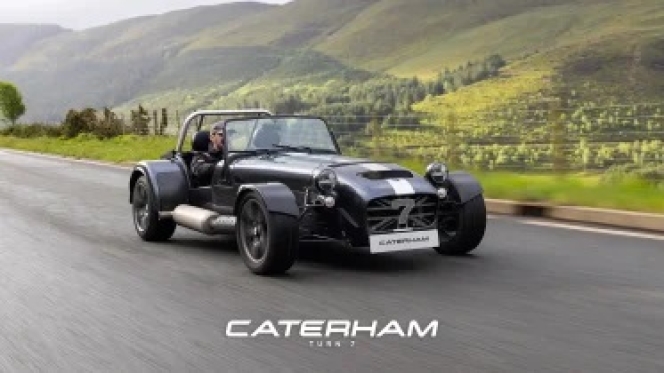
Caterham has expanded its official UK retailer network by appointing Yorkshire-based Caterham Turn 7. The father-and-son team of Jim and Callum McDougall founded the business, which has built a strong reputation within the Caterham community as an independent pre-owned specialist and service centre. The Seven runs deep in the McDougall family, with Jim having helped establish the concept behind the Caterham Academy and Callum having worked as a Sales Executive for Caterham at the original Town End showroom.
Beyond its established pre-owned operation, the North Yorkshire facility will now offer the complete Seven range, along with official parts, workshop servicing and aftersales support. This appointment strengthens Caterham's presence in the region and formalises a longstanding relationship with a business already deeply embedded in the brand's culture.
Christian Gorton, Global Head of Sales at Caterham Cars, said, “We are thrilled to welcome Caterham Turn 7 to our official UK retailer network. Callum, Jim, Carl and the team are already integral, highly respected members of the Caterham community, having built a brilliant reputation as an independent specialist in Yorkshire. Their lifelong passion for the Seven, motorsport ties and technical knowledge make this appointment a natural evolution. Expanding our official footprint in the North East ensures our growing community of drivers will receive exceptional service and support.”
Callum McDougall, Director of Turn 7, said, “It is great to be back working with Caterham again after nearly 13 years of being an independent specialist. Our team and our facility have been growing steadily over the last five years along with our fantastic community of Seven owners. Becoming the official sales and service centre for the area will give us the ability to provide even better services to our customers, with more products and backing by Caterham themselves. I've watched Caterham change a lot over the 16 years I have been in the industry, and I am really pleased to say that it looks like they are in a really good place right now, with some exciting new products on the horizon. We are all very excited to be joining the official retailer network and helping to drive, maintain and support the future of the Seven and its owners.”
Intangles Study Exposes Risky Driving Behaviour Across 598 Indian School Buses
- By MT Bureau
- October 16, 2026
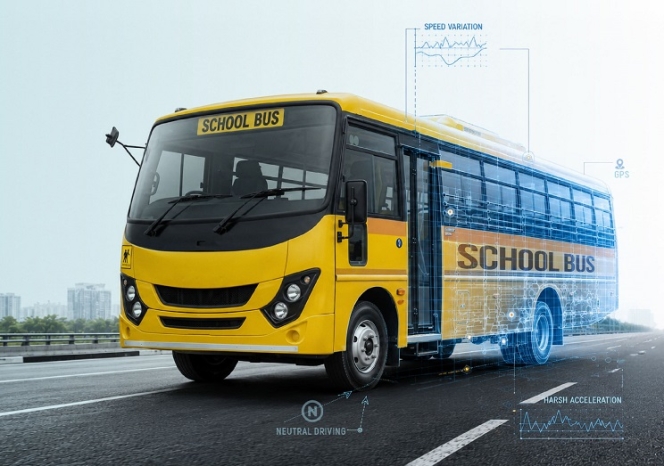
A recent study by Intangles, a global AI-powered prescriptive analytics firm focused on commercial fleets and mobility analytics, examined school bus safety across India and found that one in five of the vehicles analysed had recorded at least one over-speeding incident. The research covered 598 school buses in 61 cities over a six-month period during 2026, forming part of the company’s Interesting Angles Episode 2 report titled Beyond the Rulebook. More than 75,000 flagged driving events were assessed across four behaviours: over-speeding, hard braking, harsh acceleration and coasting.
Regional contrasts proved striking. In Delhi, four out of five buses analysed logged over-speeding incidents, compared with the national ratio of one in five. Maharashtra also raised concerns, with harsh acceleration events occurring at six times the national average. The report further identified 116 buses that triggered over-speeding alerts every two to three days, averaging roughly 79 kmph during those instances, well above prescribed limits. Such findings underscore the value of continuous driving behaviour monitoring alongside mandatory speed governors and standard GPS tracking.
Hard braking proved the most common flagged behaviour, representing 81.5 percent of all safety events. Each bus averaged 126 flagged events over six months, including about 103 hard braking incidents, or nearly one every two school days. The study described a ‘Bell Effect’, where hard braking rose sharply between 7 AM and 8 AM across regions, coinciding with the morning commute. While no direct cause was established, the pattern suggests operational pressures such as congestion, tight schedules and the race to reach school on time may contribute.
Comparisons between school and city buses revealed sharp differences. Harsh acceleration stood at 4.6 percent versus 1.8 percent, hard braking at 81.5 percent versus 38.9 percent and coasting at 2.9 percent versus 0.4 percent, amounting to fourfold, threefold and ninefold gaps, respectively. In Maharashtra, harsh acceleration made up 30 percent of flagged events against a 5 percent national average, while Pune recorded 42 percent compared with Mumbai’s 15 percent, indicating that congestion alone may not explain aggressive acceleration.
The findings arrive as school transportation safety rules evolve. Maharashtra’s July 2026 regulations introduce seat belts, CCTV, live video access, GPS tracking, panic buttons, digital attendance and state monitoring integration. Nationally, Advanced Driver Assistance Systems are being phased into new buses and trucks between 2026 and 2028. Yet with older vehicles still operating, the study stresses strengthening safety practices within existing fleets.
Intangles maintains that driving behaviour monitoring, real-world trip data, cameras and structured driver coaching can help schools and operators spot unsafe patterns and take corrective action. Integrating these tools with existing requirements may improve accountability and visibility in daily school transportation. The analysis used proprietary algorithms to assess event frequency, timing and geography, and its findings reflect observed behaviour within the study sample.
Anup Patil, CEO, Intangles, said, "School bus safety is often measured by whether a vehicle meets prescribed regulations, from speed governors and GPS tracking to onboard safety equipment. But compliance does not necessarily tell us how safely a child is being driven. Our analysis found recurring instances of speeding and hard braking across school buses, with some of these behaviours occurring repeatedly during routine journeys. What is equally important is understanding the conditions in which these incidents occur.”
Vikram Melapudi, Chief AI Scientist, Intangles, said, “Schools and safety officers need greater visibility into real world driving behaviour so they can identify recurring risks, address unsafe practices and strengthen driver accountability. The focus must shift from simply checking whether a bus is compliant to continuously assessing how safely it is being operated."
Stellantis Reaffirms India Plans With INR 40 Billion Investment, 12 Product Launches
- By MT Bureau
- October 15, 2026
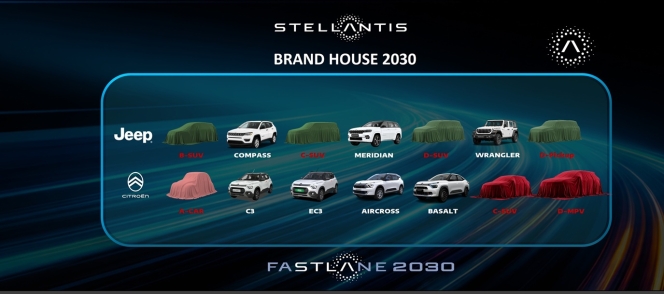
European automotive group Stellantis has announced an investment of approximately INR 40 billion (EUR 400 million) to scale its Indian operations under its FaSTLAne 2030 strategy. The commitment brings the manufacturer's cumulative capital deployment in India to INR 150 billion by 2030.
The roadmap outlines 12 vehicle introductions over the next three years across its Jeep and Citroen brands, comprising 7 new models and 5 major product upgrades. The releases will span the B, C and D SUV segments, alongside a multi-purpose vehicle, an A-segment car and a pickup truck.
The initial product under the expanded plan is scheduled for commercial launch in Q2 of 2027. Powertrain options will include internal combustion engines, hybrid, plug-in hybrid and battery-electric platforms, supported by a target local component sourcing level of 90 percent across its manufacturing plants in Ranjangaon, Thiruvallur and Hosur.
Tianshu Xin, COO, Stellantis Asia-Pacific Region, said, "India has a dual role for Stellantis: it is an important market that we intend to grow in, and an increasingly significant capability base for the region and the wider Group. India is a long-term commitment for us, not just a volume chase. Under FaSTLAne 2030, our region-led model gives the India team greater ownership of decisions, and the roadmap we are announcing today reflects our long-term conviction in this market. A stronger product cadence, a multi-energy technology approach and India’s capabilities across manufacturing, engineering, software and sourcing give us the foundation to build a larger and more competitive business here through 2030."
Shailesh Hazela, CEO & MD, Stellantis India, said, "Our commitment to India will be measured by what we put on the road. Having built a strong foundation over the years, our focus now shifts to scaling the business. Twelve launches across Jeep and Citroën over the next three years will significantly broaden our market participation and give Indian customers more choice across segments and powertrains, supported by deeper localisation and a stronger sales and service network. With fresh investment of approximately ₹5,000 crore, we are building greater scale, relevance and competitiveness in this market, while strengthening India’s role in Stellantis’ global operations."
The investment phase expands on the INR 110 billion previously deployed by Stellantis in India for manufacturing facilities, software development centres in Bengaluru, ICT hubs in Hyderabad and regional component export channels.
Indian Auto Sales See Record Growth Across Segments In Q2 FY2027
- By MT Bureau
- October 15, 2026
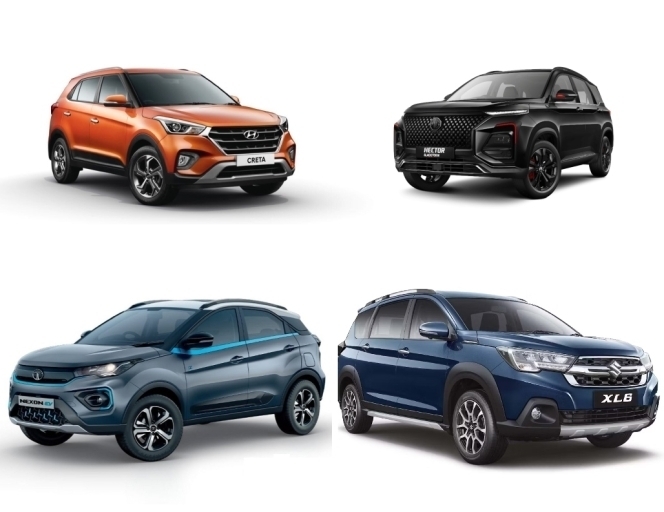
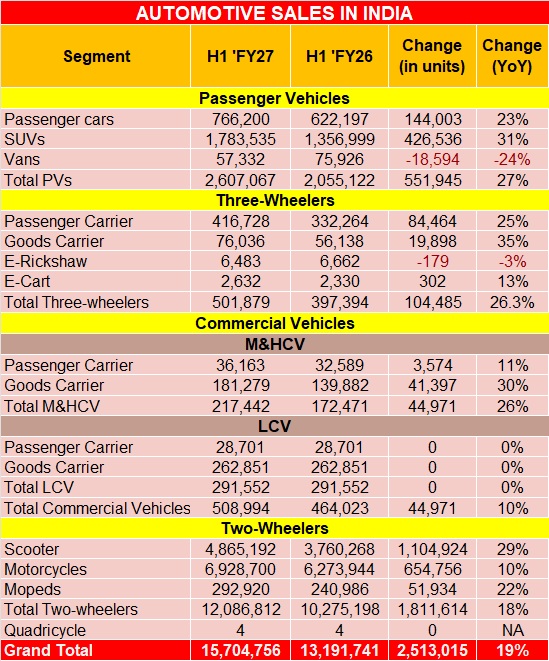
The Society of Indian Automobile Manufacturers, the apex body representing automakers across segments in the country, has released the wholesales data for Q2 FY2027, which saw record performance across passenger vehicles, commercial vehicles, three-wheelers and two-wheelers.
In Q2 FY2027, the passenger vehicle segment domestic sales reached 1.36 million units, up 30.7 percent YoY. Sports Utility Vehicles (SUVs) accounted for 68 percent of total passenger vehicle sales, recording a growth of 34.2 percent, while passenger car sales increased by 24.9 percent. Passenger vehicle exports declined by 5.2 percent to 229,087 units, impacted by logistics constraints in West Asia and higher baseline comparison figures.
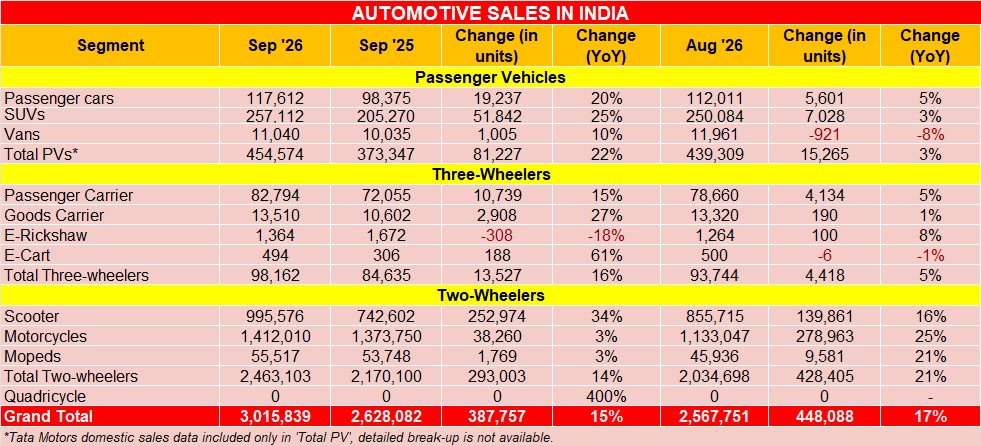
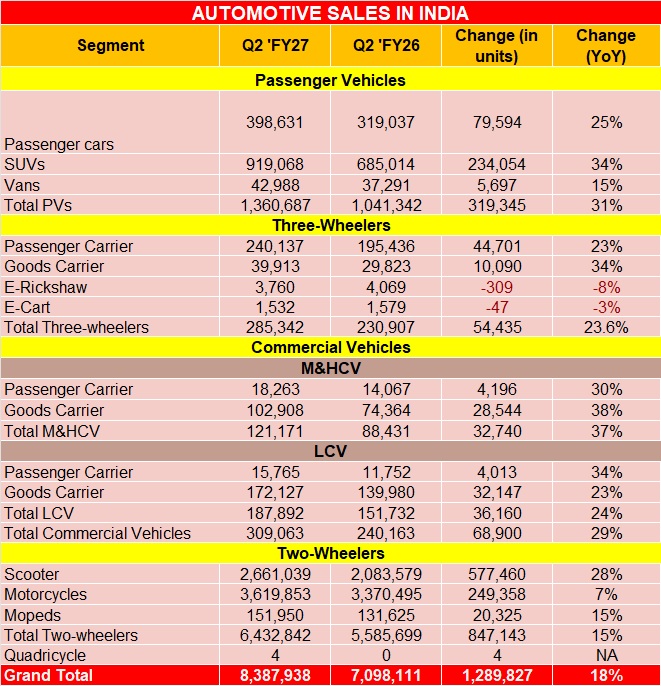
The two-wheeler segment posted domestic sales of 6.43 million units, registering a growth of 15.2 percent YoY. Scooter sales increased by 27.7 percent, while motorcycle sales rose by 7.4 percent. Two-wheeler exports reached a record Q2 total of 1.65 million units, marking an increase of 27.7 percent over the same period last year.
In the three-wheeler category, domestic sales grew by 23.6 percent to 285,342 units, driven by demand for cargo configurations and electric L5 vehicles. Three-wheeler exports reached a record Q2 total of 161,060 units, representing a 30.4 percent increase. The commercial vehicle segment recorded domestic sales of 309,063 units, marking a growth of 28.7 percent, while commercial vehicle exports rose by 72.5 percent to exceed 41,416 units, supported by infrastructure spending and fleet replacement demand.
Shenu Agarwal, President, SIAM, said, "The Indian automotive industry delivered a strong performance in the first half of FY2026-27, following a robust second quarter and a strong September 2026. This stellar performance across all segments of the automobile industry has been supported by improved affordability following GST 2.0, resilient rural and urban demand, healthy freight movement, infrastructure-led economic activity, and a gradual replacement cycle across vehicle segments. The electric vehicle ecosystem also continues to mature with multiple offerings, improving charging infrastructure and supportive policy measures. At the same time, alternative fuel technologies are witnessing increasing acceptance and are expected to play an important role in India's sustainable mobility transition. Industry looks forward to the festive season for the continued momentum while remaining cautiously optimistic due to prevailing geo-economic uncertainties. Continued investments in infrastructure, sustained economic growth, and rising adoption of cleaner and more efficient mobility solutions are expected to support industry growth through the second half of 2026-27."
Comments (0)
ADD COMMENT