

- Royal Enfield
- Eicher Motors
- Volvo Eicher Commercial Vehicles
- VECV
- Siddhartha Lal
- B Govindarajan
- Vinod Aggarwal
Eicher Motors Reports Record Financials for FY2025, Royal Enfield Crosses Million Annual Motorcycle Sales
- By MT Bureau
- May 14, 2025
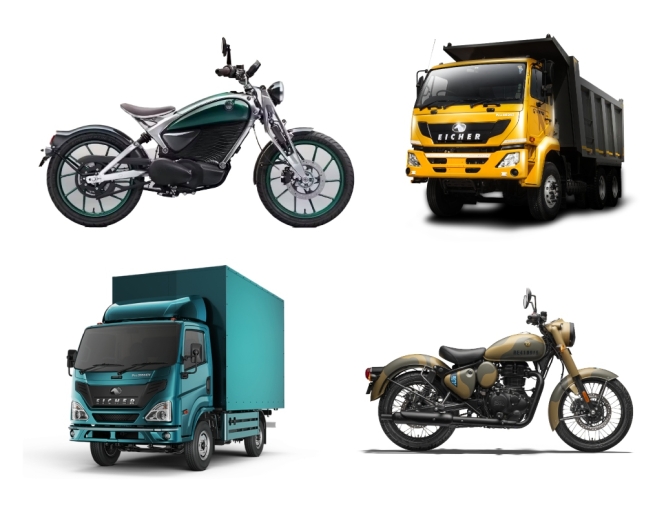
Two-wheeler and commercial vehicles major Eicher Motors has reported its record financial results for FY2025.
For the quarter ending 31 March 2025, Eicher Motors reported its highest-ever quarterly revenue from operations at INR 52.41 billion, marking a 23.1 percent increase over the same period last year. Quarterly EBITDA rose 11.4 percent to INR 12.58 billion, while net profit surged 27.3 percent to INR 13.62 billion.
Royal Enfield registered its highest-ever quarterly sales during Q4, with 280,801 motorcycles sold, up 23.2 percent YoY.
For fiscal 2025, Eicher Motors reported revenue of INR 188 billion, a 14.1 percent increase over FY2024, EBITDA rose 8.9 percent to INR 47.12 billion, while PAT stood at INR 47.34 billion, up 18.3 percent YoY.
The company also reported that Royal Enfield crossed the 1 million mark in annual sales for the first time in its history, clocking 1,002,893 units, up 10 percent YoY. Domestic sales grew 8.1 percent to 902,757 units, while exports surged 29.7 percent to 100,136 units.
The iconic brand launched six new motorcycles during the year, including the Guerrilla 450, Bear 650, Classic 650, Goan Classic 350, the 2024 Classic 350 (featuring a Factory Custom Programme) and the Scram 440.
Royal Enfield also made its debut in electric mobility with Flying Flea, a city+ EV brand inspired by the 1940s model of the same name. The new EV line-up is set to launch its first product by 2026, blending classic aesthetics with cutting-edge technology.
To strengthen its international footprint, Royal Enfield inaugurated its first fully owned CKD (completely knocked down) assembly plant in Thailand and announced a second CKD unit in Brazil aimed at serving the LATAM region. It also expanded operations in Bangladesh with a new manufacturing facility and flagship showroom.
Eicher Motors’ commercial vehicle arm, VECV, also posted a strong performance in a flat market. It reported annual revenue of INR 235.48 billion, up 7.7 percent from the previous year. PAT rose 57 percent to INR 12.86 billion, while EBITDA stood at INR 20.23 billion. The company sold 90,000 vehicles in FY2025, a 5.4 percent YoY growth.
VECV introduced the Eicher Pro X range – electric small commercial trucks assembled on an all-woman assembly line – as part of its push for sustainability and inclusivity. Volvo Trucks, part of the joint venture, launched India’s first FM Road Train for efficient long-haul logistics and also began deliveries of LNG-powered trucks.
Siddhartha Lal, Chairman, Eicher Motors, said, “We have had a remarkable year at EML and have reported exceptional performance across both Royal Enfield and VE Commercial Vehicles. In the motorcycle business, the middleweight segment saw a lot of action from our peers. Remaining unfazed and maintaining focus on our strategic goals and community, Royal Enfield stood head and shoulders above everyone else to sell one million motorcycles annually, for the first time in its history. With several global award winning and category defining motorcycles now sitting within the Royal Enfield portfolio, we are super excited and confident about the possibilities that lie ahead of us. At VECV also we saw record-breaking volumes and a strong performance despite the prevailing challenging market conditions. What excites me the most is that we have done it all quietly, consistently and with a sense of purpose. We balanced creativity with rigour, legacy and progress in a way that’s unique to our company and I genuinely believe we are just getting started.”
B Govindarajan, MD, Eicher Motors and CEO, Royal Enfield, said, “FY25 was an incredible year for Eicher Motors and Royal Enfield. We delivered our best-ever financial performance and despite a slow start to the year, we built strong momentum in the second half, launching six new motorcycles, achieving a record festive season and seeing healthy demand across all our products. We also strengthened our international footprint, with consolidated exports surging 29.7 percent to 100,136 units and opened new CKD operations. We also marked our entry into electric mobility with Flying Flea, our city+ EV brand that brings together timeless design and modern tech. It’s been a year of growth, resilience and execution and we are excited for what lies ahead.”
Vinod Aggarwal, MD & CEO, VE Commercial Vehicles, said, “VECV continued to outperform a nearly flat industry in FY2025, with vehicle sales growing 6 percent to 90,161 units. Our company closed the year as a market leader in the Indian 5-18.5T Light and Medium Duty truck segment and recorded its highest ever deliveries across key business verticals.”
- Renewable Energy India Expo and The Battery Show India
- TBSI
- Philip Green
- Yogesh Mudras
- Anandi Iyer
- Fraunhofer Office
- Informa Markets
- Manu Srivastav
- Jai Asundi
Critical Minerals And Battery Manufacturing Focus Shifts To India At TBSI
- By MT Bureau
- October 24, 2026
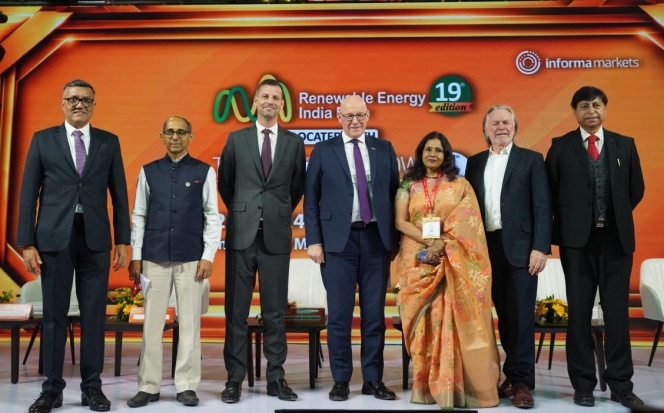
Industry leaders at the Renewable Energy India Expo and The Battery Show India (TBSI) highlighted critical mineral access, technology partnerships and domestic manufacturing capabilities to strengthen India's electric vehicle supply chain.
The event convened over 1,080 exhibitors, 1,400 brands and 54,000 professionals, focusing on international collaboration across critical minerals, battery technology and energy storage.
Interestingly, Australia, represented by 20 companies and 32 exhibitors, identified battery production and electric vehicle supply chains as areas for cooperation with Indian manufacturers, leveraging its lithium, cobalt and rare earth reserves. Projections shared at the exhibition indicate India's renewable energy market will reach 486 GW by 2030, while the battery storage sector is projected to surpass USD 8.5 billion by 2031, growing at a compound annual growth rate of 33 percent.
Philip Green, Australia’s High Commissioner to India, said, "The two countries could combine Australia’s engineering expertise and mineral resources with India’s manufacturing strength and integration into global supply chains. Australia produces more than 50 percent of the world’s lithium, according to Green, and holds the world’s second-largest cobalt reserves. It also ranks second or third globally in rare earth resources." he said.
Yogesh Mudras, Managing Director of Informa Markets in India, said, "Renewable energy generation and grid storage needed to expand together as the country advanced its energy transition. India’s renewable energy market is projected to reach 486 GW by 2030, growing at a compound annual growth rate (CAGR) of 15 percent. The country’s battery storage sector is projected to exceed USD 8.5 billion by 2031, with a CAGR of 33 percent."
Anandi Iyer, Director of the Fraunhofer Office in India, said, "India and Germany had opportunities to collaborate in battery research, power electronics, advanced engineering and industrial automation. Approximately 800 GW of renewable energy capacity additions globally in 2025, while global battery storage deployment reached 108 GW, an increase of 40 per cent from the previous year. Technological self-reliance did not mean working in isolation, highlighting the importance of trusted partnerships and supply chains that can translate research into commercially viable solutions."
Manu Srivastav, Additional Chief Secretary in Madhya Pradesh’s Power & Renewable Energy Department, said, "Renewable energy was becoming increasingly competitive with conventional power as costs declined.”
Jai Asundi, Executive Director of the Centre for Study of Science, Technology & Policy, said, "India would need continued investment in manufacturing, energy storage, grid infrastructure, research and skilled talent to build a resilient clean energy ecosystem."
Caterham Confirmed For Built in Britain Zone At London International Motor Show 2027
- By MT Bureau
- October 23, 2026

Caterham has confirmed its participation in the London International Motor Show 2027, with the British manufacturer set to appear in the event's Built in Britain zone at Excel London from 26 to 28 February 2027. The maker of the legendary Seven, produced in Britain since 1973, will display a selection of its cars on stand 1920.
Visitors will have the opportunity to examine one of the purest driving machines available anywhere, with the Seven widely regarded as a definitive British sports car thanks to its light, simple, hand-built construction in Kent and driver-focused engineering. The Built in Britain zone celebrates the designers, engineers and craftspeople sustaining the country's automotive industry, with specialist sports car makers playing a central role.
Though small in scale, these manufacturers wield enormous influence through cars whose character and focus are admired by major global firms and sought after by enthusiasts. The zone offers them a capital stage before a national audience. The show runs alongside Motorsport Expo and Car Culture UK, with one combined ticket covering all three and around 90,000 visitors expected across the weekend. Friday 26 February serves as the press and trade day, running alongside the public opening.
Stephen Maitland-Oxley, Event Director, London International Motor Show, said, “Caterham is exactly the kind of company Built in Britain was created to celebrate. The Seven is a British icon, and the team behind it has spent more than 50 years proving that lightness, ingenuity and sheer driving fun never go out of fashion. Britain's niche sports car makers are a national asset and we are delighted to give them the spotlight they deserve. Having Caterham with us is a wonderful way to set the tone for the zone.”
Trevor Steel, Senior Vice President – Operations, Caterham Cars, said, “ "At its core, the Caterham Seven is engineered to deliver a driving experience that is as pure, enjoyable and rewarding to the driver, as any car on sale today. Since its inception by Colin Chapman nearly 70 years ago, and since becoming a Caterham in 1973, the Seven has always been proudly built here in Britain, and this is heritage we’re always wishing to celebrate. Built in Britain is a natural home for us, and we are looking forward to meeting enthusiasts, owners and a new generation of drivers in London next February.”
GP Petroleums Appoints Shirish Suvagia As Chief Financial Officer
- By MT Bureau
- October 23, 2026

GP Petroleums has appointed Shirish Suvagia as its new Chief Financial Officer and Key Managerial Personnel, effective 15 October 2026.
Suvagia is a Chartered Accountant with over 23 years of experience in corporate finance, treasury, strategic planning, mergers & acquisitions, and debt and equity fundraising.
He holds Bachelor's and Master's degrees in Commerce from the University of Mumbai, an Executive MBA from IIM Indore, a CISA certification from ISACA, and an IFRS certification from the ICAI.
In his role as CFO, Suvagia will manage the company's financial strategy, treasury, business planning, capital allocation, risk management and reporting functions as GP Petroleums expands its IPOL lubricants brand across domestic and international markets.
Ayush Goel, Chairman & Managing Director of GP Petroleums, said, "We are delighted to welcome Suvagia to GP Petroleums. His experience across corporate finance, treasury, fundraising and mergers & acquisitions will be a valuable asset to the Company, particularly as we focus on capital allocation, business expansion and long-term value creation. We look forward to his contribution as we take the company forward. We are confident that his leadership and financial expertise will support the Company in creating sustainable value for all stakeholders."
"I am excited to join GP Petroleums at an important stage of its growth journey. IPOL is a well-established and respected brand with strong market fundamentals and significant opportunities ahead. I look forward to partnering with the Board and leadership team to further strengthen the Company's financial capabilities, support strategic growth initiatives, and drive long-term value creation for stakeholders," said Suvagia.
SAEINDIA to Host Asia Pacific Automotive Engineering Conference In New Delhi
- By MT Bureau
- October 23, 2026
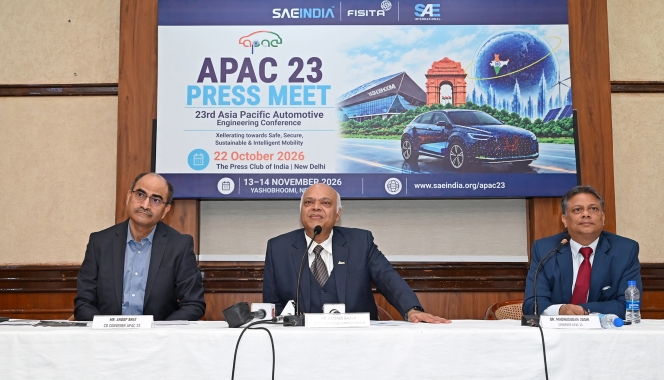
SAEINDIA is set to host the 23rd Asia Pacific Automotive Engineering Conference (APAC 23) from 13 to 14 November 2026 at the Yashobhoomi Convention Centre in New Delhi.
The event, held under the theme ‘Xellerating towards Safe, Secure, Sustainable & Intelligent Mobility,’ returns to India for the second time following a 15-year interval. The conference will convene more than 1,000 delegates and 500 mobility experts representing vehicle manufacturers, component suppliers, technology firms, research organisations and regulatory bodies across 11 countries in the Asia-Pacific region.
The agenda comprises 150 technical presentations and 80 exhibitors covering subject areas such as powertrains, automated driving, cybersecurity, software-defined vehicles, vehicle dynamics, advanced materials and regulatory standards.
The venue features an exposition hall, a technology theatre for product demonstrations, and the TechHive platform designed to connect mobility start-up ventures with industry leaders, technology experts, and investors.
“APAC 23 represents an important opportunity for India to engage with the Asia-Pacific mobility engineering community at a time when our industry is undergoing fundamental transformation. By bringing together industry, academia, researchers, innovators and policymakers, we aim to create meaningful conversations and collaborations that can contribute to safer, smarter and more sustainable mobility,” said Saurabh Dalela, President of SAEINDIA.
Anoop Bhat, Co-Convenor, APAC 23, said, “The scale and diversity of APAC 23 have been designed to create an environment where engineering knowledge, technology innovation and business opportunities come together. From technical presentations and the exposition to TechHive and the Technology Theatre, participants will have multiple opportunities to discover technologies, exchange ideas and build collaborations across the mobility ecosystem.”




Comments (0)
ADD COMMENT