

- Federation of Automobile Dealers Association
- FADA
- C S Vigneshwar
- Reserve Bank of India
- auto retails
- car sales
- two-wheeler sales
- commercial vehicle sales
- Diwali
Auto Retail For September Slips In The Red, FADA Pins Hope On Festivities To Boost Demand
- By MT Bureau
- October 07, 2024
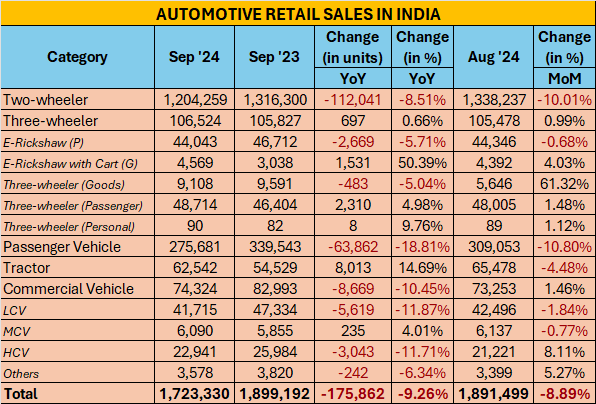
The automotive retail sales numbers for September 2024 show a decline in demand for two-wheelers, passenger vehicles and commercial vehicles. Barring three-wheelers with a flat growth and tractor segment with 14 percent growth, sales have declined both on a month-on-month basis as well as year-on-year basis.
The overall auto retails came at 17,23,330 units, which is a decline of 9.26 percent over last year. This includes 12,04,259 two-wheelers (-8.51% YoY); three-wheelers 1,06,524 units (0.66% YoY); 2,75,681 passenger vehicles (-18.81% YoY); 62,542 tractors (14.69% YoY) and 74,324 commercial vehicles (-10.45% YoY).
C S Vigneshwar, President, Federation of Automobile Dealers Association (FADA) said, “The 2024 southwest monsoon recorded 8 percent above-normal rainfall—the highest in four years—which has boosted Kharif sowing by 1.5 percent YoY. This increase in agricultural productivity has positively impacted rural demand and economic sentiment. Despite the onset of festivals such as Ganesh Chaturthi and Onam, Dealers have reported that the performance has been largely stagnant. This suggests that overall market sentiment during these festive periods has been underwhelming, with a trend leaning towards flat or negative growth. The Shraddh period further impacted sales negatively, leading to a YoY decline in retail sales across various categories.”
He further stated that while discounts and offers have been introduced across segments to stimulate demand, but they have “yet to translate into a significant improvement in sales.”
Vigneshwar said that the two-wheeler sales decline can be attributed to low consumer sentiment, poor inquiries, and reduced walk-ins. Seasonal factors like the Shraddh period, Pitrapaksha, and heavy rains further impacted demand, resulting in delayed purchases and a subdued market environment.
The three-wheeler sales showed marginal growth of 0.99 percent MoM and 0.66 percent YoY, driven by positive customer engagement and increasing demand for e-rickshaw options. However, overall demand remained subdued as many customers deferred purchases in anticipation of the upcoming festive season and heavy rains impacted walk-ins and sales activity.
The commercial vehicle segment reflected a mixed performance, while there was positive sentiment and marginal growth in regions supported by infrastructure projects, overall demand remained weak due to low government spending, extended monsoon delays and seasonal challenges. Despite some improvement in fleet purchases, the market conditions remain subdued.
The passenger vehicle segment has been a case of worry with an alarming trend of declining consumer demand and deteriorating market sentiment. Seasonal factors such as Shraddh and Pitrapaksha, coupled with heavy rainfall and a sluggish economy, have exacerbated the situation, leaving dealers with historically high inventory levels of 80-85 days—equivalent to 7.9 lakh vehicles worth INR 790 billion.
“Given the critical festive season around the corner, FADA urges OEMs to take immediate corrective measures to avoid a financial setback. FADA also calls on the Reserve Bank of India (RBI) to issue an advisory to banks, mandating stricter channel funding policies based only on Dealer consent and on actual collateral, to prevent dealers from facing additional financial pressure due to unsold stock. This is the final opportunity for PV OEMs to recalibrate and support market recovery before it's too late!”
Going forward, FADA’s near-term outlook for automobile retail is cautiously optimistic as both Navratri and Diwali fall in the same month, creating strong expectations for a surge in vehicle sales.
With healthy water levels in reservoirs and improved crop yields supporting rural demand, the festive season is expected to drive a substantial boost in two-wheeler, passenger vehicle, and tractor sales with new launches been planned for the month. However, the passenger vehicle segment faces a critical situation due to high inventory levels at dealerships.
Vigneshwar cautions that if sales do not pick up as expected in October, dealers could face significant financial pressure from unsold stock piling up in their warehouses.
While dealers and OEMs are betting on robust festive sales, especially in rural markets where positive cash flow and better agricultural conditions are expected to spur demand, the outcome remains uncertain.
He states that a successful October is essential to clear out excess inventory and set a positive growth trajectory for the remainder of FY2025. With rising inquiries and optimistic dealer sentiments, the outlook leans towards optimism, but high stakes and dependency on October’s performance warrant a cautious approach.
“If the anticipated sales do not materialise, it could shift the outlook to pessimistic, putting dealers as well as OEMs in a difficult position heading into the new year,” he concludes.
Kia India Clocks Highest-Ever Monthly Sales Of 32,017 Units In September 2026
- By MT Bureau
- October 01, 2026
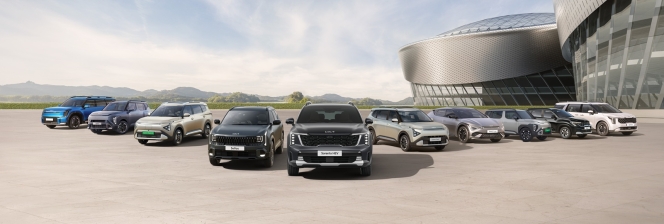
Kia India, one of the leading passenger vehicle manufacturers, has reported its best-ever monthly wholesale performance of 32,017 units in September 2026, representing a 41 percent increase compared to 22,700 units sold last year.
For Q3 of CY2026, the company recorded sales of 89,259 units, reflecting a 38.5 percent growth over 64,443 units for the same period last year.
In terms of YTD (January – September 2026) cumulative sales reached 253,008 units, marking a 22.5 percent increase from 206,582 units reported during the corresponding period in 2025.
Kia India attributed the robust performance to healthy demand across its portfolio incuding Seltos and Sonet models, alongside contributions from the Carens, Carens Clavis, Clavis EV, Syros EV and Sorento, which is offered in diesel and hybrid powertrain options. The company's powertrain options now span petrol, diesel, CNG, hybrid, and electric configurations across its product range.
Atul Sood, Senior Vice-President of Sales and Marketing, Kia India, said, "Our strong performance in September and across the third quarter reflects the continued trust of our customers and the strength of Kia’s evolving portfolio. The Seltos and Sonet continue to be key contributors to our growth, while the strong response to the Sorento and Syros EV reinforces our strategy of expanding into new segments and powertrain categories in line with evolving customer aspirations. As mobility needs become increasingly diverse, we are focused on providing meaningful choice across conventional, CNG, hybrid and electric powertrains, supported by ownership solutions that address real customer needs. We remain committed to building on this momentum through distinctive products, advanced technologies and differentiated experiences designed around the needs of Indian customers."
At present, Kia India operates a retail and service network comprising 915 touchpoints across 425 cities, alongside 137 certified pre-owned outlets across the country.
Toyota Kirloskar Motor Sells 25,027 PVs In September 2026
- By MT Bureau
- October 01, 2026
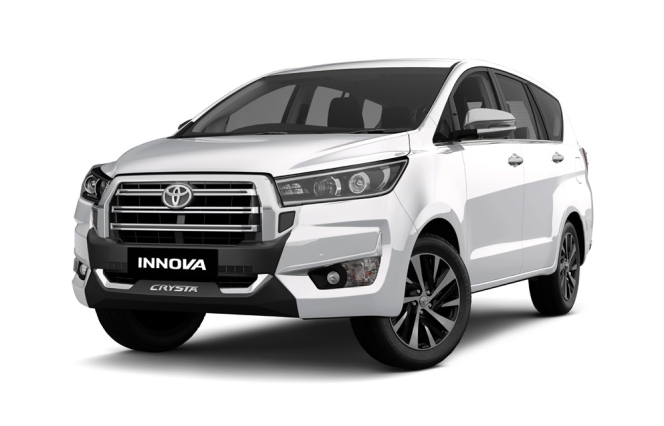
Toyota Kirloskar Motor (TKM), one of the leading passenger vehicle manufacturers, has reported its total wholesales of 28,218 units in September 2026, comprising 25,027 units sold in the domestic market and 3,191 units exported.
For the YTD period (January – September 2026), the automaker reported cumulative total sales of 294,914 units, representing an 8 percent increase compared to 272,824 units sold last year.
Domestic sales for the 9-month period rose 9 percent to 269,619 units, up from 247,081 units in the previous year, while exports reached 25,295 units, compared to 25,743 units a year ago.
Sabari Manohar, Executive Vice-President of Sales-Service-Used Car Business, Toyota Kirloskar Motor, said, "September witnessed continued customer interest across segments, supported by our focus on quality, durability and reliability. As we enter the festive season, we remain committed to strengthening customer engagement and working closely with our dealer partners to deliver enhanced mobility experiences and address evolving customer needs."
Nissan Motor India Reports Sales Of 3,300 Units In September 2026
- By MT Bureau
- October 01, 2026
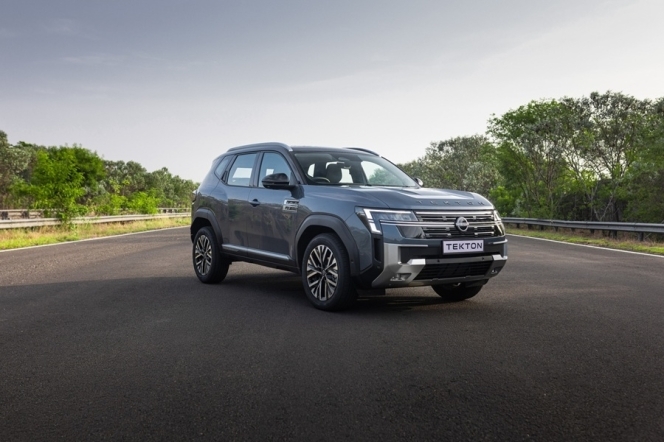
Nissan Motor India, one of the leading passenger vehicle manufacturers, has announced its wholesales for September 2026.
The company sold 10,025 units last month, comprising 3,300 units in the domestic market, up 100 percent YoY, as against 1,652 units last year. Exports, on the other hand, came to 6,725 units.
Deliveries during the month were supported by sales across the company's SUV portfolio, including the Nissan Tekton, Magnite, and Gravite, alongside expansion of its retail network.
Saurabh Vatsa, Managing Director, Nissan Motor India, said, "Our domestic volumes nearly doubled year-on-year in September, validating Nissan’s product-led strategy, the strength and capability of our network, the contribution of our finance and business partners, and the increasing confidence of Indian customers in the Nissan brand. The growing volumes in the domestic market give us a strong foundation to build scale in India. We would also like to acknowledge the continued support of our international dealers, distributors and customers across overseas markets, who are enabling us to deliver a robust export performance. We are confident about the opportunity ahead and remain committed to accelerating our momentum through distinctive products and a stronger network for customers who value the Nissan brand and its products."
Tata Motors Passenger Vehicles Records Sales Of 68,810 Units In September 2026
- By MT Bureau
- October 01, 2026

Mumbai-headquartered automotive major Tata Motors Passenger Vehicles has announced its wholesales for September 2026 and Q2 FY2027.
The company reported sold 70,210 passenger vehicles last month, up 15 percent YoY, as against 60,907 units last year. In the domestic market sales grew 15 percent YoY to 68,810 units from 59,667 units a year ago, while exports grew by 13 percent to 1,400 units. Monthly electric vehicle dispatches reached 15,384 units, representing a 67 percent increase over 9,191 units in September 2025.
In Q2 FY2027, the wholesales touched 201,723 units, up 40 percent YoY, as against 144,397 units for the same period last year. The domestic market saw a healthy uptick of 40 percent YoY at 140,189 units, while exports clocked 20 percent YoY growth to 5,049 units. Electric vehicle sales, comprising domestic and export volumes, came at 47,150 units for the quarter, reflecting a 90 percent YoY increase over 24,855 units.
Interestingly, for Q2 FY2027, electric vehicles accounted for 23 percent of the company’s total sales volume, while CNG models contributed 28 percent, bringing the combined volume of alternative powertrains to 51 percent of overall deliveries.
Shailesh Chandra, MD and CEO, Tata Motors Passenger Vehicles, said, “In Q2 FY27, passenger vehicle demand sustained the strong momentum seen following GST 2.0, despite the quarter being seasonally softer. Industry Vahan volumes grew around 24 percent YoY, led by increasing adoption of greener powertrains, providing a promising backdrop for the forthcoming festive season. For Tata Motors Passenger Vehicles, Q2 FY27 was our highest-ever quarter, with sales of 201,723 units and industry-beating growth of 40 percent YoY. We ended the quarter on a strong note, crossing the 70,000-unit sales milestone in September and look forward to carrying this momentum as we enter the festive period. Our greener powertrain portfolio continued to be a significant growth driver. EVs recorded their highest-ever quarterly sales of over 47,000 units, growing 90 percent YoY, with EV penetration in our portfolio rising sharply to 23 percent, compared with around 8 percent for the industry. CNG also delivered its highest-ever quarterly sales and accounted for 28 percent of our volumes. Together, EV and CNG now contribute 51 percent of our sales, reflecting the rapid shift in customer preference towards greener mobility.”
“Customer response remained strong across our portfolio, with Punch emerging as India’s highest-selling SUV during the quarter. Building on the momentum of our Q1 launches, we further strengthened our portfolio with Curvv SeriesX, Sierra Legend Series and the all-new Tata Aeris. We also unveiled our new customer-facing identity, TATA.CARS, reflecting the evolution of our brand in step with the aspirations of today’s Indian car buyer. Looking ahead, we remain optimistic about the festive season, supported by a strong order book and healthy customer traction across the portfolio. As we progressively scale up production, our focus will be on fully leveraging this demand, sustaining our growth momentum and further strengthening our competitive position in the market,” added Chandra.



Comments (0)
ADD COMMENT