

MG Motor India Banks On ‘Net Green Power’ To Fuel Its EV – MG ZS
- By 0
- February 04, 2020
By T Murrali
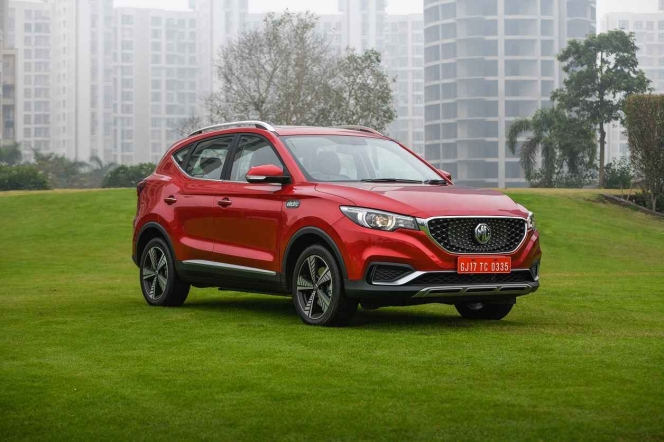
MG Motors, owned by SAIC (formerly Shanghai Auto Industrial Corporation), has launched its pure Electric Vehicle (EV) MG ZS in the international market to recreate a ‘new hot spot’ for its global strategy. This strategy is based on the success of its first new energy vehicle MG 6 that has won good market feedback and reputation. As part of its plan to target those who would like to have all the benefits of a zero emission vehicle without compromising on style MG Motors India has unveiled MG ZS EV, its global SUV.
 Under the guidance of SAIC Group’s new four-fold strategies of ‘electrification, intelligent networking, sharing, and internationalization,’ MG has been leading the trend in the field of fuel vehicles, and its new energy vehicles to attract young people. Equipped with the world-class ‘Net Green’ power and SAIC’s leading system of electric drive, battery, and electric control, MG ZS pure electric vehicle boasts of a constant velocity range of up to 428km.
Moreover, the latest generation of ‘intelligent interconnection’ system and the exclusive colour of new energy will provide a better and trendier choice for the global market where the demand for pure electric vehicles is increasing. The new EV uses MG’s new kansei (emotional) design to make its shape more modern; it has also introduced the exclusive colour of new energy, making it more attractive. The vehicle is equipped with a panoramic sunroof, luggage rack and other configurations.
Not compromising on aesthetics the vehicle has an appreciable build quality that can thrill with its performance and is powered by i-Smart. Assembled at its plant in Halol, Gujarat, the new electric SUV is 4,314 mm long, 1,809 mm wide and stands 1,620 mm tall while the wheelbase is 2,579 mm. It is touted to be the first pure electric internet SUV with a clean, efficient and fast powertrain.
“As an enabler and catalyst for India’s EV revolution, MG Motor India is creating a strong, end-to-end electric vehicle ecosystem in association with leading players in the sustainable energy domain. A truly global and best-in-class EV SUV, the ZS EV has already registered significant success in more than 10 international markets such as the United Kingdom, Europe, Australia, and Southeast Asia. It has also been extensively tested for India-specific requirements. We hope that it will recreate its success in India, thanks to the strong EV ecosystem that we are putting in place. We will evaluate opportunities to further expand this ecosystem to more markets across India, based on customer response,” Rajeev Chaba, President and Managing Director, MG Motor India, said.

The Collaborators
Understanding the importance of leveraging expertise of global majors to offer cost competitive solution to customers, MG Motors has collaborated with world leaders such as CATL, UAES, Bosch, Infineon, Exicom, Umicore and Fortum.
The China-based battery and technology company CATL, specializes in the manufacture of lithium-ion batteries for EVs, energy storage systems, and battery management systems. UAES is the power electronics solutions provider, and Bosch and Infineon offer software and other support. Exicom helps in second-life use of batteries, and Umicore ensures safe and sustainable recycling of end-of-life batteries.
The collaboration with Fortum India is to set up a 50 kW DC fast charging infrastructure. It has installed such fast public charging stations for EVs across MG’s showrooms in Delhi NCR, Hyderabad, Mumbai, Bengaluru and Ahmedabad. Over the next 5 years Fortum plans to have one charging facility every 5 km in major metro cities and every 25 km on the highways.
Exterior And Interior
Inspired by the majestic London Eye, true to its British genes, the headlamps give the MG ZS EV a powerful persona, the kind which makes the EV stand out in the crowd. It complements the aesthetics of the grille, which connotes the magnetic fields between celestial bodies, and brings out the glam quotient. The deep concave grille is supplemented with enough chrome to get the bling on.
The tail lights depict the plough, also called the big dipper. They are inspired by the seven brightest stars of the constellation, Ursa Major, which is the largest northern constellation and third largest constellation in the sky. The side design depicts the phantom that flies through the corners. The panoramic sky roof covers 90 percent of the roof bringing in natural light. It’s like having the sky as a companion on every journey.
In the interior, the ZS comes with an updated version of the Hector’s infotainment system dubbed, iSmart EV 2.0. It has an embedded SIM card for internet connectivity and also has the ability to connect to an external home Wi-Fi network or mobile hotspot. The iSmart EV 2.0 features real-time maps with charging station locator from TomTom, music from Gaana app and weather by Accuweather. The updated system also gets a new graphic interface and improved hardware over the Hector’s iSmart system.
The system offers over 60 connected car features including Range alerts, Battery status, Eco-friendly updates, Remote vehicle control (for AC on/off, door lock/unlock, light flashing and honking) E-Call (self-initiated emergency call sends a message and location to the 24/7 pulse hub if airbags are deployed), I-Call (get a call from the MG pulse hub for general assistance or road side assistance at the touch of the i-Call button), Geofencing, Navigation, Smart Drive (driver analytics-harsh braking, running idle, routes taken etc. to improve driving skills) and Security Alert (get alerts on the app in case of abnormal door opening, over speed etc.)
The vehicle has a CO2 saver feature which displays the amount of carbon-dioxide the owners save in real-time. MG ZS air-conditioning unit comes fitted with particulate matter 2.5 air filters to provide fresh and healthy air inside the cabin, thus maintaining healthy Indoor Air Quality (IAQ). It can bring bad air quality level of up to 300 AQI down to regular levels in just 35 minutes.
The vehicle is equipped with 3D surround effect, which enhances the driving experience with audible navigation assistance and provides close-to-ear experience.
The MG ZS EV gets an 8.0-inch touchscreen infotainment system with Apple Carplay and Android Auto. It is equipped with a visually delightful screen that gives all the information at a single glance and allows the driver to manage complete vehicle settings with just a touch. MG ZS can get new software over the air.
 Safety
As safety is key, the MG ZS comes with European Standards such as European E-MARK, European REACH (environmental standards in the car) and European E-NCAP (safety standard design). In terms of safety the vehicle has 6 airbags, which include dual front airbags, front-seat side-impact airbags, and side-curtain airbags that work together with the seatbelts. It is adequately armoured to save the lives of the occupants.
The EV has auto headlamps to mitigate heavy overcast skies or an enclosure, such as a parking garage. In the case of cruise control, it doesn’t let the driver lose control over the speed. Instead it lets the driver to set a speed limit, and it will handle the throttle accordingly.
The SUV is equipped with an electric parking brake to ensure it is held safely when brakes are suddenly pressed. The electronic gear shift knob gives a complete sense of control over gear shifts. The reverse parking-assist system helps the driver to sense when objects are in the vehicle’s blind spot, thus help prevent accidents which may be caused due to difficulty in reverse parking. The hill descent control system helps the user enjoy the mountains as much as the highways. It prevents rollback on a slope when the brake is released and switched to the accelerator pedal. Besides, it had TPMS to get real-time information about the tyre pressure through a pictogram display. Heated OVRM is part of the standard equipment to clear the fog and ice on the side view mirror, thereby ensuring visibility at all times.
The Battery
The ultra-high density 44.5 kWh battery makes the vehicle to zip 0-100 kmph in 8.5 seconds. It helps deliver maximum power of 142.7 PS, maximum torque of 353 Nm. The liquid-cooled NMC (Nickel Manganese Cobalt) battery from CATL, gives the car a travel range of 340 km on a full charge. It comes with a kinetic energy reverse system, which stores the extra generated power for later use.
The battery of ZS complies with IP67 and UL 2580 - standards for safety that cover waterproof, dustproof, collision monitoring, electromagnetic shielding, insulation monitoring, high voltage interlock, overload protection, short circuit, intrusion, smoke, soaks, fire and fall.
Charging System
The MG ZS EV is equipped with CCS Type-2 European standard connector and is able to rapid charge from public chargers and also comes equipped with an AC slow charger. The lithium-ion battery can be charged through four options. AC Fast Charger that is provided and installed by MG Motor India at home or office, free of cost. With this 80 percent of charging is done in 6-8 hours. The portable charger that comes with every car can be plugged into any 15A socket. The batteries can be charged up to 80 percent n 16-18 hours. DC superfast chargers that are available at MG dealerships 24x7 can charge the batteries up to 80 percent within 50 minutes. Besides, the vehicle maker is also planning to set up AC Fast Chargers at MG dealerships along key routes in satellite cities. In an emergency, road side assistance for mobile charging support is offered 24x7. The MG logo in the vehicle glows to indicate that the SUV is getting charged. Glowing stops, once the charging is complete.
MG ZS EV comes with three driving modes: Sport, for accelerated driving and a thrilling drive experience; Normal, for balanced range and driving performance; and Eco, for efficient driving to maximize range. (MT)
BMW Group India Opens Retail.NEXT Dealership In Navi Mumbai
- By MT Bureau
- September 30, 2026
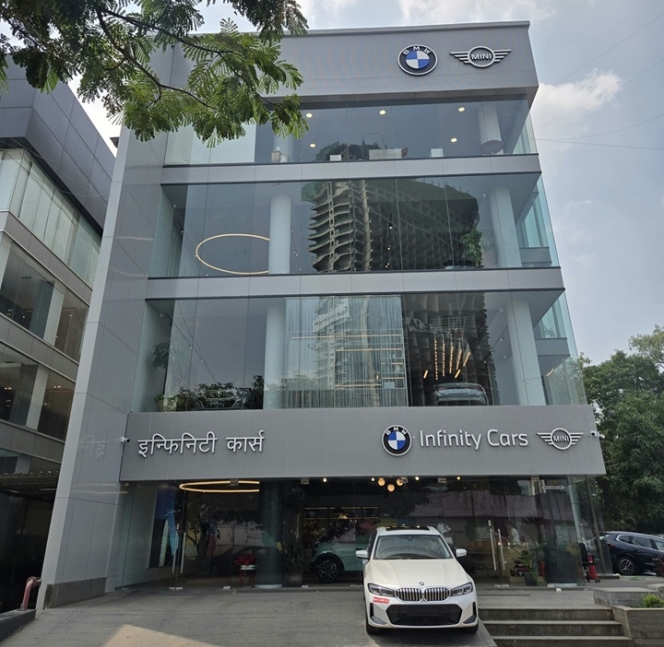
German luxury automotive company BMW Group India has expanded its retail presence in Navi Mumbai by introducing the MINI brand at the Infinity Cars dealership. The update brings new BMW models, MINI vehicles and BMW Premium Selection pre-owned cars into a single location.
The Infinity Cars facility covers 6,774 square feet on a single level, utilising BMW's Retail.NEXT layout. The site features a Central Customer Walkway, digital configuration terminals, a dedicated pre-owned vehicle display area in the basement and a lifestyle section for brand merchandise and accessories. Infinity Cars operates six sales and service locations for BMW Group India across the Mumbai region.
Hardeep Singh Brar, President and CEO, BMW Group India, said, "The luxury mobility landscape in India is becoming increasingly experience led, with customers seeking brands that reflect their lifestyle and individuality. MINI, with its iconic design, distinctive character and expressive personality, resonates strongly with this evolving audience. Mumbai continues to be one of the most important markets for luxury automobiles in India and the introduction of MINI at Infinity Cars further strengthens our presence in the region. Through the Retail.NEXT concept, we are redefining how customers engage with our brands by creating immersive, digital-first and customer-centric experiences. Together with Infinity Cars, we look forward to bringing the unique world of MINI closer to customers in Navi Mumbai and accelerating the brand's growth in the market."
Pooja Choudary, Dealer Principal, Infinity Cars, said, "We are proud to deepen our association with BMW Group India by introducing MINI at Infinity Cars in Navi Mumbai. Building on our strong presence in the region with BMW and BMW Premium Selection, MINI adds a distinctive new expression of premium mobility to our portfolio. Its iconic character will help us connect with a new generation of customers while giving our existing clientele even greater choice. We look forward to growing MINI in Navi Mumbai and taking our partnership with BMW Group India to the next level."
The facility applies unified sales, service and administrative systems to manage customer operations from point of sale through ongoing vehicle maintenance.
Spinny Opens Its First Spinny Park In Mumbai
- By MT Bureau
- September 30, 2026
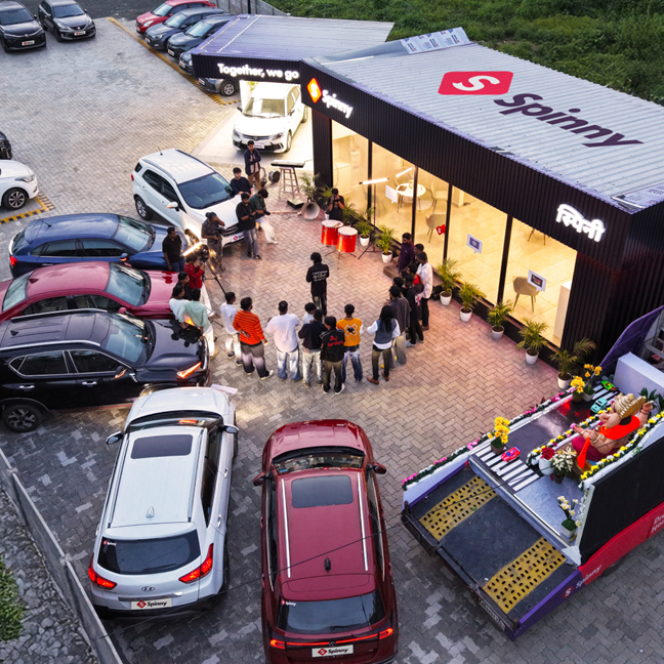
Used car retail platform Spinny has opened its first Spinny Park in the Mumbai region, located on Kalyan-Bhiwandi Road near K N Park Hotel, Rannoli.
The facility covers 15,000 square feet and holds space for 61 cars, providing buying and selling services for vehicles in Kalyan and surrounding areas.
The location offers vehicle viewing, test drives, financing and ownership transfers under its Spinny Assured brand. For vehicle owners seeking to sell, the platform's SellRight service handles valuations, payments and registration certificate transfers at the site.
Niraj Singh, Founder and CEO, Spinny, said, "Mumbai has been an integral part of Spinny’s journey, and this is the right time to bring a Spinny Park here. Maharashtra has been an important market for us, and this is a meaningful next step in getting even closer to our customers. This is the time for coming together, and celebrating this new chapter with the community makes it all the more meaningful."
The launch included Spinny Park Live, an event featuring local Marathi performers during the Ganpati festival season, hosted by Marathi Kapil.
The Kalyan location expands Spinny's network in Maharashtra, where it already operates five hubs in Mumbai including Dadar, Seawoods, Vidyavihar, Kandivali, and Thane, along with four sites in Pune, and operations in Nashik and Nagpur. The company combines physical locations with doorstep services for test drives and sales. Vehicle inventory for the network is processed through Integrated Quality Centres after inspection and refurbishment, drawing from procurement operations across 100 cities nationwide.
Porsche India Launches Cayenne Electric At INR 17.72 Million
- By MT Bureau
- September 30, 2026
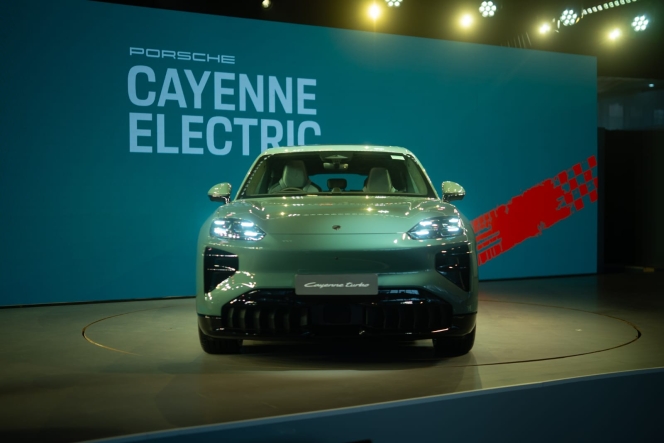
German luxury car brand Porsche India has launched the Cayenne Electric, expanding its electric vehicle lineup in the country while introducing an electric propulsion system for its popular Cayenne model range.
The model arrives in two variants, the Cayenne Electric (priced at INR 17.72 million) and the Cayenne Turbo Electric (priced at INR 22.75 million), with customer deliveries commencing immediately following its release in Mumbai. Porsche will continue to sell internal combustion engine (ICE) variants of the Cayenne in India alongside the electric models.
Ashutosh Dixit, Head of Porsche India, said, “The Cayenne enters an important new era with electrification, combining uncompromising Porsche performance with electric mobility while remaining unmistakably Porsche. It continues to offer the everyday usability our customers expect from the Cayenne, together with the performance, engineering and driving experience that define our sports cars. Its introduction marks an important next chapter for Porsche in India as we continue to broaden the choices available to our customers.”
JSW MG Motor India Delivers 50 Hector Tomahawk EVs in Single-Day Event In Surat
- By MT Bureau
- September 29, 2026
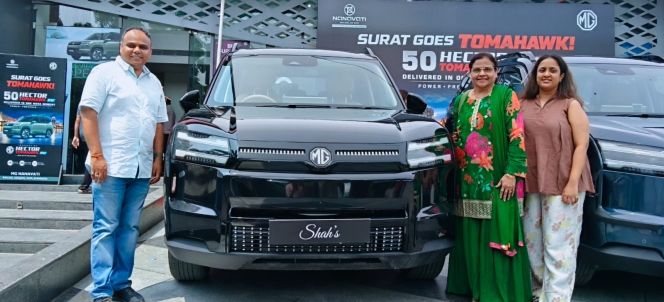
JSW MG Motor India, one of the leading passenger vehicle manufacturers, completed the delivery of 50 units of the Hector Tomahawk EV in Surat in a single day, following the market launch of its electrified SUV model line.
The Hector Tomahawk lineup includes both battery-electric vehicle (EV) and plug-in hybrid electric vehicle (PHEV) powertrains. The Hector Tomahawk EV incorporates a 69.2 kWh battery pack paired with an electric motor producing 150 kW and 310 Nm of torque, yielding a certified range of 517 km on a single charge and supporting DC fast charging up to 90 kW.
The Hector Tomahawk PHEV combines a 1.5-litre petrol engine, a dedicated hybrid transmission and a 20.5 kWh battery pack, delivering an electric range of 115 km and a combined driving range exceeding 1,100 km.
The SUV measure 4,745 mm in length, 1,850 mm in width and 1,770 mm in height, with a 2,810 mm wheelbase and 230 mm of ground clearance at the battery casing. On the inside it features a 15.6-inch central display screen, the i-SMART 3.0 connected software platform with artificial intelligence voice command integration, Vehicle-to-Home (V2H) power output capabilities and Level 2 Advanced Driver Assistance Systems (ADAS).
The Hector Tomahawk EV is offered under a Battery-as-a-Service (BaaS) introductory pricing scheme starting at INR 1.39 million with a battery rental fee of INR 4.90 per kilometre, or at an outright ex-showroom price starting at INR 1.94 million for the Excite 7-seater variant, rising to INR 2.34 million for the Essence 7-seater model.
The Hector Tomahawk PHEV, available exclusively as a 7-seater, starts at a BaaS price of INR 2.17 million with a battery rental fee of INR 3.20 per kilometre, or an outright ex-showroom price of INR 2.56 million for the Exclusive trim and INR 2.77 million for the Essence trim. A lifetime battery warranty is provided to original owners for both EV and PHEV variants.
Comments (0)
ADD COMMENT