

3ev Industries And 3eco Systems Partner With Cautio To Deploy AI Dash Cameras Across 10,000 E3Ws
- By MT Bureau
- March 05, 2026
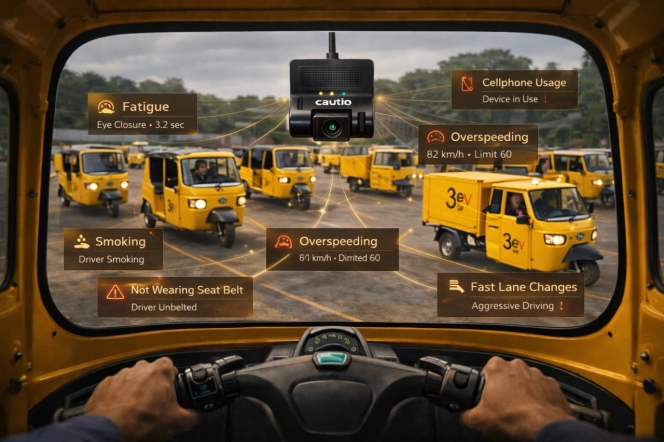
3ev Industries, a Bengaluru-based three-wheeler electric vehicle (EV) OEM manufacturer, and 3eco Systems, a full-stack EV logistics platform, have entered into a strategic partnership with Cautio, one of India’s leading video telematics companies, to install the latter's AI-powered dash camera systems across their electric three-wheeler fleet. The collaboration involves installing systems from Cautio into 10,000 electric three-wheelers. This initiative is designed to enhance protection for drivers, passengers and the wider community, with over 1,200 vehicles already operational in Bengaluru and Chennai. Crucially, Cautio’s dashcams will become a standard factory-installed feature on all new vehicles produced by 3ev.
This move represents a significant shift in India's electric mobility landscape by establishing safety as a fundamental, built-in component from the manufacturing stage. The partnership aims to create a comprehensive data network that links the original equipment manufacturer with the fleet operator while prioritising driver welfare and using data-driven accountability as a key market advantage. As electric fleets expand, the focus is expected to move beyond simply electrifying vehicles to incorporating intelligent systems that ensure safety and operational efficiency.
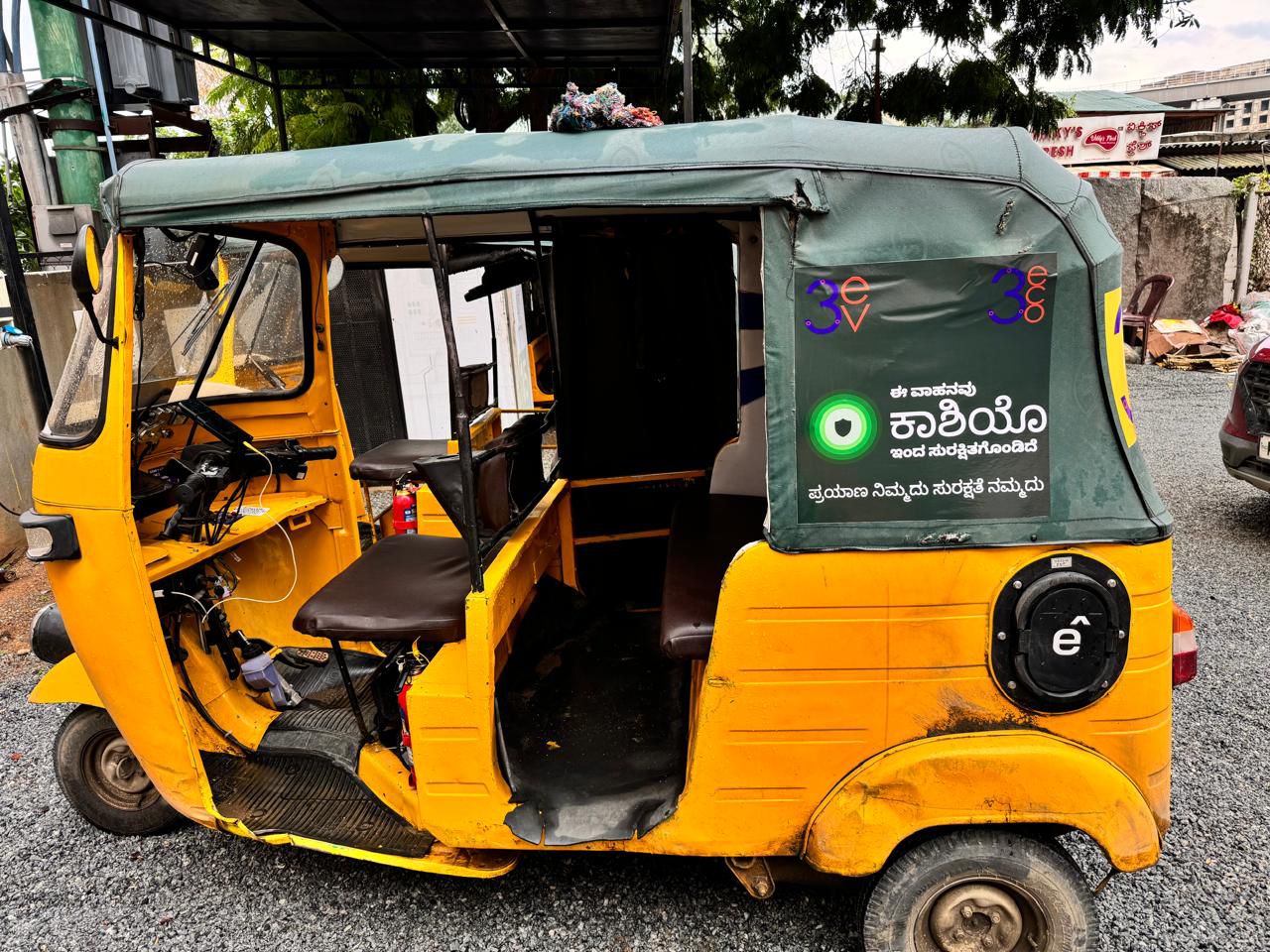
The decision to collaborate with Cautio followed a rigorous assessment of various global and domestic telematics platforms. Key evaluation criteria included performance in edge computing, the precision of real-time alerts and device durability in challenging environments characterised by high temperatures and dust. A pivotal factor was Cautio’s India-centric design philosophy. Unlike systems developed for highway driving in mature markets, Cautio’s technology is specifically tailored for the complexities of Indian urban conditions, such as congested traffic, unreliable 4G connectivity and extreme weather. Its architecture processes data directly on the device, ensuring core safety functions remain operational even without a stable cloud connection, thereby minimising latency and blind spots.
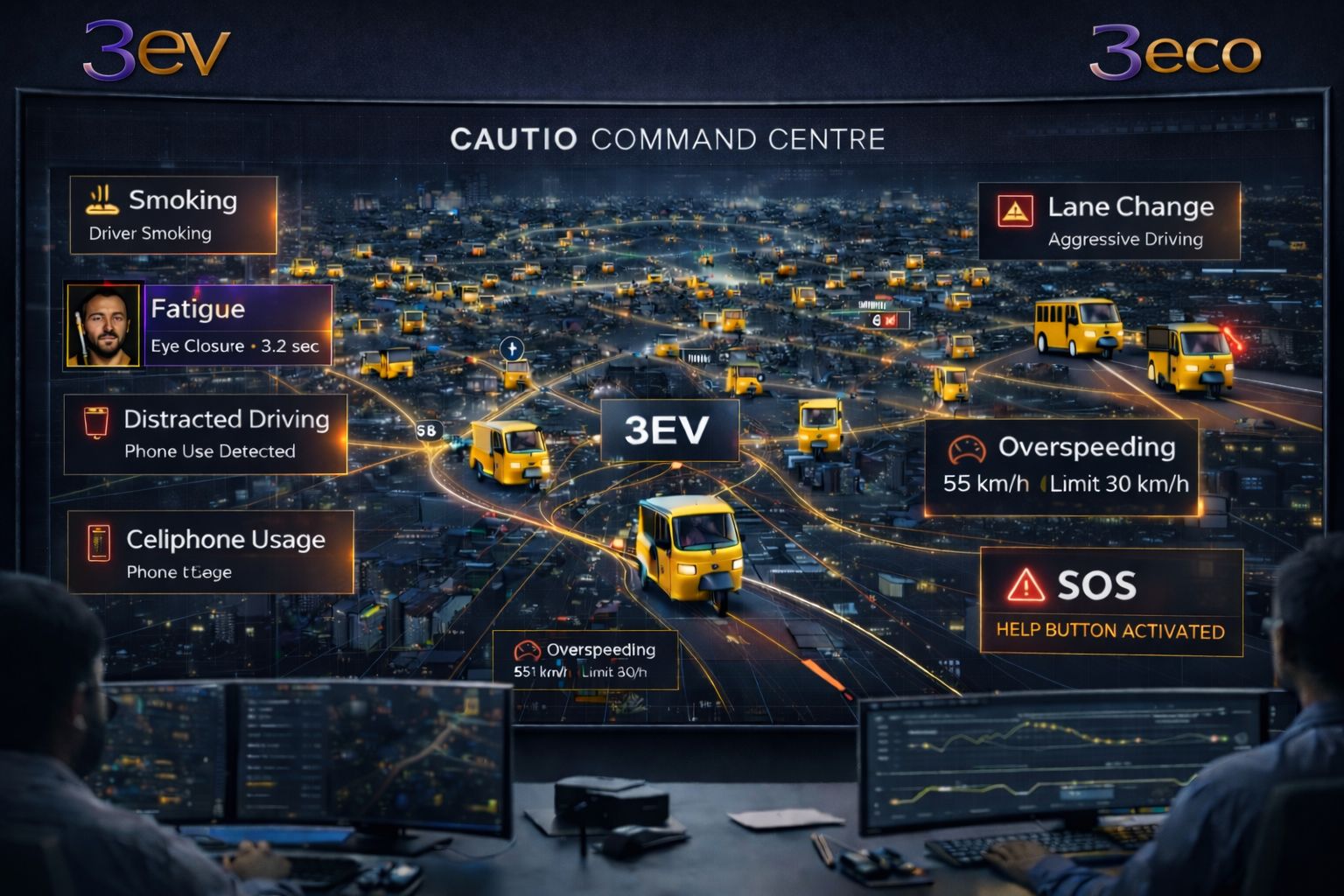
The AI-driven system employs computer vision to continuously monitor driver behaviour, issuing instant alerts upon detecting signs of fatigue, distraction or mobile phone usage. Concurrently, Advanced Driver Assistance Systems (ADAS) analyse the road environment to warn of potential collisions and lane deviations, a critical function in India’s mixed-traffic scenarios. All trip data is consolidated into a centralised dashboard, offering fleet managers real-time, comprehensive oversight of their operations.
Beyond the hardware installation, the multi-year agreement includes a joint commitment to research and development, driver training and community road safety initiatives. The collective goal is to develop a scalable and structured approach to safety within the electric three-wheeler sector. As citywide fleet electrification progresses and safety regulations evolve, the integration of such embedded AI systems is anticipated to become increasingly vital to operational protocols and risk mitigation strategies.
Suman Mishra, Director, 3eco Systems, said, “Our objective was not just to add monitoring hardware but to deploy technology that meaningfully supports drivers on the road.”
Karan Kadaba, Director, 3ev Industries, said, “Following a detailed evaluation across global and domestic platforms, Cautio emerged as the right partner, combining technical capability with a deep understanding of Indian operating conditions. Other platforms required reliable 4G connectivity that simply does not exist across all our routes. This collaboration reflects our continued focus on building a safety-first operating framework for drivers, fleet partners and passengers.”
Ankit Acharya, Co-Founder & CEO, Cautio, said, “What we are building with 3ev Industries and 3eco Systems is not a vendor-client relationship. It is a shared mission. The electric three-wheeler driver is the new face of India’s urban mobility workforce. These are young people building livelihoods, serving communities, connecting cities. They deserve the same level of safety that protects drivers in premium fleets. But safety cannot stop at a device – it must extend to how we train drivers, how we develop technology and how we hold ourselves accountable to the communities we serve. India is asking for safer roads. With 3ev and 3eco, we are answering. This is more than a deployment. This is the start of building a safer country.”
BlueBinaries To Acquire MicroNova’s Automotive Testing Business
- By MT Bureau
- September 25, 2026
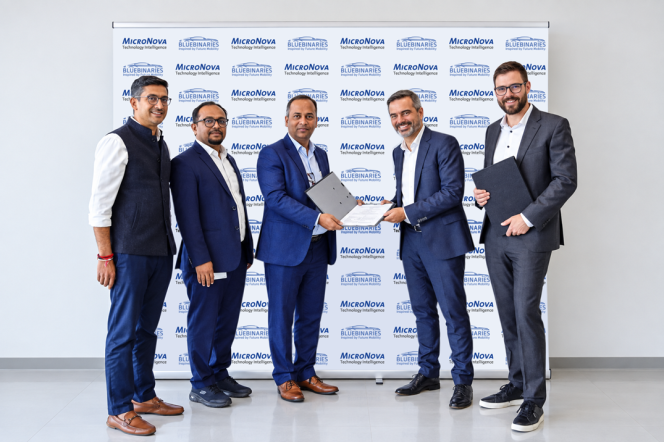
Mobility engineering and technology company BlueBinaries has signed a definitive agreement to acquire the automotive testing business of Germany-based MicroNova AG.
The carved-out entity will operate as an independent company within the BlueBinaries group under the name NovaBinaries. Following the transaction, BlueBinaries projects annual revenue of USD 50 million and aims to expand revenue to USD 100 million in the coming years.
Founded in 2017 and headquartered in Chennai, BlueBinaries provides vehicle engineering, digital engineering, testing and homologation services to original equipment manufacturers across India, Europe, North America, the Middle East and Asia.
MicroNova, based in Vierkirchen near Munich, develops testing and validation systems for the automotive sector, including hardware-in-the-loop systems, test automation platforms, virtualisation solutions and engineering services. Its test automation platform, EXAM, is used by European automotive manufacturers. NovaBinaries will focus on software test solutions, hardware-in-the-loop systems, test automation, virtual validation, and software test factories by combining MicroNova’s product portfolio with BlueBinaries’ engineering operations.
Srinivas Aravapalli, Founder and CEO, BlueBinaries, said, "The acquisition of MicroNova’s industry-leading HiL Testing and Test Automation business represents a watershed moment in BlueBinaries’ journey towards absolute technological leadership in the global mobility ecosystem. By integrating these world-class validation and test automation technologies into our existing portfolio, we are uniquely positioned to offer an unmatched, end-to-end test offerings to our customers.”
Kishore LM, Founder and COO, BlueBinaries, said, “The acquisition of the Automotive Testing business from MicroNova is a strategic leap that enhances our ability to offer right technology solutions across automotive software testing. MicroNova’s technical depth, customer centricity, and regional strength align perfectly with our strategic vision to be the first partner choice for global customers complimenting our current portfolio. Our intent is to offer these proven technologies and better solutions globally combining precision, engineering excellence, scale, and flexibility while the mobility industry moves into the SDV and AI era.”
- Kantar
- Google India
- AI
- Artificial Intelligence
- YouTube
- Maps
- Gemini
- Google Search
- Siddharth Shekhar
- Virat Khullar
- Hyundai Motor India
Google-Kantar Study Finds 93% Of Indian Car Buyers Use AI Tools During Vehicle Research
- By MT Bureau
- September 24, 2026
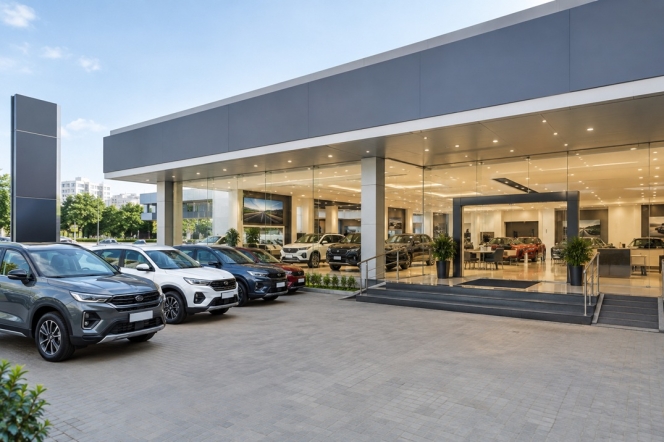
A study conducted by Google and Kantar titled ‘Automobile Purchase Journey in the Age of AI’ shows that 93 percent of automobile shoppers in India utilise artificial intelligence (AI) interfaces during their research process.
The research indicates that the car buying process involves multiple digital platforms, with 87 percent of buyers interacting with Google services including Search, YouTube, Maps and Gemini. Consumers utilising artificial intelligence touchpoints consult an average of 7.8 resources to research and evaluate choices, compared to 6.9 touchpoints for buyers overall. Within Google Search, 90 percent of surveyed users reported encountering AI Overviews, while 89 per cent utilised AI Mode to process technical specifications, vehicle features and financing options. Furthermore, 80 percent of buyers using AI chatbots also turn to Google Search or YouTube for active research.
The findings highlight that initial consideration sets form early, with 80 percent of buyers maintaining a predefined list of brands prior to active research. Approximately six in 10 buyers use YouTube for casual exploration, where 77 percent of users rely on professional automotive reviewers to inform their choices. Daily media consumption habits among car buyers show that 63 percent watch YouTube, 55 percent stream YouTube on television screens, 54 percent read newspapers and 43 percent watch linear television. Decision-making remains a shared process within households, with 64 percent of respondents involving family members and 53 percent consulting spouses. Vehicle safety ratings and styling were identified as primary motivators by 41 percent of buyers.
Siddharth Shekhar, Director, Google India, said, "The car buying journey in India is deliberate, non-linear, and deeply digital-particularly ahead of the festive season, when consideration peaks. Buyers move between discovery on YouTube and conversational validation on Search. Among surveyed Google Search users, 90 percent come across AI Overviews and 89 percent use AI Mode to navigate nuanced, complex queries. As AI helps buyers navigate complex choices, our ad and commerce solutions help automotive brands respond to their intent-connecting initial curiosity directly to the showroom."
Virat Khullar, Head of Marketing, Hyundai Motor India, said, "The automotive purchase journey is increasingly shaped by moments of discovery, research and intent across digital channels. Our partnership with Google helped us harness the scale of YouTube to build awareness and the intelligence of AI-powered Search ad solutions to identify and convert high-intent consumers. By unifying upper- and lower-funnel marketing, we were able to deliver a more relevant and efficient customer experience, turning consideration into action and driving strong sales momentum for Hyundai Verna."
The study was carried out by Kantar in May 2026 across metropolitan and Tier-1 cities in India, surveying 1,022 consumers who had purchased a car within the preceding six months.
Accenture, Google Cloud Launch Horizon Platform For SDVs With Volvo Cars
- By MT Bureau
- September 22, 2026
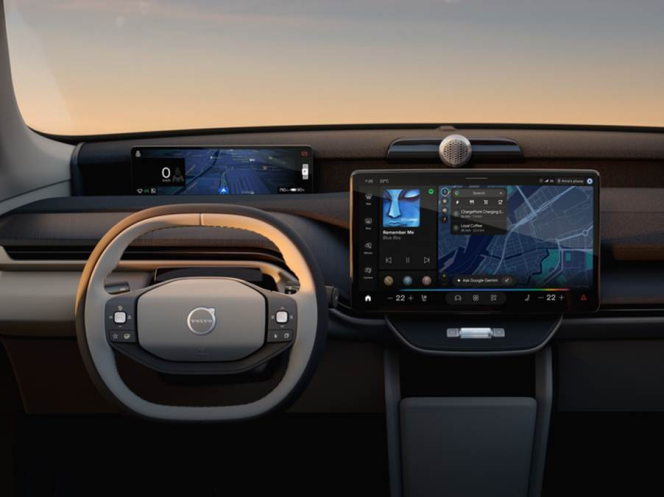
Accenture and Google Cloud have announced that Volvo Cars has signed on as the lead industry partner for Horizon, an open-source software development platform designed for car makers and automotive suppliers to build, test and deploy software on the Android Automotive Operating System.
The Horizon platform unifies cloud-native development tools, virtual testing environments and artificial intelligence workflows. Volvo Cars is migrating its global software development environment for the Android Automotive Operating System to the platform to accelerate engineering processes and virtual testing across its global development teams.
Insights gathered from Volvo Cars' deployment will be used by Accenture and Google Cloud to refine the platform and expand its generative artificial intelligence features for automotive and industrial manufacturers.
According to metrics provided by Accenture and Google Cloud, testing speeds using virtual Cuttlefish-based Android Automotive environments can improve by up to 9 times, while infotainment feature development costs can decrease by up to 40 percent. Software build times, which previously required up to two hours, can yield feedback within minutes through caching and build pipeline optimisation.
Remote access to virtual and physical device farms allows engineers to test software without requiring local physical test equipment, while virtual workbenches enable developers to set up development environments in seconds.
Gregor Zetsche, Head of Connected Experience, Volvo Cars, said, "We’re building some of the most complex products in the world, which requires a development environment built to match. As Horizon’s lead industry partner, we can directly solve our toughest engineering challenges and empower our teams to deliver new experiences faster than ever."
Juergen Reers, Global Automotive & Mobility Lead, Accenture, said, "Horizon enables a faster, more flexible and efficient way to deliver software-defined vehicle features. Its standardised, repeatable and scalable processes help deliver reliable, high-quality software products, while significantly reducing time to market. Horizon will allow Volvo Cars’ engineers to focus on what matters most: creating differentiated vehicle experiences and continuously delivering new value to drivers through software at high speed."
Henry Bzeih, Global Director for the Automotive Industry, Google Cloud, said, "Software now defines the automotive brand. Horizon on Google Cloud gives Volvo Cars the ability to move faster while releasing high-quality software and features on a cadence that matches the expectations of modern mobility. This is how next generation digital experiences reach drivers at agile speed."
Accenture and Google Cloud are working with additional automotive and industrial organisations to expand adoption of the Horizon platform across international markets.
Emerson Expands Bangalore Test And Measurement R&D Centre
- By MT Bureau
- September 22, 2026
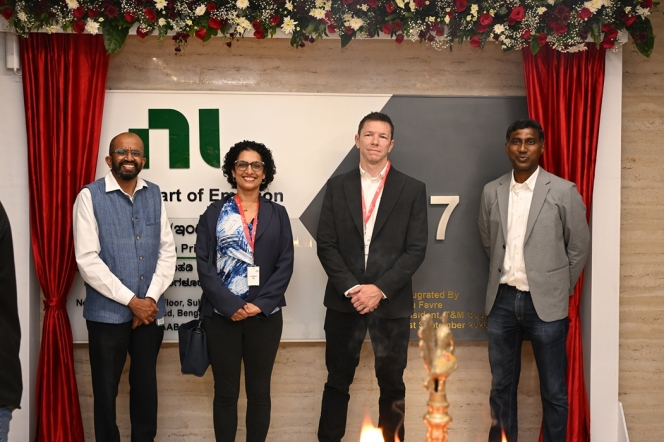
Emerson has announced the expansion of its test and measurement research and development (R&D) facility in Bengaluru, which it claims is an additional 50 percent.
The investment increases capacity at the site to develop software-defined and automated validation technologies for industrial customers.
The Bengaluru facility operates as Emerson's NI Software Centre of Excellence and represents the company's second-largest test and measurement R&D centre globally. Engineering teams at the site hold product responsibility for test software platforms, AI-enabled engineering capabilities, systems engineering technologies and radio frequency test software. The tools serve clients across the semiconductor, aerospace, defence, transportation, life sciences and manufacturing sectors.
Ritu Favre, President of Emerson's Test & Measurement business, said, "Bangalore plays an increasingly strategic role in Emerson’s global test innovation network. The site combines deep expertise in test software and AI-enabled engineering and validation technologies with close connections to rapidly evolving industries. This investment helps customers manage growing product complexity, streamline validation and bring new innovations to market faster."
The expansion provides capacity to advance automated validation workflows and integrated test platforms as hardware complexity increases across shortened product development timelines.
Emerson's investment aligns with domestic growth in semiconductors, electric mobility, and aerospace manufacturing driven by initiatives such as the India Semiconductor Mission and the National Electric Mobility Mission Plan.
Alongside the R&D centre, Emerson operates a second Bengaluru location dedicated to application engineering, calibration services, sales and customer support.

Comments (0)
ADD COMMENT