

Mercedes-Benz Commences Mass Production Of Axial Flux Motors At Historic Berlin Plant
- By MT Bureau
- June 10, 2026
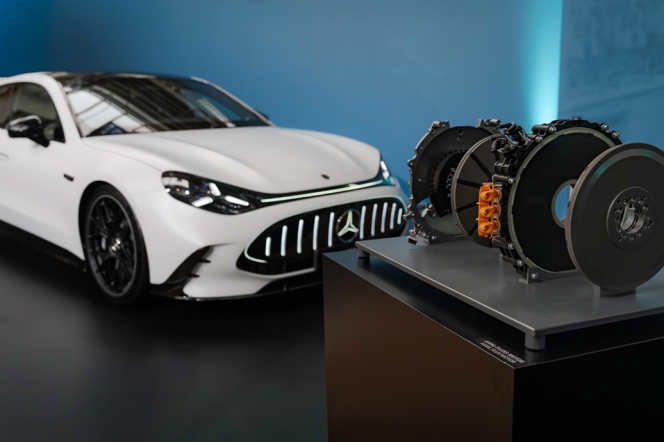
German luxury carmaker Mercedes-Benz has officially launched large-scale series production of its new high-performance electric axial flux motor at its Berlin-Marienfelde facility.
Founded in 1902, the company’s oldest active manufacturing site is being transformed into a global centre of excellence for high-performance electric motor fabrication.
The compact, high-power-density drive system is making its commercial production debut on the front and rear axles of the new all-electric Mercedes-AMG GT 4-Door Coupe.
Bringing axial flux technology to automotive mass production required overcoming steep engineering barriers. The manufacturing footprint spans approximately 30,000 square meters across three production halls, utilising seven highly automated assembly lines.
The production workflow comprises 98 distinct process steps, including 65 deployed for the first time by Mercedes-Benz and 35 entirely new to the global manufacturing sector. These industrial innovations have generated more than 30 patent applications.
The axial flux motor, rather than using traditional round wire, uses rectangular copper wire to pack more conductive material into a tight space, boosting power density. Mercedes-Benz co-developed a high-speed bending process to shape the wire at tight radii without pinching, wrinkling or breaking the insulation coating.
The coil ends are connected to adjacent wires via ultra-precise laser welding. This delivers minimal, highly localised thermal input to prevent heat damage to surrounding plastic components.
Furthermore, drivetrain plastic parts undergo simultaneous laser transmission welding. To prevent geometric inaccuracies, an AI-driven optical system tracks component placement in real time, locks virtual protection zones over sensitive areas and verifies seal integrity instantly.
During final assembly, the stator is structurally integrated between two heavy, magnet-loaded rotor discs. The line manages massive magnetic pull forces of up to 9 kN (approx. 900 kg), keeping the stator perfectly balanced within the magnetic centre plane under a tight tolerance of less than 0.1 millimetres using micro-frequency control pulses.
The current motor design builds on early prototype architectures from British electric motor specialist YASA, which became a wholly-owned subsidiary of Mercedes-Benz in 2021.
Michael Schiebe, Member of the Board of Management, Mercedes-Benz Group AG (Production, Quality & Supply Chain), said, “With the start of large‑scale series production of the axial flux motor in Berlin‑Marienfelde, we are bringing a pioneering innovation for electromobility into industrial reality. In doing so, we are sending a strong signal of technological leadership, operational excellence and the transformation of the automotive industry in Germany."
Patrick Schnieder, German Federal Minister of Transport, noted, “Mastering the demanding axial flux technology is a major opportunity for the German and European automotive industry. This innovative electric motor helps establish a strong foothold in the premium segment. The start of production of the axial flux motor in Berlin-Marienfelde sends a powerful signal about Germany’s strength as an industrial location. With Mercedes-Benz’s axial flux motor, electromobility gains additional momentum. A decisive factor in the continued success of e-mobility is the availability of charging infrastructure. Through our Charging Infrastructure Master Plan 2030, we support both the considerable commitment of the charging infrastructure industry and the efforts of the automotive industry.”
- Wavye
- NVIDIA
- Stellantis
- Assises du Véhicule Autonome
- autonomous
- Philippe Tabarot
- Kaity Fischer
- Anne Laliron
- Ali Kani
Wayve, NVIDIA, And Stellantis Collaborate To Develop Autonomous Vehicle Ecosystem In France
- By MT Bureau
- October 26, 2026
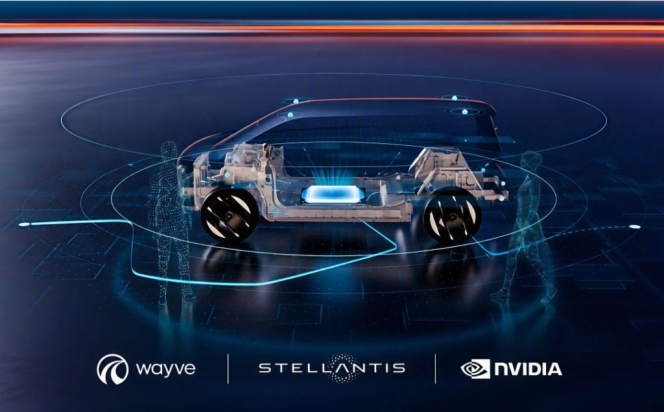
Wayve, NVIDIA and Stellantis have announced a joint collaboration alongside the French government at the Assises du Véhicule Autonome to support the deployment of autonomous vehicles in France and across the European Union.
The initiative combines Stellantis’ L4-Ready Platforms with the Wayve AI Driver system, integrating NVIDIA Halos OS on the NVIDIA Hyperion compute and sensor architecture. The collaboration aims to establish an autonomous vehicle value chain in France, spanning silicon development, software integration and vehicle manufacturing.
Local transport partners will engage with trade unions, municipal authorities, and mobility stakeholders to address regulatory alignment, safety requirements, and operational deployment.
Philippe Tabarot, French Minister of Transports, said, "I am pleased to see this collaboration between Wayve, NVIDIA and Stellantis launched at the Autonomous Vehicle Forum in France. France is committed to adapting its regulatory framework to accelerate the development of autonomous vehicles while maintaining strict safety and data sovereignty requirements. By bringing together trade unions, city authorities, and mobility stakeholders, this collaboration embodies the collaborative spirit of the Assises du Véhicule Autonome, as well as the approach required to transition from trials to real-world deployment."
Kaity Fischer, VP Autonomous Mobility & Operations, Wayve, said, "France is leading the way in preparing for autonomous vehicles, and we’re proud to enter this collaboration at such an important moment. By working directly with the French Government and our partners, we can help shape how this technology is deployed safely and responsibly and accelerate its development across the country and entire EU."
Anne Laliron, SVP of Technology Research, Stellantis, said, "This collaboration will help accelerate the delivery of autonomous driving technologies that make mobility safer and more convenient for customers. While its impact is global, France is one of Stellantis’ key centres for engineering and technology development, making it a natural home for advancing the future of AI-powered mobility."
Ali Kani, VP of Automotive, NVIDIA, said, "Bringing safe autonomous mobility to Europe requires deep collaboration across AI, computing and vehicle engineering. NVIDIA Hyperion platform, combined with Wayve’s embodied AI and Stellantis’ automotive expertise, provides a foundation for that ambition. Together with the French Government and local partners, we can help build an ecosystem that brings the benefits of autonomous driving to communities across France and Europe."
Audi Debuts Curved Digital OLED Lighting Technology On New Q91
- By MT Bureau
- October 26, 2026

German luxury carmaker Audi has introduced third-generation digital OLED rear lighting technology on the Q91, marking the production debut of three-dimensionally curved digital OLED panels in the automotive industry.
The lighting system incorporates carrier glass measuring 0.1 millimetres in thickness, allowing a bend radius of up to 200 millimetres to match the vehicle's body contours. The Q91 uses six digital OLED panels housing 512 individual segments, including an outer curved panel with 99 segments.
The curved positioning extends light visibility to wider lateral angles and incorporates warning symbols within the communication light system to alert surrounding traffic to breakdowns, emergency braking or accidents. Up to eight digital light signatures are available across static, active and semi-active display settings.
The vehicle also features digital Matrix LED headlights utilising a 13-millimetre micro-LED module containing 25,600 individual micro-LEDs. The headlight system projects high-resolution lane lighting, orientation paths and dynamic turn signal graphics directly onto the road surface to assist lane centring and indicate directional changes to pedestrians and other vehicles.
Audi first introduced OLED technology on the TT RS in 2016, followed by segmented digital OLEDs on the Q5 in 2020 and second-generation panels on the Q6 e-tron in 2024.
Stefan Berlitz, Head of Lighting Development at AUDI AG, said, "At Audi, light means safety first and foremost – seeing and being seen. Digitalisation opens up entirely new possibilities for further enhancing road safety. The curved digital OLED technology in the Audi Q91 impressively demonstrates this technology’s potential. It combines design freedom, personalization, and communication with the vehicle’s surroundings at a new level. Our vision is to gradually transform light into an intelligent means of communication that makes interaction between the vehicle and its surroundings even safer and more intuitive."
Bolt Selects NVIDIA To Power European Autonomous Ride-Hailing Fleet
- By MT Bureau
- October 22, 2026
European ride-hailing platform Bolt has selected the NVIDIA Alpamayo Stack autonomous driving software to operate its vehicle fleet in Europe, starting with Lucid automobiles.
The deployment commences in Madrid in 2027, with subsequent deployment planned in Germany and France. The initiative supports the integration of at least 25,000 Level 4-ready Lucid vehicles equipped with NVIDIA Hyperion compute and sensor architecture. The program contributes to Bolt's objective of deploying 100,000 autonomous vehicles across Europe and the UNECE region by 2035. The system integrates reasoning artificial intelligence with perception and planning modules alongside NVIDIA Halos safety controls.
Jevgeni Kabanov, President and Head of Autonomous Driving, Bolt, said, “Autonomous driving will change how people move around cities, and Europe should play a major role in how that future is built. Our ambition isn't to bring autonomous driving to just a handful of cities. We want to make autonomous ride-hailing available at scale across Europe, with 100,000 vehicles on our platform by 2035. We're bringing together some of the best technologies in the world to make that possible. Following our first autonomous mobility launch in Luxembourg, our next step with NVIDIA and Lucid is to begin a programme in Madrid in 2027. The Region of Madrid is pioneering a structured framework for commercial autonomous mobility in coordination with national authorities. Germany will also be a priority for what comes next, with cities already setting out clear ambitions for autonomous mobility.”
Rishi Dhall, Vice-President of Automotive, NVIDIA, said, “Robotaxis will scale when every vehicle is built on a common, safety-engineered foundation. NVIDIA Hyperion standardises the compute and sensor architecture across vehicle platforms, while NVIDIA Alpamayo Stack and Halos provide the driving intelligence and safety foundation. Bolt’s European platform, operational experience and work with cities and regulators make it a strong partner to bring autonomous ride-hailing to market at scale in Europe.”
- Valeo
- NVIDIA
- NVIDIA Halos
- NVIDIA DRIVE AGX
- Level 4
- Marc Vrecko
- Rishi Dhall
- Robotaxi
- autonomous mobility
Valeo Collaborates With NVIDIA To Develop Autonomous Driving Compute Platforms
- By MT Bureau
- October 22, 2026
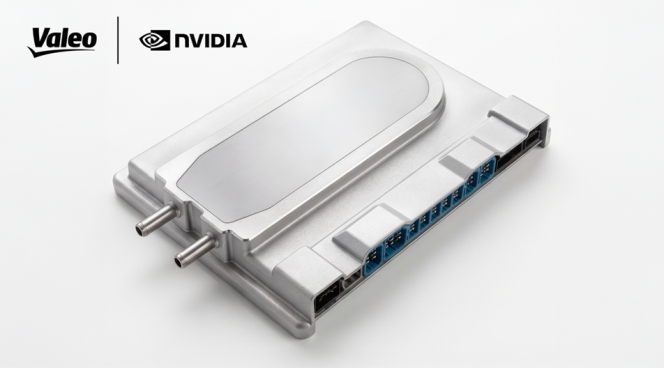
French tier 1 supplier Valeo has announced plans to develop and industrialise high-performance compute platforms utilising the NVIDIA Hyperion reference architecture and NVIDIA Halos safety system.
The initiative combines Valeo's vehicle integration capabilities with centralised computing architectures to support software-defined mobility systems. The platform utilises the NVIDIA DRIVE AGX Thor architecture to deliver processing performance and redundancy for Level 4 autonomous driving, commercial trucking and robotaxi applications. The development framework enables automakers to integrate features and deploy autonomous technologies across vehicle models.
Marc Vrecko, Chief Executive Officer, Valeo Brain Division, said, "Our work with NVIDIA marks a significant milestone in our mission to make autonomous driving a safe, scalable reality. By seamlessly integrating NVIDIA’s advanced compute power into our next-generation platforms, we are delivering the flexible, centralised intelligence vehicle manufacturers require to redefine the driving experience and meet the evolving demands of tomorrow’s intelligent vehicles."
Rishi Dhall, Vice-President of Automotive, NVIDIA, said, "Valeo’s expertise in high-performance computing, vehicle integration and automotive-scale industrialisation will help automakers adopt NVIDIA Hyperion and NVIDIA Halos at production scale. Together, NVIDIA and Valeo are providing the AI performance, functional safety and scalability needed to accelerate the development of Level 4 autonomous vehicles and robotaxis."
Comments (0)
ADD COMMENT