

Nawgati Announced As Title Sponsor For PDAP Annual General Meeting 2026
- By MT Bureau
- March 18, 2026
Nawgati, an Indian fuel-tech company, has been named the title sponsor for the 2026 Annual General Meeting (AGM) of the Petrol Dealers Association Pune (PDAP). The association represents over 900 petroleum dealers within the Pune district.
The AGM is scheduled for 21 March 2026 at the Hotel Westin Koregaon Park, Pune. The event includes an industry exhibition designed to showcase technological solutions and services within the petroleum retail value chain.
Attendees will include senior bureaucrats, officials from oil marketing companies and representatives from dealer associations across Maharashtra. The gathering focuses on the convergence of digital innovation and existing fuel retail infrastructure.
Nawgati is utilising the platform to highlight Aaveg for Dealers, an operating system developed for fuel retailers. The platform integrates several operational functions into a single interface: real-time accounting and inventory management, sales intelligence and automated invoicing, digital contracts and credit control systems.
The company currently operates across India and has established subsidiaries in the UAE and Sri Lanka to scale its connected fuelling ecosystem.
Vaibhav Kaushik, Co-Founder & CEO, Nawgati, said, “The Petrol Dealers Association Pune AGM is bringing together stakeholders who are directly involved in these discussions through this Annual General Meeting, and Nawgati is pleased to support a platform that encourages meaningful exchange within the sector, as such conversations are important in shaping practical solutions that benefit both dealers and consumers.”
Aalaap Nair, Co-Founder, Nawgati, added, “Through Aaveg for Dealers, we are introducing an all-in-one operating system designed specifically for modern fuel retailers. It brings together real-time accounting, inventory management, and sales intelligence into a single, seamless platform. By enabling greater control over credit, customers, and cash flow, supported by smart insights, automated invoicing, and digital contracts, Aaveg is simplifying operations and helping dealers run more efficient, scalable fuel businesses.”
Dhruv Ruparel, President of the Petrol Dealers Association Pune, stated, “The Annual General Meeting serves as an important forum for the dealer community, as it gives us a platform to engage on operational and industry-related developments. Nawgati’s association this year as the “title sponsor” reflects the increasing role of tech-led solutions in fuel retail, which is strengthening these operations. We are looking forward to constructive discussions that support the sector’s continued progress.”
- Delta Electronics
- NVIDIA
- NVIDIA Halos
- NVIDIA Hyperion
- NVIDIA DRIVE AGX
- James Tang
- Rishi Dhall
- Level 4 Autonomous
Delta Partners NVIDIA To Develop Level 4 Autonomous Driving Systems
- By MT Bureau
- October 02, 2026
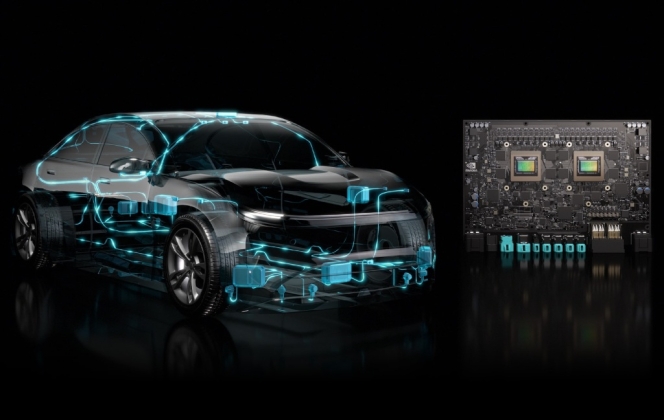
Taiwan-headquartered Delta Electronics has announced a collaboration with NVIDIA aimed at developing autonomous driving systems for next-generation vehicles.
The partnership combines Delta’s automotive energy management, electric powertrain systems and in-vehicle high-performance computing system integration with the NVIDIA Hyperion reference platform and NVIDIA Halos safety system.
NVIDIA Hyperion serves as a sensor and compute architecture for Level 4 autonomous vehicles and robotaxis, utilising dual NVIDIA DRIVE AGX Thor processors to enable production-ready vehicle autonomy.
James Tang, Executive Vice-President of Mobility Business Category, Delta, said, "Autonomous driving requires years of technology development, continuous innovation, and strong system integration. Our commitment to the EV sector began several years ago, developing strong expertise in power electronics and key automotive technologies, and accumulating extensive development experience with world-class automakers. We are honoured that NVIDIA recognises Delta’s automotive expertise and strategic direction. Through this joint endeavour, we will further integrate AI and HPC capabilities into the enhancement of advanced autonomous driving functions, turning next-generation smart vehicles into real-world applications while pursuing new opportunities in the fast-growing smart mobility market."
Rishi Dhall, Vice-President of Automotive, NVIDIA, said, "Level 4 autonomous driving requires powerful in-vehicle computing, a comprehensive sensor architecture and close collaboration across the automotive ecosystem. By combining Delta’s automotive and system integration expertise with NVIDIA Hyperion, we can accelerate the development of safe, intelligent and scalable autonomous driving systems for the next generation of mobility."
Under the agreement, Delta will work alongside NVIDIA’s engineering teams to integrate its system technology into the Hyperion architecture, while leveraging NVIDIA's international network to broaden commercial engagement with global automotive manufacturers.
- Stellantis
- Wavye
- Wave by Vento
- Antonio Filosa
- Alex Kendall
- Adam Jonas
- Morgan Stanley
- Artificial Intelligence
- ADAS Level 2++
- Fiat 500e
- Maserati Grecale
Stellantis And Wayve To Showcase AI Mobility Technology At Wave By Vento 2026
- By MT Bureau
- October 02, 2026
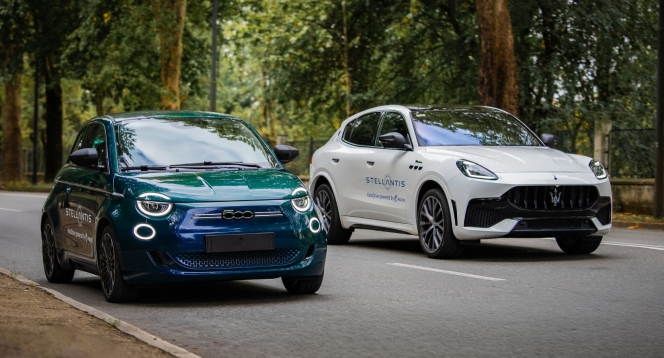
Stellantis and Wayve will participate in the Wave by Vento event in Turin from 7 to 9 October 2026, featuring executive sessions, technical presentations and demonstration rides focused on artificial intelligence in mobility.
A keynote session titled ‘Technology Made for Humans’ will feature Stellantis CEO Antonio Filosa and Wayve Co-Founder and CEO Alex Kendall on 9 October. Moderated by Adam Jonas, global embodied AI and robotics strategist at Morgan Stanley, the discussion will focus on AI-powered mobility and strategic partnerships for technology deployment at scale.
During the event, Stellantis and Wayve will conduct demonstration rides in Fiat 500e and Maserati Grecale development vehicles equipped with the STLA AutoDrive platform powered by Wayve.
The system integrates the Wayve AI Driver to demonstrate hands-free, door-to-door supervised automated driving, categorised as Level 2++, in real-world driving conditions. The integration follows the Jeep Grand Cherokee development vehicle displayed at Stellantis' Investor Day in May, applying the same core AI driving software across three vehicle architectures without model-specific software re-engineering.
Announced in May 2026, the strategic partnership between Stellantis and Wayve focuses on supervised automated driving software for highway and urban environments. Stellantis targets its first commercial product launch using the technology in North America in 2028.
- Energy in Motion
- EIM
- Dr. Hanif Qureshi
- Ministry of Heavy Industries
- Mahendra Singhi
- Dalmia Cement
- Arun Kumar Khurana
- UltraTech Cement
- Manav Bansal
- Drivn
- Narendra Murkumbi
- battery swap
Energy In Motion Inaugurates EV Battery Swapping And Charging Infrastructure For CVs Along NH-48 Corridor
- By MT Bureau
- September 29, 2026
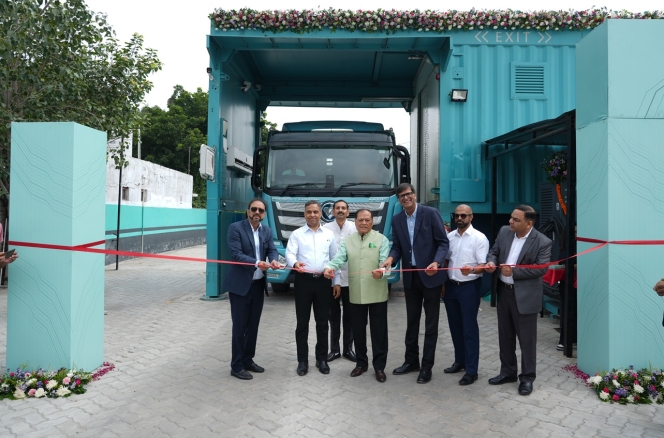
Energy In Motion (EIM Ltd) has inaugurated a heavy-duty battery swapping-cum-charging station at Rewari, Haryana, expanding its energy infrastructure along the NH-48 Delhi-Mumbai freight corridor.
The facility was inaugurated by Dr. Hanif Qureshi, IPS, Additional Secretary, Ministry of Heavy Industries, Government of India. The event was attended by representatives from cement and logistics companies, fleet operators, financial institutions, and transport providers, including Mahendra Singhi, Board Member and Advisor at Dalmia Cement, Arun Kumar Khurana, Joint President and Head of Operations Logistics at UltraTech Cement, Manav Bansal, Co-Founder and CEO at Drivn and Narendra Murkumbi, Managing Director at Energy In Motion.
The Rewari station joins existing EIM facilities at Palwal and Kotputli along the NH-48 corridor. Each station operates with a connected load of 2.5 MW to supply power directly along key transit routes. The infrastructure utilises a battery-swapping model designed to replace depleted heavy-vehicle batteries with charged units, reducing vehicle idle time compared to stationary plug-in charging methods.
Narendra Murkumbi, MD, EIM, said, “The Rewari station is dedicated to support Green logistics more economically. The facility can swap a discharged battery of an Electric Heavy commercial vehicle (e-HCV) typically in 7 minutes, against 55-60 minutes of charging time through a conventional charger, there by yielding a significantly higher fleet availability and better economics for any fleet owner or transporter. The station has the capacity to serve over 150 vehicles a day. EIM’s Battery Swapping, together with its larger capacity battery of 350 kWh, can result into a 10 percent increment in the No. of monthly return trips on any corridor for any Logistics Service Provider (LSP). We plan to set-up 40 such stations across India in the current financial year, of which 8 are already operational and 7 more in various stages of installation. EIM, in its pursuit of creating value for its customers through innovative solutions, has already gained large traction across India through its ‘Maitryi’ model (Battery as a Service or BaaS) where a customer’s upfront capital deployment stands reduced by 40 percent while buying a heavy-duty electric truck, a capital-intensive item.”
EIM offers its infrastructure under a Battery as a Service (BaaS) commercial structure, designated as the 'Maitryi' model. The arrangement separates the vehicle purchase price from the battery unit, lowering initial capital expenditure for logistics providers purchasing heavy-duty electric trucks. The company plans to deploy 40 heavy-duty swapping-cum-charging stations across India during the current financial year, with eight facilities currently in operation and seven in development.
- Toyoda Gosei Co
- Toyoda Gosei (China) Investment Co
- CATARC Component Technology (Tianjin) Co
- China Automotive Technology & Research Center
Toyoda Gosei Partners China Automotive Technology & Research Center
- By MT Bureau
- September 28, 2026
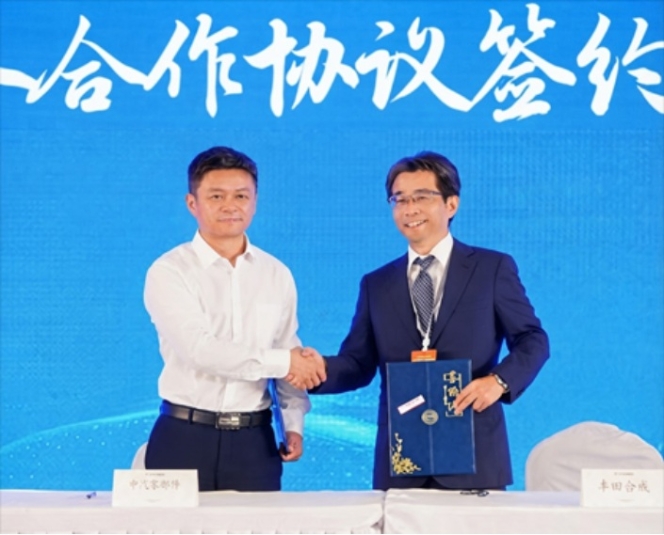
Japanese tier 1 supplier Toyoda Gosei Co’s regional headquarters in China, Toyoda Gosei (China) Investment Co., has inked a partnership agreement for safety standards and technical innovations with CATARC Component Technology (Tianjin) Co., a group company of the China Automotive Technology & Research Center (CATARC).
The agreement focuses on safety standards and technical developments as China Automotive Technology & Research Center formulates vehicle safety regulations and industry standards in China.
As per the understanding, Toyoda Gosei (China) Investment Co., aims to accelerate product development by increasing the deployment of computer-aided engineering technology and creating safety products tailored to local requirements.
The partnership comes amid market shifts in China driven by the adoption of electric vehicles and the entry of new automotive manufacturers. Toyoda Gosei plans to leverage its engineering resources to supply safety components to carmakers operating within the Chinese automotive sector.
Comments (0)
ADD COMMENT