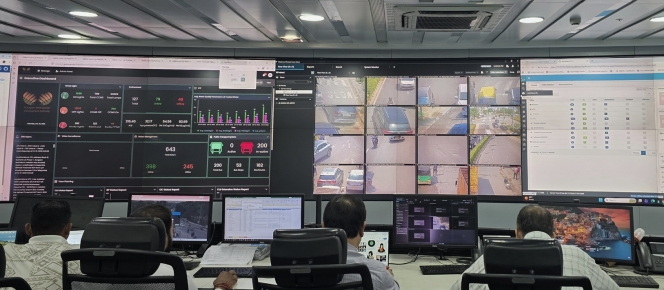
Maruti Suzuki India, the country’s largest passenger vehicle manufacturer, has announced the second phase expansion of its Integrated Traffic Management System (ITMS) in Gurugram under its corporate social responsibility initiative, allocating approximately INR 750 million to the project.
The expansion will see the installation of 1,000 additional radar-integrated cameras across 70 junctions and nine road stretches covering 65 kilometres in the city. Combined with the initial phase, which deployed 400 cameras across 23 junctions, the completed network will encompass 1,400 cameras across 93 junctions and 13 road corridors.
Implemented in partnership with the Gurugram Metropolitan Development Authority and the Gurugram Police, the automated system detects traffic offences including speed limit violations, red-light jumping, helmetless riding, triple riding and wrong-side driving. The camera units record registration plate details and transmit data directly to the Integrated Command and Control Centre for enforcement processing.
Sibash Kabiraj, Commissioner of Police, Gurugram, said, "We appreciate Maruti Suzuki’s continued support in strengthening Gurugram’s traffic management infrastructure through its CSR initiative. The expansion of the Integrated Traffic Management System will further strengthen our ability to monitor traffic violations, enable timely enforcement, and encourage greater compliance with traffic regulations."
P C Meena, CEO of the Gurugram Metropolitan Development Authority, said, "GMDA is committed to building a robust, technology-driven surveillance network to strengthen traffic management and road safety across Gurugram. The expansion of CCTV coverage in collaboration with Maruti Suzuki India Limited and Gurugram Police will enable more effective traffic monitoring, strengthen enforcement of traffic rules and promote greater road discipline. Connecting the CCTV network with GMDA’s Integrated Command and Control Centre will further enhance real-time surveillance, improve coordination among enforcement agencies and facilitate quicker action against traffic violations, contributing to safer roads for all commuters."
Rahul Bharti, Senior Executive Officer of Corporate Affairs, Maruti Suzuki India, said, "We are pleased to further strengthen our partnership with GMDA and the Gurugram Traffic Police in advancing road safety through technology-driven interventions. This advanced tracking system addresses issues like riding without helmets, triple riding, red-light violations, over-speeding, and wrong-side driving. These violations highlight a critical road-safety challenge, as human error continues to be the leading cause of road accidents in India. The findings reinforce the need for sustained, collaborative efforts to improve compliance with traffic regulations and foster safe road behaviour. Improving road safety requires a combination of responsible driving, robust driving license testing and effective traffic enforcement. We are committed to working alongside authorities in these areas to build a safer mobility ecosystem."







Comments (0)
ADD COMMENT