

SIIMC 2022 Kicks Off In Bengaluru, India
- By Juili Eklahare
- October 13, 2022
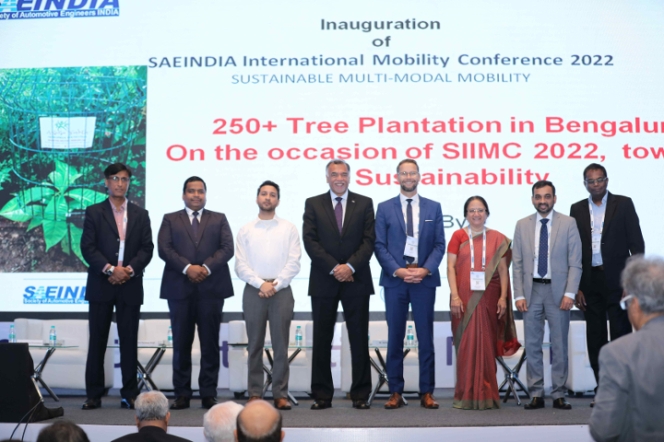
The SAEINDIA International Mobility Conference (SIIMC 2022), the tenth edition of the Society of Automotive Engineers INDIA’s (SAEINDIA) flagship event, kicked-off on Wednesday, which is being hosted at Bengaluru, India. The three-day event will bring together the mobility ecosystem, with a phygital event to be held between 12 October to 14 October, 2022.
The theme for this year’s conference is “Sustainable Multi-Modal Mobility Ecosystem”, which takes forward SAEINDIA’s commitment on advancing and promoting mobility engineering. Dr Murugesh Nirani, Minister of Large and Medium Industries, Government of Karnataka, was the chief guest of the inaugural session. Along with the inaugural session, there was also an exclusive press meet.
Sharing his thoughts on sustainable multi-modal solutions, Mahesh Babu, SIIMC 2022 Conference Patron, and CEO at Switch Mobility India, said, “A robust mobility framework is the need of the hour to mitigate the impact of growing emissions and rapid urbanisation. Sustainable multi-modal solutions will help de-carbonise 100 million tonnes of CO2 by 2030. SIIMC 2022 is a platform where all three stakeholders – the government, the industry and the communities have come together to make sustainable multi-modal mobility a reality.”
How is SIIMC 2022 different?
At the press meet, K Venkataraj, Deputy Director General, SAEINDIA, put across that with the tenth edition of the conference, each edition enhances itself. “This is because the transportation sector has gone through so much of transformation,” he remarked and continued, “We are actually living through the mobility sector transformation era. In order to address the present-day challenges, SAEINDIA’S duty is to bring in experts to the knowledge-takers and knowledge-givers. It’s a K2K business we are in. So, we bring in worldwide experts, who present it in terms of number of papers.”
All for the need for sustainability
Munirathinam Dhananjayan, Chair-Organising Committee, Founder and MD of Focus Group, said that the SIIMC 2022 three-day event will see over 700 mobility experts, including industry leaders and professionals from research and development, manufacturing, and services come together and network under one roof. “The key highlight of the tenth edition of the SIIMC 2022 is going to be the presentation of more than 180 papers and 543 abstracts on engineering innovations, with a focus on promoting sustainable and multi-modal mobility in the country. SIIMC 2022 will see a host of panel discussions and individual presentations, putting the spotlight on trends and innovations shaping the future of mobility,” he mentioned.
Some of the key sessions of the conference will see speakers coming together and discussing themes, states SAEINDIA. Some of these themes include the role of the automotive industry in meeting the challenges of global warming, the design and development of low cost electric microcars for urban commuting, edge-computing for multi-modal and intermodal mobility, building globally connected car platforms – unearthing complexity, balancing energy efficiency, driving excitement and comfort in battery electric vehicles, and if battery swapping is a viable alternative to accelerate the electric vehicle adoption in India.
Talking about the focus areas and theme of the SIIMC 2022 conference, Venkataraj said, “This year’s conference theme, “Sustainable Multi-Modal Mobility Ecosystem”, resonates well with the present-day reality, where mobility is considered to be playing a big role in achieving sustainable development by promoting goals, like a clean and green environment and equitable livelihood.”
Venkataraj went on to assert, “We are in a very critical and early stage of production of sustainable solutions in mobility. Which is why, this year’s conference is going to help technocrats, stakeholders, etc, where they can learn from one another about what is happening in other countries. This way, India and other nations can gain knowledge from this conference.”
Additionally, while at the event, Suhas Gopinath, CEO, Globals Inc., inaugurated TechHive, claimed SAEINDIA. TechHive is a one-stop shop for start-ups to showcase their products and services to the global and Indian automotive market. It works towards facilitating networking and supporting new business opportunities, by bringing together start-ups, the automotive industry and investors.
The government’s role
When asked about the Government of India’s initiatives to set up multi-modal logistics parks across the country, Rashmi Urdhwareshe, President, SAEINDIA, cited that the government is addressing this in multiple ways. “One is improving the infrastructure by way of private connectivity,” she informed and went on, “The second is working on efficient goods transformation – we have even seen in one of the presentations how important it is to address goods transportation across the country. The third initiative is to look at greener solutions – not at just electrification but others, too, like LNG for example, which has great opportunity.”
What else to expect at the conference
SIIMC 2022 will see panel discussions that will be led by industry experts and researchers. As per SAEINDIA, the speakers will be from India’s leading automotive and technology organisations, as well as science and engineering institutes. The key organisations participating in the conference include Maruti Suzuki, Tata Motors, Volvo, Ashok Leyland, Bosch, Indian Oil Corporation and Indian Institute of Science.
According to SAEINDIA, C V Raman, CTO at Maruti Suzuki, Vijay Nirani, Managing Director at MRN Group, Vinay Harne, CTO at TVS Motors, Brian McMurray, President at General Mortors, Korea, Dr Sri Srinath, President at SAE International and Prashant Doreswamy, President at Continental Automotive India are some of the prominent industrialists who will be delivering various sessions at the conference.
DRIVN And Purple Bus Expand Fleet Partnership To 276 Electric Intercity Coaches
- By MT Bureau
- October 12, 2026
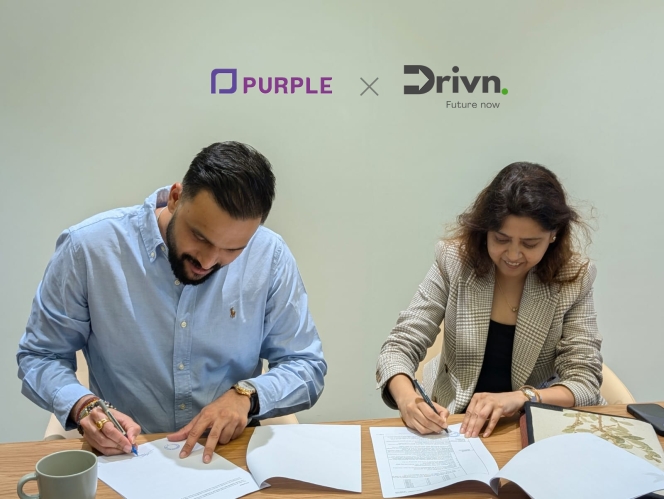
Electric commercial vehicle leasing platform DRIVN and private intercity bus operator Prasanna Purple Mobility Solutions, operating as Purple Bus, have expanded their electric fleet agreement to 276 buses.
The agreement increases the initial commitment of 100 electric buses, utilising an operating lease model and fleet management software.
The initial deployment covered intercity routes in Western and Southern India, including the Mumbai–Pune, Bengaluru–Chennai and Hyderabad–Vijayawada corridors. The expanded fleet under the Letter of Intent will cover additional routes, including Nagpur–Chandrapur, Nagpur–Amravati and Bengaluru–Tirupati.
DRIVN will supply asset financing, leasing, charging infrastructure management, real-time battery diagnostics and route performance analytics to support the deployment.
Alpna Jain, Co-Founder and Chief Business Officer, DRIVN, said, "Expanding our partnership with Purple Bus marks an important milestone for us at DRIVN. Increasing the initial agreement from 100 buses to a commitment of 276 reflects the strength of the relationship we have built with the team. Our focus is to simplify the transition to electric commercial vehicles by bringing together the financing, vehicles and tech capabilities operators need to run their fleets effectively. We look forward to continuing our work with Purple Bus as its requirements evolve."
Saurabh P Patwardhan, Director, Purple Bus, said, "Our experience with the initial deployment has reinforced a key learning: scaling electric mobility requires not only putting more electric buses on the road, but also building the right ecosystem around them. A nearly three-fold growth in the commitment from our partner reflects our confidence in that approach and our intention is to make electric mobility a larger part of our operations. DRIVN combines operational expertise with a strong technology platform, using real-time data and insights across routes, vehicles and fleet performance to support smarter deployment. We believe this combination will be critical to scaling electric intercity mobility sustainably and efficiently."
The partnership combines Purple Bus's route operations with DRIVN's leasing and data infrastructure to support the transition to electric intercity passenger transport in India.
Mahindra Commences Production Of MAXSEEDER Precision Zero-Till Seeding Machine
- By MT Bureau
- October 12, 2026
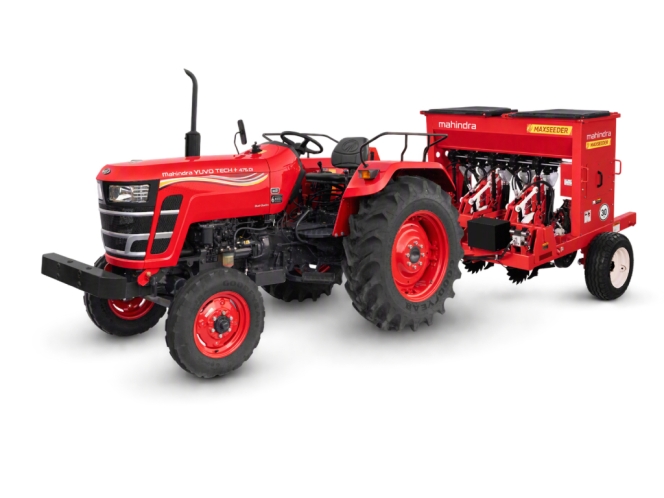
Mumbai-headquartered automotive major Mahindra & Mahindra has commenced commercial production and supply of the MAXSEEDER, a precision zero-till, multi-crop seeding machine manufactured under licence from Canadian firm Clean Seed Technologies.
Built at Mahindra's farm machinery plant in Pithampur, Madhya Pradesh, the machinery will launch initially through dealerships in Punjab and Haryana before expanding to other domestic and international agricultural markets.
The MAXSEEDER operates as a tractor-trailed unit compatible with tractors rated at 35 horsepower and above. Engineered for multi-crop seeding across wheat, rice, soybean, maize and cotton, the machine enables direct sowing into paddy residue to eliminate stubble burning.
It features five independent row units with adjustable spacing, multiple metering options and an Electronic Control Unit controlled via a smartphone application to regulate seed and fertiliser dispensing. The unit places urea approximately 1.5 inches below the seed line to improve nutrient uptake and lower input consumption.
Field trials conducted in Punjab and Haryana demonstrated the machine's ability to operate in heavy crop residue with minimal soil disturbance, reducing fuel, labour, and field preparation requirements ahead of planting cycles.
Veejay Nakra, President of the Farm Equipment Business at Mahindra & Mahindra, said, "Mahindra is proud to partner with Clean Seed to deliver sustainable, mechanisation solutions to farmers world over. The patented and innovative ‘zero-till’, multi-crop seeding machine – the MaxSeeder, combined with Mahindra’s world-class manufacturing, ensures benefits for both farmers and the environment. The collaboration also underscores Clean Seed’s confidence in Mahindra’s capabilities and our shared commitment to advancing access to modern farm machinery globally and in India, while showcasing Indian manufacturing excellence on the world stage."
Graeme Lempriere, Chairman and Chief Executive Officer of Clean Seed Capital Group, said, "Seeing our SMART Seeder MINI-MAX enter production at Mahindra is a proud milestone and a testament to years of innovation, collaboration and belief in our vision of delivering sustainable seeding and planting solutions for farmers in India and around the world. I am deeply impressed by Mahindra's scale and manufacturing capabilities and inspired by the commitment and passion the Mahindra team has brought to this project."
- Ashok Leyland
- Tamilnad Mercantile Bank
- Neelakantan
- R. Ananda Ganesan
- Salee S Nair
- K M Balaji
- Madhavi Deshmukh
- Salee S Nair
Ashok Leyland Partners Tamilnad Mercantile Bank For Commercial Vehicle Financing
- By MT Bureau
- October 12, 2026
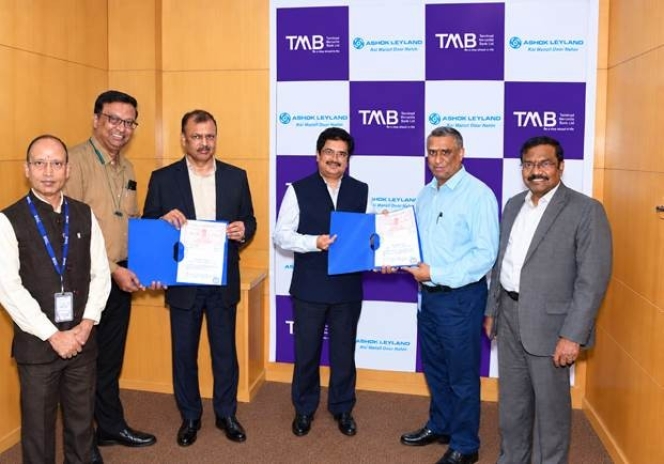
Chennai-headquartered commercial vehicle manufacturer Ashok Leyland, the flagship company of the Hinduja Group, has signed a Memorandum of Understanding with Tamilnad Mercantile Bank to provide financing solutions for purchasers of its trucks and buses.
The agreement was executed by Neelakantan, Vice-President of Finance at Ashok Leyland and R. Ananda Ganesan, Executive Vice-President and Country Head of Credit at Tamilnad Mercantile Bank, in the presence of Salee S Nair, Managing Director and Chief Executive Officer of Tamilnad Mercantile Bank.
Under the partnership, Tamilnad Mercantile Bank will extend end-to-end vehicle loans with structured repayment schedules across Ashok Leyland's range of light, medium and heavy commercial vehicles.
The partnership leverages Tamilnad Mercantile Bank's network of over 600 branches, with coverage across rural, semi-urban and commercial hubs in Tamil Nadu and South India. The initiative aims to increase credit accessibility for transport operators, fleet owners, small and medium enterprises and agricultural businesses purchasing commercial vehicles.
K M Balaji, Whole-Time Director and Chief Financial Officer, Ashok Leyland, said, "We are pleased to partner with Tamilnad Mercantile Bank (TMB) to provide accessible and convenient financing solutions to our customers. Financing plays an important role in enabling customers to invest in commercial vehicles and grow their businesses. This partnership will further strengthen our customer-centric approach by facilitating greater access to finance for customers purchasing Ashok Leyland trucks and buses. We look forward to a meaningful and long-term association with Tamilnad Mercantile Bank (TMB)."
Madhavi Deshmukh, Senior Vice-President and National Head of Sales for Medium and Heavy Commercial Vehicles, Ashok Leyland, said, "Our customers are at the heart of everything we do, and ensuring easy access to financing is an important part of supporting their business journeys. By joining hands with Tamilnad Mercantile Bank (TMB), we are extending another avenue for customers to access timely financing support. The partnership will help improve vehicle penetration across regions and ensure that customers can benefit from faster turnaround times and tailored financing offerings that suit their operational requirements."
Salee S. Nair, MD and CEO, Tamilnad Mercantile Bank, said, "We are delighted to partner with Ashok Leyland, a leading name in India’s commercial vehicle industry. Through this partnership, TMB will offer tailored financing solutions backed by seamless processes and customer-centric service. By leveraging the combined strengths of TMB's robust banking network and Ashok Leyland's extensive market presence, we aim to support business growth and drive greater mobility for transport operators and fleet owners."
Truck Rentals Hold Firm On Festive Dispatches And Core Sector Expansion
- By MT Bureau
- October 06, 2026
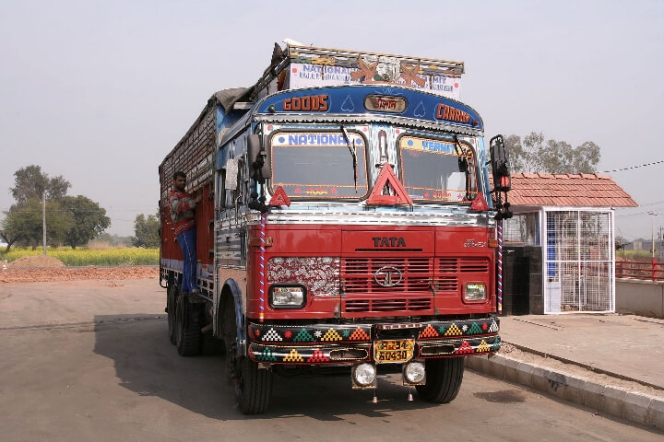
India’s transportation sector recorded growth across vehicle categories in September 2026, driven by festive dispatches and core sector demand, according to the Shriram Mobility Bulletin.
Truck rentals remained stable across key trunk routes, remaining above levels recorded during the same period in the previous year.
The company finds that on a MoM basis, rentals on the Bengaluru–Mumbai–Bengaluru route grew by 1.3 percent, followed by the Delhi–Mumbai–Delhi route at 1.1 percent and the Delhi–Hyderabad–Delhi route at 1 percent.
The YoY perspective showed increases on all monitored routes, led by Delhi–Kolkata–Delhi at 13 percent, Bengaluru–Mumbai–Bengaluru at 11 percent and Kolkata–Guwahati–Kolkata at 10 percent.
Vehicle dispatches reflected sequential expansion in core industries. Construction equipment sales rose 31 percent MoM, earth-moving equipment increased 17 percent and goods carriers grew 13 percent. Passenger cars and two-wheelers each recorded a 4 percent sequential rise, whereas agricultural tractors fell 15 percent and commercial tractors declined 22 percent.
On a YoY basis, maxi cab sales grew 75 percent, three-wheeler goods vehicles rose 63 percent and goods carriers increased 40 percent. Agricultural trailers recorded a year-on-year decline of 27 percent.
Electric vehicle adoption increased across all monitored segments. Electric two-wheelers recorded a 13 percent MoM rise and a 111 percent YoY gain. Electric passenger cars grew 12 percent sequentially and 143 percent YoY, while electric three-wheelers increased 8 percent MoM and 113 percent YoY.
Sudarshan Holla, Joint MD & COO, Commercial Vehicles, Shriram Finance, said, "Firm truck rentals amid festive dispatches, strong two-wheeler demand, accelerating EV adoption, and healthy sales of heavy-duty trucks and construction equipment all point to resilient economic activity. Importantly, the strength seen in commercial vehicles and construction equipment indicates continued momentum in infrastructure and core sectors, reinforcing a positive outlook for the broader economy. Concerns of a potential interest rate increase during the festive season may be a sentiment dampener."
Interestingly, fuel consumption data showed a 2 percent sequential rise in diesel use alongside a 5 percent decline in petrol consumption. On a YoY basis, petrol and diesel consumption increased by 7.2 percent and 4.9 percent, respectively. FASTag collections fell 3.9 percent in volume and 1.2 percent in value MoM, though YoY collection value increased by 11 percent.
Comments (0)
ADD COMMENT