

Tata Motors’ PV And CV Sales In The Negative, Outlook Remains Positive
- By MT Bureau
- July 01, 2025
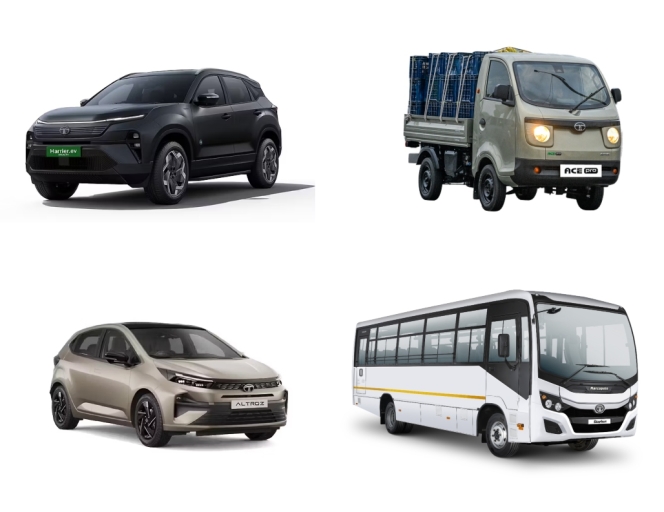
Tata Motors, one of the leading passenger vehicle and commercial vehicle manufacturers in the country, has announced its wholesales for June 2025 and Q1 FY2026.
The company reported that its total PV sales came at 124,809 units in Q1 FY2026, down 10 percent from Q1 FY2025 on a YoY basis. Domestic PV sales, including EVs, came at 123,839 units, down 10 percent YoY. For June, PV sales came at 37,083 units, down 15 percent compared to the same period last year.
| TATA MOTORS PASSENGER VEHICLES | ||||||
| June '25 | June '24 | Change (in %) | Q1 '26 | Q1 '25 | Change (in %) | |
| PV Domestic (includes EV) | 37,083 | 43,524 | -15% | 123,839 | 138,104 | -10% |
| PV IB | 154 | 100 | 54% | 970 | 578 | 68% |
| Total PV (includes EV) | 37,237 | 43,624 | -15% | 124,809 | 138,682 | -10% |
| EV (IB + Domestic) | 5,228 | 4,657 | 12% | 16,231 | 16,579 | -2% |
Shailesh Chandra, Managing Director, Tata Motors Passenger Vehicles and Tata Passenger Electric Mobility, said, “In Q1 FY2026, the passenger vehicle industry experienced volume pressures, particularly in May and June, with flat growth reflecting continued softness in demand."
"The electric vehicle segment emerged a bright spot, driven by robust growth and the launch of new EV models across OEMs, enhancing customer interest and consideration. Tata Motors reported wholesales of 124,809 units in Q1 FY2026, including 16,231 EV units, underscoring our commitment to aligning wholesale and registration volumes. EV sales gained strong momentum towards the end of the quarter with a healthy growth trajectory. The refreshed Tiago posted 16 percent YoY volume growth in Q1 FY2026 and new launches – Altroz and Harrier.ev – saw a positive market response, with their full impact expected in the coming months,” he said.
On the other hand, Tata Motors’ commercial vehicle (CV) business reported sales of 85,606 units, down 6 percent YoY for Q1 FY2026. Domestic CV sales at 79,572 units, were down 9 percent as compared to Q1 FY2025.
In June 2025 alone, total CV sales came at 30,238 units, which is 5 percent lower than June 2024. In the domestic market, the demand for Medium and Heavy Commercial Vehicles (MH&ICV) came at 12,871 units, as against 4,640 units for the same period last year. During Q1 FY26, MH&ICV domestic sales were 37,370 units as against 40,349 units in Q1 FY25.
| TATA MOTORS COMMERCIAL VEHICLES | ||||||
| June '25 | June '24 | Change (in %) | Q1 '26 | Q1 '25 | Change (in %) | |
| HCV Trucks | 7,359 | 8,891 | -17% | 21,735 | 24,690 | -12% |
| ILMCV Trucks | 4,863 | 4,997 | -20% | 14,497 | 13,791 | -20% |
| Passenger Carriers | 5,658 | 5,654 | 4% | 15,089 | 14,893 | 9% |
| SCV Cargo & Pickup | 10,056 | 11,081 | 1% | 28,251 | 34,241 | 4% |
| Total CV Domestic | 27,936 | 30,623 | -9% | 79,572 | 87,615 | -9% |
Girish Wagh, Executive Director, Tata Motors, said, “Q1 FY26 began on a subdued note for the commercial vehicle industry with muted performance in the HCV and SCVPU segments while buses, vans and ILMCVs registered modest year-on-year growth. Tata Motors Commercial Vehicles recorded domestic sales of 79,572 units, 9.2 percent decline compared to Q1 FY25."
"However, June 2025 witnessed a sequential growth of 8 percent over May 2025. Additionally, our International Business delivered a robust 67.9 percent growth in volumes over Q1 FY25. During the quarter, we launched India’s most affordable mini-truck, the Ace Pro, offered in petrol, bi-fuel and electric powertrains, which received an encouraging market response. We enhanced driver comfort by introducing air-conditioned cabins across our entire range of light to heavy trucks. We also expanded our international footprint by entering Egypt and expanded our offerings for the Middle East North African region,” Wagh added.
Going forward, Wagh stated that with forecasts for a healthy monsoon across the country, a reduction in repo rate and renewed thrust on infrastructure development, will bring back sales momentum for the commercial vehicles segment.
Chandra too shared his optimism for the PV market and stated, “Looking ahead, while overall industry growth is expected to remain subdued, Tata Motors is well positioned to leverage its new launches to outperform across segments—including hatchbacks and SUVs, while continuing to build on the EV momentum.”
- Renewable Energy India Expo and The Battery Show India
- TBSI
- Philip Green
- Yogesh Mudras
- Anandi Iyer
- Fraunhofer Office
- Informa Markets
- Manu Srivastav
- Jai Asundi
Critical Minerals And Battery Manufacturing Focus Shifts To India At TBSI
- By MT Bureau
- October 24, 2026
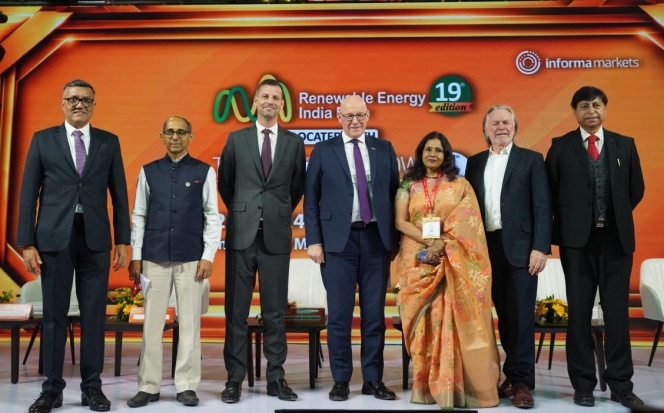
Industry leaders at the Renewable Energy India Expo and The Battery Show India (TBSI) highlighted critical mineral access, technology partnerships and domestic manufacturing capabilities to strengthen India's electric vehicle supply chain.
The event convened over 1,080 exhibitors, 1,400 brands and 54,000 professionals, focusing on international collaboration across critical minerals, battery technology and energy storage.
Interestingly, Australia, represented by 20 companies and 32 exhibitors, identified battery production and electric vehicle supply chains as areas for cooperation with Indian manufacturers, leveraging its lithium, cobalt and rare earth reserves. Projections shared at the exhibition indicate India's renewable energy market will reach 486 GW by 2030, while the battery storage sector is projected to surpass USD 8.5 billion by 2031, growing at a compound annual growth rate of 33 percent.
Philip Green, Australia’s High Commissioner to India, said, "The two countries could combine Australia’s engineering expertise and mineral resources with India’s manufacturing strength and integration into global supply chains. Australia produces more than 50 percent of the world’s lithium, according to Green, and holds the world’s second-largest cobalt reserves. It also ranks second or third globally in rare earth resources." he said.
Yogesh Mudras, Managing Director of Informa Markets in India, said, "Renewable energy generation and grid storage needed to expand together as the country advanced its energy transition. India’s renewable energy market is projected to reach 486 GW by 2030, growing at a compound annual growth rate (CAGR) of 15 percent. The country’s battery storage sector is projected to exceed USD 8.5 billion by 2031, with a CAGR of 33 percent."
Anandi Iyer, Director of the Fraunhofer Office in India, said, "India and Germany had opportunities to collaborate in battery research, power electronics, advanced engineering and industrial automation. Approximately 800 GW of renewable energy capacity additions globally in 2025, while global battery storage deployment reached 108 GW, an increase of 40 per cent from the previous year. Technological self-reliance did not mean working in isolation, highlighting the importance of trusted partnerships and supply chains that can translate research into commercially viable solutions."
Manu Srivastav, Additional Chief Secretary in Madhya Pradesh’s Power & Renewable Energy Department, said, "Renewable energy was becoming increasingly competitive with conventional power as costs declined.”
Jai Asundi, Executive Director of the Centre for Study of Science, Technology & Policy, said, "India would need continued investment in manufacturing, energy storage, grid infrastructure, research and skilled talent to build a resilient clean energy ecosystem."
Caterham Confirmed For Built in Britain Zone At London International Motor Show 2027
- By MT Bureau
- October 23, 2026

Caterham has confirmed its participation in the London International Motor Show 2027, with the British manufacturer set to appear in the event's Built in Britain zone at Excel London from 26 to 28 February 2027. The maker of the legendary Seven, produced in Britain since 1973, will display a selection of its cars on stand 1920.
Visitors will have the opportunity to examine one of the purest driving machines available anywhere, with the Seven widely regarded as a definitive British sports car thanks to its light, simple, hand-built construction in Kent and driver-focused engineering. The Built in Britain zone celebrates the designers, engineers and craftspeople sustaining the country's automotive industry, with specialist sports car makers playing a central role.
Though small in scale, these manufacturers wield enormous influence through cars whose character and focus are admired by major global firms and sought after by enthusiasts. The zone offers them a capital stage before a national audience. The show runs alongside Motorsport Expo and Car Culture UK, with one combined ticket covering all three and around 90,000 visitors expected across the weekend. Friday 26 February serves as the press and trade day, running alongside the public opening.
Stephen Maitland-Oxley, Event Director, London International Motor Show, said, “Caterham is exactly the kind of company Built in Britain was created to celebrate. The Seven is a British icon, and the team behind it has spent more than 50 years proving that lightness, ingenuity and sheer driving fun never go out of fashion. Britain's niche sports car makers are a national asset and we are delighted to give them the spotlight they deserve. Having Caterham with us is a wonderful way to set the tone for the zone.”
Trevor Steel, Senior Vice President – Operations, Caterham Cars, said, “ "At its core, the Caterham Seven is engineered to deliver a driving experience that is as pure, enjoyable and rewarding to the driver, as any car on sale today. Since its inception by Colin Chapman nearly 70 years ago, and since becoming a Caterham in 1973, the Seven has always been proudly built here in Britain, and this is heritage we’re always wishing to celebrate. Built in Britain is a natural home for us, and we are looking forward to meeting enthusiasts, owners and a new generation of drivers in London next February.”
GP Petroleums Appoints Shirish Suvagia As Chief Financial Officer
- By MT Bureau
- October 23, 2026

GP Petroleums has appointed Shirish Suvagia as its new Chief Financial Officer and Key Managerial Personnel, effective 15 October 2026.
Suvagia is a Chartered Accountant with over 23 years of experience in corporate finance, treasury, strategic planning, mergers & acquisitions, and debt and equity fundraising.
He holds Bachelor's and Master's degrees in Commerce from the University of Mumbai, an Executive MBA from IIM Indore, a CISA certification from ISACA, and an IFRS certification from the ICAI.
In his role as CFO, Suvagia will manage the company's financial strategy, treasury, business planning, capital allocation, risk management and reporting functions as GP Petroleums expands its IPOL lubricants brand across domestic and international markets.
Ayush Goel, Chairman & Managing Director of GP Petroleums, said, "We are delighted to welcome Suvagia to GP Petroleums. His experience across corporate finance, treasury, fundraising and mergers & acquisitions will be a valuable asset to the Company, particularly as we focus on capital allocation, business expansion and long-term value creation. We look forward to his contribution as we take the company forward. We are confident that his leadership and financial expertise will support the Company in creating sustainable value for all stakeholders."
"I am excited to join GP Petroleums at an important stage of its growth journey. IPOL is a well-established and respected brand with strong market fundamentals and significant opportunities ahead. I look forward to partnering with the Board and leadership team to further strengthen the Company's financial capabilities, support strategic growth initiatives, and drive long-term value creation for stakeholders," said Suvagia.
SAEINDIA to Host Asia Pacific Automotive Engineering Conference In New Delhi
- By MT Bureau
- October 23, 2026
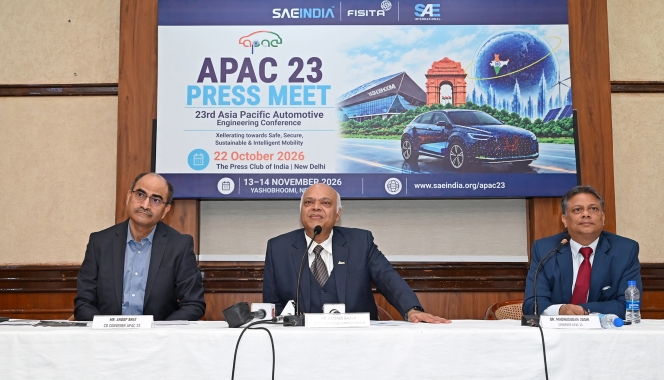
SAEINDIA is set to host the 23rd Asia Pacific Automotive Engineering Conference (APAC 23) from 13 to 14 November 2026 at the Yashobhoomi Convention Centre in New Delhi.
The event, held under the theme ‘Xellerating towards Safe, Secure, Sustainable & Intelligent Mobility,’ returns to India for the second time following a 15-year interval. The conference will convene more than 1,000 delegates and 500 mobility experts representing vehicle manufacturers, component suppliers, technology firms, research organisations and regulatory bodies across 11 countries in the Asia-Pacific region.
The agenda comprises 150 technical presentations and 80 exhibitors covering subject areas such as powertrains, automated driving, cybersecurity, software-defined vehicles, vehicle dynamics, advanced materials and regulatory standards.
The venue features an exposition hall, a technology theatre for product demonstrations, and the TechHive platform designed to connect mobility start-up ventures with industry leaders, technology experts, and investors.
“APAC 23 represents an important opportunity for India to engage with the Asia-Pacific mobility engineering community at a time when our industry is undergoing fundamental transformation. By bringing together industry, academia, researchers, innovators and policymakers, we aim to create meaningful conversations and collaborations that can contribute to safer, smarter and more sustainable mobility,” said Saurabh Dalela, President of SAEINDIA.
Anoop Bhat, Co-Convenor, APAC 23, said, “The scale and diversity of APAC 23 have been designed to create an environment where engineering knowledge, technology innovation and business opportunities come together. From technical presentations and the exposition to TechHive and the Technology Theatre, participants will have multiple opportunities to discover technologies, exchange ideas and build collaborations across the mobility ecosystem.”


Comments (0)
ADD COMMENT