

BMW M Produces 1 Millionth Vehicle As Munich Plant Prepares For Electric M3
- By MT Bureau
- October 05, 2026
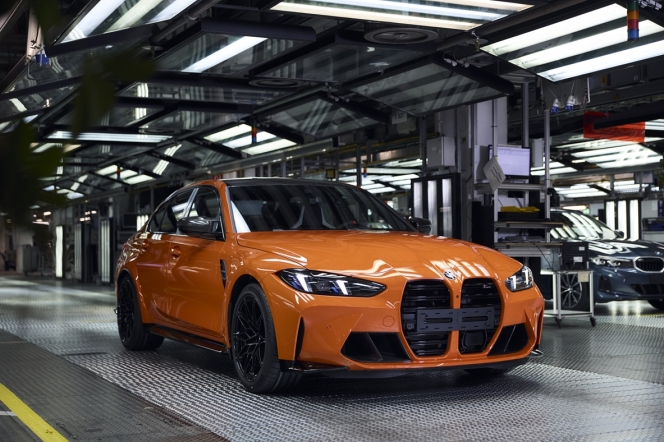
German automotive luxury brand BMW M has produced its one-millionth vehicle, a BMW M3 finished in BMW Individual Fire Orange III special paintwork, at the BMW Group Plant Munich. The milestone vehicle was presented by Peter Weber, head of BMW Group Plant Munich, to Franciscus van Meel, CEO of BMW M, during an official ceremony.
The production milestone marks over five decades of BMW M manufacturing. Moving forward, the Munich facility will produce the fully electric BMW M3 based on BMW M Neue Klasse technology, following the fully electric BMW i3 as the second Neue Klasse model manufactured at the site.
The Munich facility has produced the current generation of the BMW M3 since 2020. From 2027 onwards, the BMW Group will manufacture exclusively fully electric vehicles at the site. The company is investing approximately EUR 650 million to convert the Munich facility, incorporating a new body shop, vehicle assembly line, and logistics infrastructure across one-third of the total plant area.
Franciscus van Meel said, "BMW M combines road and racetrack capabilities with everyday practicality. The one-millionth BMW M vehicle shows that these values are still very much appreciated by our customers, 40 years after the market launch of the first BMW M3. This motivates us to continuously develop our BMW M high-performance vehicle portfolio based on BMW M Neue Klasse technology, including fully-electric models, in line with our core brand promise."
Peter Weber said, "The BMW M3 has close ties to the BMW Group’s main plant in Munich. We are delighted that we will also be producing the first fully-electric BMW M3 here in Munich. BMW M has a special emotional significance for our associates here – so we are especially proud to be actively shaping the future of this icon."

- GAC
- Quark Amorphous Alloy-Carbon Fibre Electric Drive
- China Automotive Technology and Research Centre
- Quark Electric Drive 2.0
- 2027 AION i60
- HYPTEC
- AION
- AISTALAND
GAC Produces 100,000th Quark Amorphous Alloy-Carbon Fibre Electric Drive Unit
- By MT Bureau
- November 27, 2026
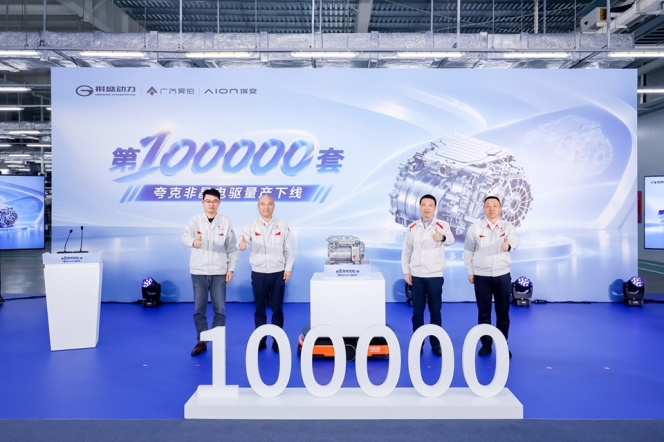
GAC has reached a production milestone of 100,000 units for its Quark Amorphous Alloy-Carbon Fibre Electric Drive, with the 100,000th assembly rolling off the production line on 20 November.
Developed by GAC's powertrain research and development team, the drive unit moves amorphous alloy technology from laboratory testing into volume automotive production through a manufacturing process covering bonding, stamping and lamination across 3,800 layers.
Engineered with 0.025 mm amorphous alloy stator strips, which deliver 20 to 100 times the permeability of silicon steel and a core loss of 5.7 W/kg – and a rotor wrapped in a 1 mm carbon fibre sleeve, the motor reaches speeds of 30,000 rpm.
Certified by the China Automotive Technology and Research Centre, the motor achieves a peak efficiency of 99.03 percent, while the drive system records 94.184 percent efficiency under the CLTC cycle and a power density of 17.29 kW/kg on a 1,000 V platform.
Integrating 12 components – including the motor, controller, reduction gearbox, on-board charger, and power management system – into a 59 kg unit, the drive utilises a silicon carbide (SiC) power module to cut controller losses by 71.6 percent compared with silicon-based IGBTs, paired with GAC's E-drive 2.0 control algorithm to lift drive efficiency by over 2 percent.
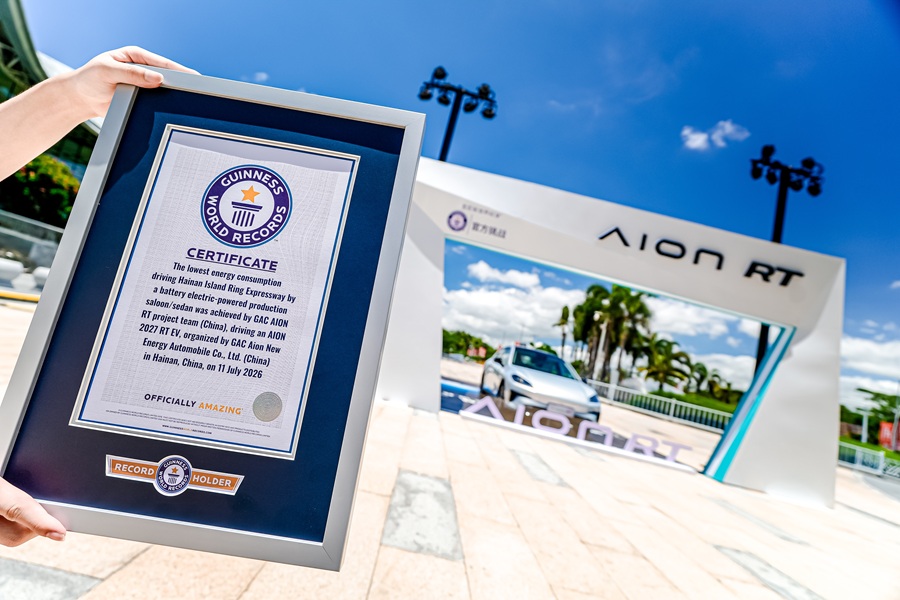 The Quark Electric Drive 2.0 is deployed across models including the AION N60, 2027 AION RT, and 2027 AION i60, reducing vehicle energy consumption by 4 per cent and adding 30 to 50 km of driving range without altering battery capacity. In testing on the Hainan Island Ring Expressway, the 2027 AION RT recorded consumption of 8.571 kWh/100 km to set a Guinness World Record for ‘Lowest energy consumption driving Hainan Island Ring Expressway by a battery electric-powered production saloon/sedan’, while the 2027 AION i60 increased its range from 650 km to 700 km.
Building on electric drive research initiated in 2010, GAC plans to deploy the technology across HYPTEC, AION and AISTALAND models, extend amorphous alloys to transmissions and range extenders, and evaluate applications for robots and aircraft.
Volvo Cars Trains Hexagon Robotics Humanoids At Ghent Manufacturing Plant
- By MT Bureau
- November 27, 2026
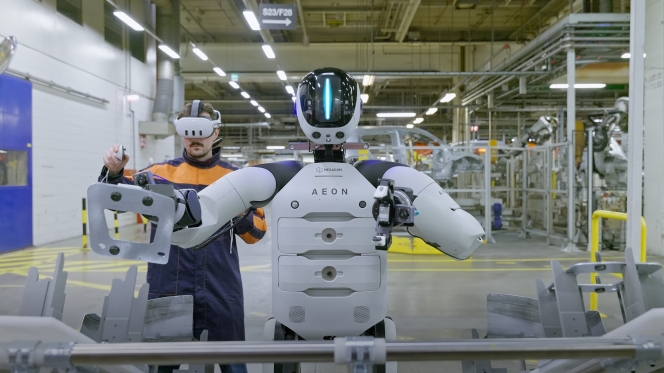
Swedish luxury car brand Volvo Cars has deployed AEON humanoid robots at its manufacturing plant in Ghent, Belgium, to train and validate the machines on tasks ahead of a factory pilot in the half of 2027 and production deployment from mid-2027.
Working alongside the Robotics division of technology group Hexagon, Volvo Cars' team uses imitation learning to teach the units to copy workflows, beginning with placing components into two fixtures before progressing to handling parts, navigating the production area and interacting with the plant's automation systems.
The humanoids measuring 1.65 metres in height and weighing 60 kilograms is part of the AEON platform, which uses cameras and sensors to map its surroundings and handle components, moving on wheels at speeds up to 2.4 metres per second while carrying payloads of up to 10 kilograms.
Unlike robot arms restricted to locations, the platform is designed to integrate alongside employees and automation equipment across manufacturing applications.
Magnus Nilsson, Chief Manufacturing Officer, Volvo Cars, said, “AEON’s humanoid design means it can fit into our production as it is today, alongside our teams and existing automation. Our aim is for humanoid robots to take on some of the most physically demanding tasks and help make work more ergonomic for our people.”
Arnaud Robert, President, Hexagon Robotics, said, “The purpose of humanoid robotics is to deliver business value to our customers. Working closely with Volvo Cars’ teams allows us to ensure AEON performs real-world tasks that support their manufacturing process.”
- Montra Electric
- Murugappa Group
- Rhino 5538 EV
- Jalaj Gupta
- TI Clean Mobility
- PM E-DRIVE
- Navneet Sethi
- IPL Tech
Montra Electric Rolls Out 1,000th Rhino Electric Heavy-Duty Truck
- By MT Bureau
- November 20, 2026
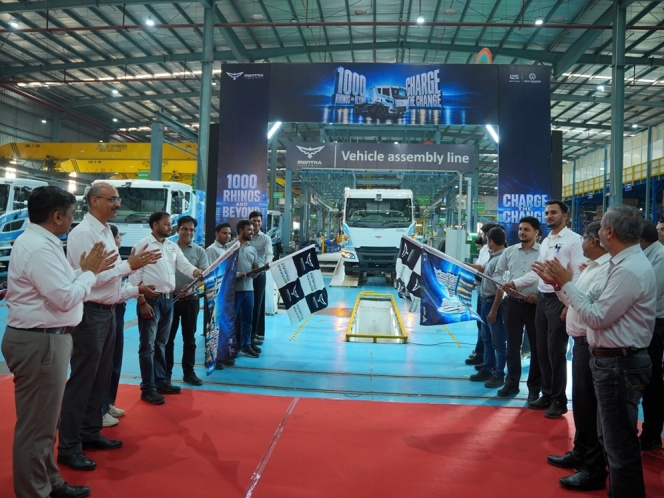
Montra Electric has rolled out its 1,000th Rhino electric truck from its Manesar facility, becoming the first Indian brand to reach the mark. The deployed Rhino fleet has recorded more than 36 million kilometres, avoided over 6.5 million kg of carbon dioxide emissions and saved operators over INR 700 million in running costs.
The Rhino 5538 EV received certification under the PM E-DRIVE scheme in January 2026, providing incentives of up to INR 960,000 per unit. Montra Electric is focusing on scaling deployments, expanding customer partnerships and increasing electric commercial vehicle adoption across India.
Jalaj Gupta, Managing Director, Montra Electric (TI Clean Mobility), said, “When we started, there was no electric heavy truck market in India to build on. We had to prove, load after load, that these trucks could do the job and pay for themselves. With policy support such as PM E-DRIVE, and customers coming back to expand their fleets, electric heavy trucking in India has reached a tipping point. Our first 1,000 Rhinos belong as much to our customers and partners as they do to us. They backed electric trucks early, and the next 1,000 will be built on that trust.”
Navneet Sethi, CEO-eM&HCV, Montra Electric (IPL Tech), said, “The 1,000th Rhino roll-out marks an important milestone in demonstrating the commercial viability of electric heavy-duty trucking in India. Our trucks have demonstrated their ability to deliver on the parameters that matter the most to fleet operators – performance under load, operational uptime, range and cost efficiency, across demanding applications and long-haul routes. The growing number of repeat orders reflects customer confidence in the product and its ability to deliver tangible business value. Our next priority is to build on this momentum, deepen customer partnerships and expand the footprint of electric heavy-duty trucks across key applications and markets in India.”
Prime Industries, Wahi Sons Ink MoU For Precision Component Manufacturing
- By MT Bureau
- November 20, 2026
Prime Industries has signed a Memorandum of Understanding with Wahi Sons for technical collaboration, component development and manufacturing.
Under the agreement, both companies will develop, manufacture and commercialise a precision-engineered component by combining Prime Industries' product and engineering capabilities with Wahi Sons' manufacturing infrastructure.
Prime Industries will serve as the technical and product-development partner, leading technology and product development, engineering inputs, technical supervision and the selection, installation and commissioning of machinery and equipment.
On the other hand, Wahi Sons will act as the manufacturing partner by providing factory space, with a manufacturing line established inside Wahi Sons' existing plant within a segregated area. The agreement follows research and development expansion for components serving the nuclear and defence sectors.
Deepak Handa, Director, Prime Industries, said, “This partnership is an important step in building Prime Industries into a technology-led precision engineering company. By pairing our product and technical expertise with Wahi Sons' proven manufacturing base, we can bring a specialised component to production efficiently and to the highest quality standards. It reflects the direction our shareholders approved in October, and we see it as the foundation for further opportunities in strategic, high-precision segments.”
Gautam Jain, Managing Director of Wahi Sons, said, “Wahi Sons has spent over three decades building precision manufacturing capabilities for leading OEMs. This collaboration with Prime Industries allows us to put that infrastructure and experience to work on a specialised, high-value product, and to expand our presence in strategic precision segments.”

Comments (1)
ADD COMMENT