

- Mercedes-Benz
- electric vehicle
- passenger vehicle
- SUV
- Gelandwagon
- India
- launch
- 2025
- 2024
- future
- santosh iyer
- lance bennett
An Electric Mercedes-Benz G-Wagon Reflects A Journey Into The Future
- By Gaurav Nandi
- January 09, 2025
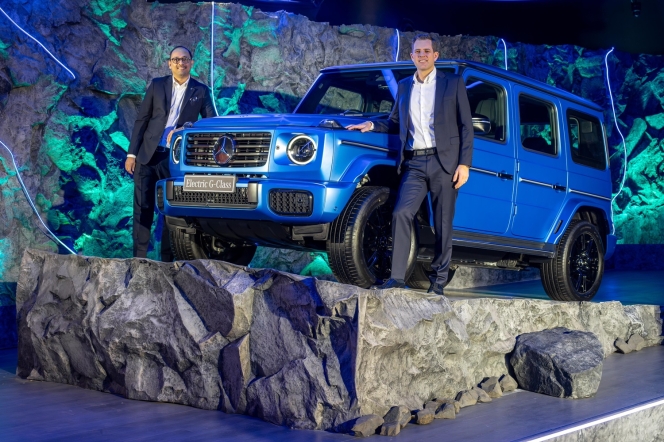
The iconic Mercedes Gelandewagen, popularly known as G-Class, will pack a robust electric powertrain under the hood, informed Mercedes-Benz India Chief Executive Officer Santosh Iyer during the company’s fourth Annual Press Conference.
Unveiling the new G 580, Vice President Sales and Marketing Lance Bennett said, “The electric Gelandewagen is powered by the EQ technology and more. Electrifying this iconic vehicle presented several challenges as we needed to preserve its signature design and legendary off-road capabilities. Integrating EV components required us to develop a unique drive system featuring four individual electric motors.”
“At the rear, the motors are connected to form a rigid axle, ensuring exceptional off-road traction. The axle is equipped with a two-speed gearbox, enabling gear reduction for low-range, off-road performance. The G 580 stands apart from other G-Class models with its raised bonnet and rear wheel arch air curtains. These elements are seamlessly integrated to improve aerodynamics and acoustic performance.”
The electric variant delivers 587 horsepower and an astounding 1,164 Nm of torque, courtesy of its four electric motors. It accelerates from 0 to 100 km/h in just 4.7 seconds. Powered by a large 116 kWh battery and an intelligent recuperation system, it offers a WLTP range of up to 473 kilometers. Fast charging from 10 percent to 80 percent takes only 32 minutes.
Like every G-Class, the G 580 underwent the legendary Schöckl test, completing the grueling trail 336 times. This symbolic number guarantees every G-Class meets the highest standards of durability, reliability and off-road capability, earning it the Schöckl badge displayed on the B-pillar.
“To put this into perspective, the G 580 can complete the Schöckl trail 13 times on a single charge. Its electric drivetrain and low-range gearbox make it the most capable off-roader in its class. It can climb inclines of up to 45 degrees—even in reverse—and wade through water up to 850 mm deep,” added Bennett.
“Engineers have designed a water- and dust-proof battery pack, encased within the ladder chassis. The innovative four-motor drive system also allows for unique off-road maneuvers, enabling the vehicle to pivot on the spot by up to 720 degrees. This feature ensures that if you reach a dead end on a trail, you can turn around with ease.
Another highlight is the G-Steer function, which tightens the turning circle off-road by braking the inner wheel to slide the rear end around sharp bends,” revealed the executive.
Inside, the electric off-road cockpit and Dynamic Select system offer a range of driving modes. In Rock Mode, the G 580 crawls effortlessly in low range with speed adjustable via steering wheel paddles, making hill ascents and descents seamless.
The G 580 is available in a special Edition 1 model, offered in five colors including the exclusive Manufaktur South Sea Blue Magno. This edition features AMG line styling, the night package and 20-inch black alloy wheels. Additional details include blacked-out door handles with keyless go and blue brake calipers.
The G580 is priced at INR 30 million (ex-showroom, pan-India). This icon has already garnered electrifying demand and is sold out until Q3 2025! Bookings and deliveries for the G 580 will start in Q4 2025, noted a company official.
EQS 450 SUV
The company also launched its 5-Seater EQS 450 SUV during the event. Commenting on the same, Iyer noted, “The EQS 450 SUV builds on the success of the EQS 580, which we launched a few months ago. The EQS 450 caters to customers seeking cutting-edge technology, generous space, and sustainability at its core.”
“We launched the EQS 580 in September last year in a 7-seater configuration. The response was phenomenal. We received feedback that there was a demand for both 7-seater and 5-seater variants. The EQS 580 exceeded all expectations, selling out within three months of its launch. Deliveries for the 7-seater will resume in April 2025, while the 5-seater variant is set to roll out soon. The EQS SUV line-up now includes two configurations: the 7-seater EQS 580, ideal for larger families with pets and frequent travel needs and the 5-seater EQS 450, designed for nuclear families who still want generous luggage space,” he added.
The EQS 450 comes in the electric art line, which distinguishes it from the 7-seater variant. It boasts features like energising air control, advanced luggage capacity and an impressive WLTP-certified range of 820 kilometers, making it one of the longest-range electric SUVs.
It is priced at INR 12.8 million(ex-showroom). Deliveries will begin in February 2025.
Look back into 2024
It was reported that Mercedes-Benz India achieved its best-ever sales of 19,565 units during the January to December 2024 period, representing a 12.4 percent increase compared to the 17,408 units sold in the same period in 2023. Growth during the second half of 2024 (July to December) was noted to be a strong 16 percent.
The fastest-growing segment was top-end vehicles (TEVs), which experienced a 30 percent year-to-date (YTD) growth. It was also highlighted that one out of every four Mercedes-Benz cars sold in India in 2024 was a TEV.
Battery electric vehicles (BEVs) also marked its best-ever sales with a 94 percent YTD growth, achieving over 6 percent sales penetration. It was noted that Mercedes-Benz introduced four new BEVs in 2024 namely, EQA 250+, EQB SUV, EQS SUV 580 and the Maybach EQS SUV. This expansion of the BEV portfolio reportedly generated significant customer interest and reinforced Mercedes-Benz’s leadership in the luxury BEV segment by achieving its highest-ever annual BEV sales.
Moreover, the company achieved the sale of 200,000 cars in India since 1994. It was mentioned that of these, 100,000 cars were sold in just the last six years (2019–2024).
Mercedes-Benz Financial Services also achieved a portfolio of INR 10 billion in India with over 50 percent penetration. It was stated that every second Mercedes-Benz retailed in India was financed through the service, which also attained an 80 percent insurance penetration rate.
Road Ahead
The company revealed plans for the launch of eight new models in 2025 with most focusing on BEVs and TEVs to offer consumers the latest products and cutting-edge intuitive technology. The company was also reported to expand its luxury network reach in 2025, planning 20 new luxury outlets supported by a commitment of over INR 4.5 billion in investment from franchise partners over three years.
It was stated that the focus on TEVs extended beyond cars with plans to partner for dedicated stores selling Maybach collection items, the first of which would be opening in Bengaluru.
Mercedes-Benz India announced a collaboration with Tata Cliq Luxury to allow enthusiasts to purchase or gift exclusive Mercedes-Benz collection items online through the ‘House of Mercedes-Benz’.
To mark the milestone of 200,000 vehicles on Indian roads, Mercedes-Benz reportedly launched several corporate citizenship initiatives. The company committed INR 75 million to road safety initiatives aimed at reducing accidents and fatalities on highways like the ‘Samrudhhi Mahamarg’ and the ‘Nizamabad Corridor’ in Hyderabad.
Additionally, a new retail campaign was launched to celebrate the 200,000 milestone, offering exclusive event invitations to existing customers and a chance for a lucky new customer to attend the F1 race in Monaco.

Maruti Suzuki India Launches Victoris Aurum Edition To Mark Sales Milestone
- By MT Bureau
- October 24, 2026
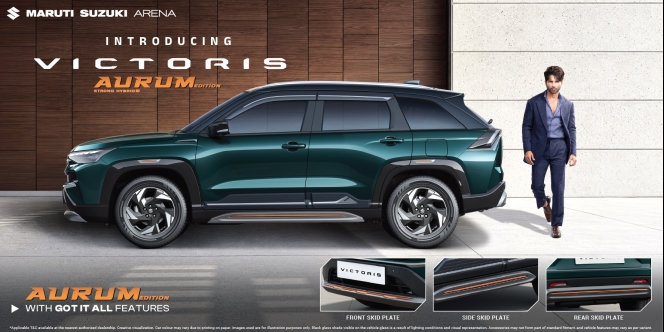
Maruti Suzuki India, the country’s largest carmaker, has introduced the Victoris Aurum Edition Strong Hybrid to mark the first anniversary of the Victoris SUV, featuring an accessory kit priced at INR 22,990.
The launch follows the model reaching sales of 100,000 and 150,000 units within its initial year of production. The Aurum Edition incorporates copper-coloured inserts on the front, side and rear skid plates, along with revised wheel arch trim.
On the outside, it gets chrome garnishes across the front grille, fenders, bumpers, body side mouldings and door visors. Interior additions comprise all-weather 3D cabin mats, a 3D boot mat and a trunk sill guard.
Furthermore, the company has partnered with actor Shahid Kapoor to lead the promotional campaign for the variant.
Partho Banerjee, Senior Executive Officer – Marketing and Sales, Maruti Suzuki India, said, "Conceptualised as a ‘Got it All’ SUV for today’s dynamic young go-getters who ‘want it all’, the Victoris has truly won the hearts of buyers. As we celebrate its first anniversary, it’s worth noting that the Victoris has become the fastest-selling PV to clock both the 150,000- and 100,000-unit sales milestones, going on to achieve the highest sales for any car in India during its 1st year of launch. Recognising these extraordinary achievements, we are introducing the Victoris Aurum Edition Strong Hybrid, with tasteful enhancements that are sure to grab eyeballs and make this festive season feel all the more special for our valuable customers. Our association with Shahid Kapoor, for the new Aurum Edition is also sure to complement the Victoris’ contemporary appeal."
Hyundai Bayon To Feature 69% High-Strength Steel Grade For Enhanced Safety
- By MT Bureau
- October 21, 2026
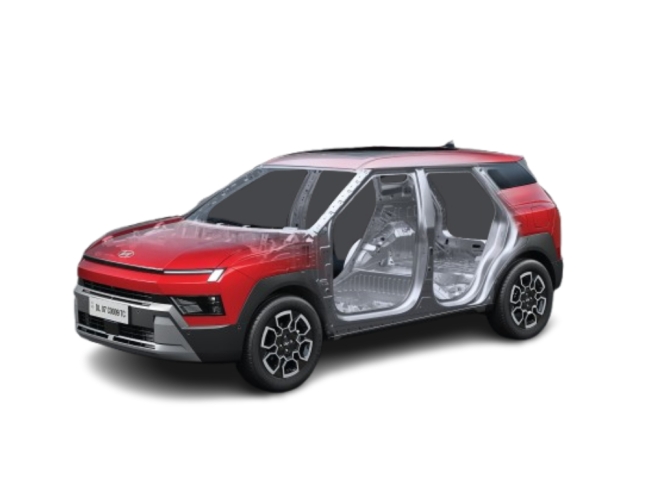
Hyundai Motor India, one of the leading passenger vehicle manufacturers, has detailed the safety specifications and platform architecture for its upcoming Bayon SUV model ahead of its official launch in India on 26 October 2026.
Built on the Global K Enhanced Platform, the Bayon utilises a body structure comprising of 69 percent high-strength steel grades, integrating hot-stamped components across the front apron, dashboard, rear floor and side reinforcements.
The vehicle incorporates Hyundai SmartSense Level 2 Pro ADAS, providing 23 driver assistance features supported by three radar units and 12 parking sensors. Over 35 safety features are fitted as standard across all variants, including six airbags, electronic stability control, hill-start assist control, a tyre pressure monitoring system (TPMS) and ISOFIX child seat anchors.
The Bayon will be powered by a 1.5-litre MPi four-cylinder petrol engine producing 84.4 kW (115 PS) and 143.8 Nm of torque, paired with a six-speed manual or an Intelligent Variable Transmission. Exterior options will span 10 colour configurations across monotone, dual-tone, and matte finishes.
Tarun Garg, Managing Director and Chief Executive Officer of Hyundai Motor India, said, "At Hyundai, we believe that true innovation is meaningful only when it enhances the everyday experiences of our customers. With the Hyundai BAYON, we have combined a robust body structure, advanced safety technologies, and intelligent driver assistance systems to deliver a comprehensive safety experience. From its reinforced chassis and high-strength steel construction to Hyundai SmartSense Level 2 Pro ADAS, the BAYON is engineered to inspire confidence not only in challenging situations, but throughout every journey. This reflects our commitment to delivering intelligent mobility solutions that are safe, connected, and progressive for modern India."
Mitsubishi Motors Launches All-New Pajero In Thailand Ahead Of Global Rollout
- By MT Bureau
- October 21, 2026
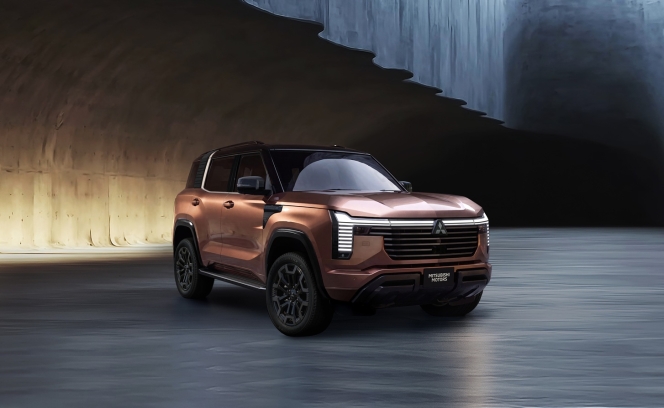
Japanese automotive major Mitsubishi Motors has commenced sales of the Pajero cross-country SUV in Thailand, serving as the initial market for the model’s international release.
The Pajero’s production takes place at the Laem Chabang facility operated by Mitsubishi Motors in Chonburi Province, which functions as a manufacturing hub for export operations.
Shipments to Australia and Japan are scheduled ahead of market releases in mid-December, followed by sequential introductions across approximately 100 countries and regions in the Middle East and Latin America starting in fiscal 2027.
The Pajero integrates four-wheel-drive capability with passenger car handling characteristics and positioning as a flagship offering.
Keisuke Kishiura, President and Chief Operating Officer, Mitsubishi Motors, said, "We are delighted to begin sales of the all-new Pajero in Thailand as the first market for its global rollout. Thailand is not only an important market for Mitsubishi Motors, but also a key hub for our production and exports. The all-new Pajero is a flagship model that embodies Mitsubishi Motors and is positioned among the top-tier cross-country SUVs in the Thai market. We will continue to deliver appealing products from Thailand to customers around the world and provide value that exceeds expectations."
Param Automotive Inaugurates Upgraded Mahindra Showroom In Ahmedabad
- By MT Bureau
- October 20, 2026
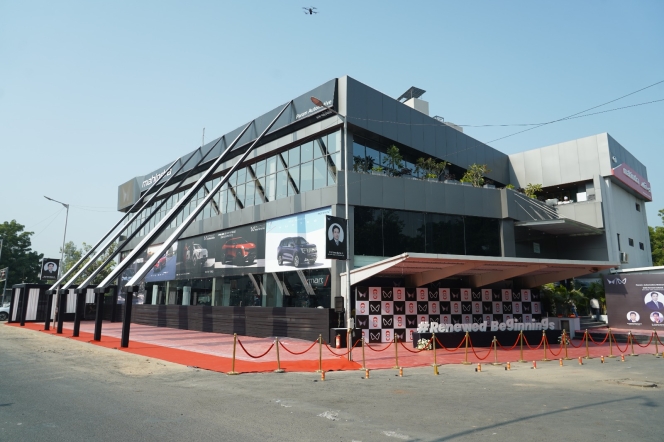
Param Automotive Group has inaugurated an upgraded dealership facility in Ahmedabad to mark its silver jubilee year.
Located at the site established in 2002, the facility spans 40,000 square feet and features display space for 18 vehicles.
The showroom includes customer lounges, delivery zones, accessory bays, test-drive areas and hospitality spaces to support vehicle sales and customer service operations.
Comments (1)
ADD COMMENT