

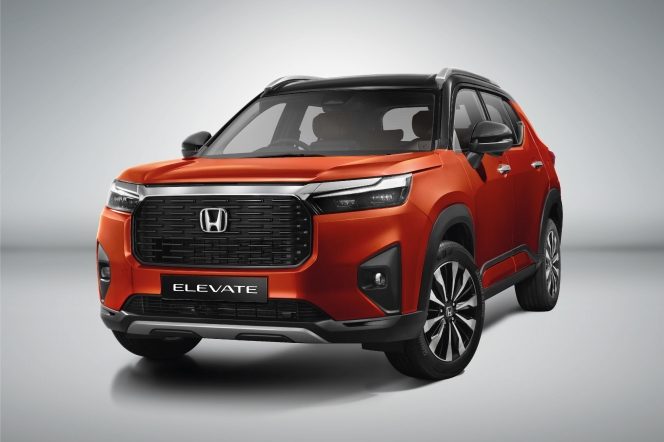
Honda Cars India Ltd. (HCIL) has unveiled its compact SUV – Honda Elevate – are teasing some its features and attributes for some time. Unveiled in India before anywhere else in the world, the Elevate will be produced in India and exported to other Honda markets in the world, underlining Honda’s operations at its plant in Rajasthan as an export hub for the Japanese automaker.
Developed on the grand concept of ‘Urban Freestyler’, the Elevate aims at customers with active lifestyles and a global mindset by blending cutting-edge aesthetics with functionality to create a visually stunning, incredibly versatile, comfortable and fun-to-drive SUV, according to company sources.
With bold and masculine exterior design with striking front face, sharp character lines and unique rear design, which signals at clever packaging, the Elevate at front employs Honda's signature grille, which is flanked by sleek LED headlights. The sides are emphasised by pronounced wheel arches with plastic cladding, which runs along the bottom of the vehicle and smart looking diamond cut 17-inch diameter alloy wheels. The rear has a distinctive tailgate design and LED taillights.
Developed by Honda R&D Asia Pacific centre in Thailand and the R&D team in India, which specifically worked on understanding potential target customers through extensive market surveys reflecting three main factors such as stylish exterior safety and comfort.
The modern interior with a two-tone colour scheme is laced with a stylish meter with premium feel welcome graphic animation. The 7-inch high-definition full colour TFT multi-information display shows information such as fuel consumption, trip meter, outside temperature, G-Meter and a clock. There is a provision to customise the operations, including the meter set up, keyless access, lighting set up, door, and Honda ‘Sensing’.
The 10.25-inch HD resolution screen at the top centre of the dashboard can be connected with various types of smart phones via wireless Apple CarPlay, Android Auto, Weblink, Bluetooth and USB. As an infotainment system interface, the screen is completed by a sub-screen, which provides access to some additional features such as the ASVM (Assistant Side View Monitor), ARVM (Assistant Rear View Monitor), Clock, Calendar, Compass, Customisable Picture, and shortcuts to commonly used Infotainment settings.
Measuring 4312 mm in length, 1790 mm in width and 1650 mm in height, the Elevate has a wheelbase of 2650 mm. As per the dimensions and the wheelbase the compact SUV is comparable to the likes of Hyundai Creta, Kia Seltos and Maruti Grand Vitara. Spacious enough to seat five people, the vehicle offers a cargo space of 458-litre. Ground clearance is a good 220 mm.
Using higher tensile steel application ratio to realise a ‘smooth and connected’ structure, which is lightweight, offers enhanced collision safety performance, best body balance, better stability and handling, the Elevate is powered by a 121 PS 1.5-litre i-VTEC DOHC petrol engine with VTC. Producing a peak torque of 145 Nm, the compact SUV is equipped with a 6-speed manual transmission or a 7-speed CVT (Continuously Variable Transmission).
A front-wheel drive design, the Elevate features 6 airbags, ABS with EBD and brake assist, vehicle stability assist with agile handling assist, hill start assist, Honda lane watch camera, light crash performance, pedestrian protection, multi angle rear camera, emergency stop signal, Isofix compatible rear side seats with lower anchorages and top tether, and an immobiliser with anti-theft alarm.
Toshio Kuwahara, Head of Regional Unit (Asia & Oceania), Honda Motor Co., Ltd. and President and CEO, Asian Honda Motor Co., Ltd. said, “Today’s World Premiere of the all-new Elevate is a stamp of commitment of Honda’s plans and aspirations for the country. The exports from India to several regions across the globe are growing continuously every year. With high level of quality standards to deliver products that exceed expectations of both local and worldwide customers, India has become one of the most important export hubs for Honda. Moving forward to 2050, Honda strives to realise carbon neutrality and zero traffic collision fatalities involving our motorcycles and automobiles. To achieve this target, Honda aims to increase the sales ratio of Battery Electric Vehicles and Fuel Cell Electric Vehicles sales to 100 percent globally by 2040, including India. For safety, we continue enhancing advanced technologies including the expansion of Honda ‘Sensing’ around the world and strengthening our safety education to reduce traffic accidents.”
Takuya Tsumura, President & CEO, Honda Cars India Ltd. said, “With the unveiling of the All New Elevate, we embark on a new journey with Honda's strong product offering in the booming SUV segment in India. Honda enjoys strong leadership and popularity in sedan segments. There has been very high anticipation amongst Honda loyalists and overall market, who have been eagerly waiting for the new model. We are confident that the Elevate will further strengthen the bond with our esteemed customers and soon become our strong third pillar of business besides the City and Amaze. We have a robust product strategy to strengthen our premium play in the market and Elevate is first model among the 5 new SUVs that will be launched by Honda in India by 2030.” “Aligning with our global vision towards carbon neutrality by focusing on electrified powertrains, we will launch Honda’s first Battery Electric Vehicle (BEV) based on this SUV within next 3 years in India,” he added.
Maruti Suzuki India Launches Victoris Aurum Edition To Mark Sales Milestone
- By MT Bureau
- October 24, 2026
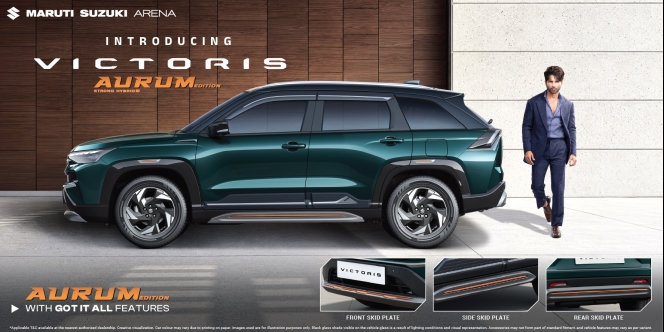
Maruti Suzuki India, the country’s largest carmaker, has introduced the Victoris Aurum Edition Strong Hybrid to mark the first anniversary of the Victoris SUV, featuring an accessory kit priced at INR 22,990.
The launch follows the model reaching sales of 100,000 and 150,000 units within its initial year of production. The Aurum Edition incorporates copper-coloured inserts on the front, side and rear skid plates, along with revised wheel arch trim.
On the outside, it gets chrome garnishes across the front grille, fenders, bumpers, body side mouldings and door visors. Interior additions comprise all-weather 3D cabin mats, a 3D boot mat and a trunk sill guard.
Furthermore, the company has partnered with actor Shahid Kapoor to lead the promotional campaign for the variant.
Partho Banerjee, Senior Executive Officer – Marketing and Sales, Maruti Suzuki India, said, "Conceptualised as a ‘Got it All’ SUV for today’s dynamic young go-getters who ‘want it all’, the Victoris has truly won the hearts of buyers. As we celebrate its first anniversary, it’s worth noting that the Victoris has become the fastest-selling PV to clock both the 150,000- and 100,000-unit sales milestones, going on to achieve the highest sales for any car in India during its 1st year of launch. Recognising these extraordinary achievements, we are introducing the Victoris Aurum Edition Strong Hybrid, with tasteful enhancements that are sure to grab eyeballs and make this festive season feel all the more special for our valuable customers. Our association with Shahid Kapoor, for the new Aurum Edition is also sure to complement the Victoris’ contemporary appeal."
Hyundai Bayon To Feature 69% High-Strength Steel Grade For Enhanced Safety
- By MT Bureau
- October 21, 2026
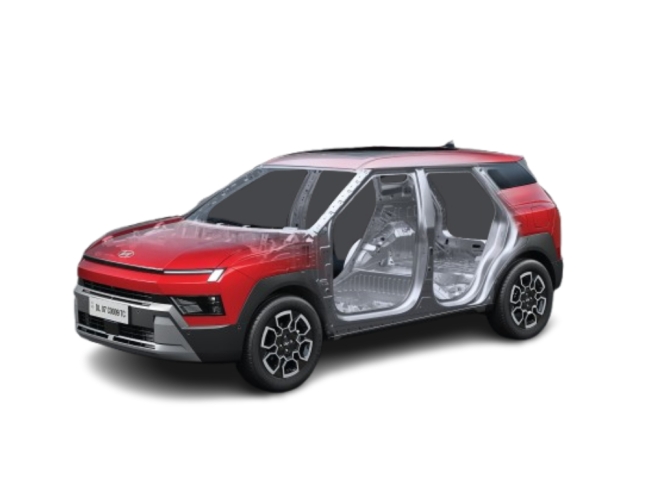
Hyundai Motor India, one of the leading passenger vehicle manufacturers, has detailed the safety specifications and platform architecture for its upcoming Bayon SUV model ahead of its official launch in India on 26 October 2026.
Built on the Global K Enhanced Platform, the Bayon utilises a body structure comprising of 69 percent high-strength steel grades, integrating hot-stamped components across the front apron, dashboard, rear floor and side reinforcements.
The vehicle incorporates Hyundai SmartSense Level 2 Pro ADAS, providing 23 driver assistance features supported by three radar units and 12 parking sensors. Over 35 safety features are fitted as standard across all variants, including six airbags, electronic stability control, hill-start assist control, a tyre pressure monitoring system (TPMS) and ISOFIX child seat anchors.
The Bayon will be powered by a 1.5-litre MPi four-cylinder petrol engine producing 84.4 kW (115 PS) and 143.8 Nm of torque, paired with a six-speed manual or an Intelligent Variable Transmission. Exterior options will span 10 colour configurations across monotone, dual-tone, and matte finishes.
Tarun Garg, Managing Director and Chief Executive Officer of Hyundai Motor India, said, "At Hyundai, we believe that true innovation is meaningful only when it enhances the everyday experiences of our customers. With the Hyundai BAYON, we have combined a robust body structure, advanced safety technologies, and intelligent driver assistance systems to deliver a comprehensive safety experience. From its reinforced chassis and high-strength steel construction to Hyundai SmartSense Level 2 Pro ADAS, the BAYON is engineered to inspire confidence not only in challenging situations, but throughout every journey. This reflects our commitment to delivering intelligent mobility solutions that are safe, connected, and progressive for modern India."
Mitsubishi Motors Launches All-New Pajero In Thailand Ahead Of Global Rollout
- By MT Bureau
- October 21, 2026
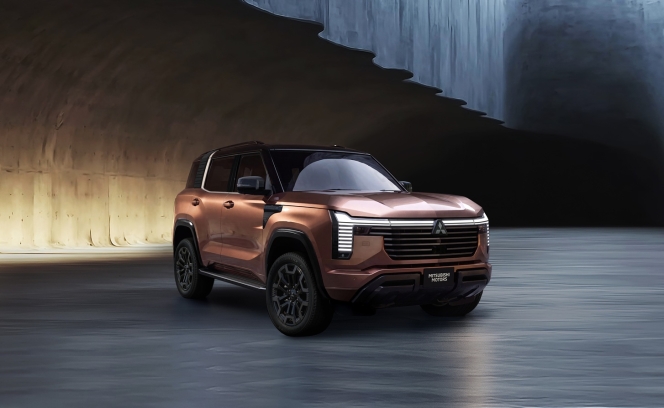
Japanese automotive major Mitsubishi Motors has commenced sales of the Pajero cross-country SUV in Thailand, serving as the initial market for the model’s international release.
The Pajero’s production takes place at the Laem Chabang facility operated by Mitsubishi Motors in Chonburi Province, which functions as a manufacturing hub for export operations.
Shipments to Australia and Japan are scheduled ahead of market releases in mid-December, followed by sequential introductions across approximately 100 countries and regions in the Middle East and Latin America starting in fiscal 2027.
The Pajero integrates four-wheel-drive capability with passenger car handling characteristics and positioning as a flagship offering.
Keisuke Kishiura, President and Chief Operating Officer, Mitsubishi Motors, said, "We are delighted to begin sales of the all-new Pajero in Thailand as the first market for its global rollout. Thailand is not only an important market for Mitsubishi Motors, but also a key hub for our production and exports. The all-new Pajero is a flagship model that embodies Mitsubishi Motors and is positioned among the top-tier cross-country SUVs in the Thai market. We will continue to deliver appealing products from Thailand to customers around the world and provide value that exceeds expectations."
Param Automotive Inaugurates Upgraded Mahindra Showroom In Ahmedabad
- By MT Bureau
- October 20, 2026
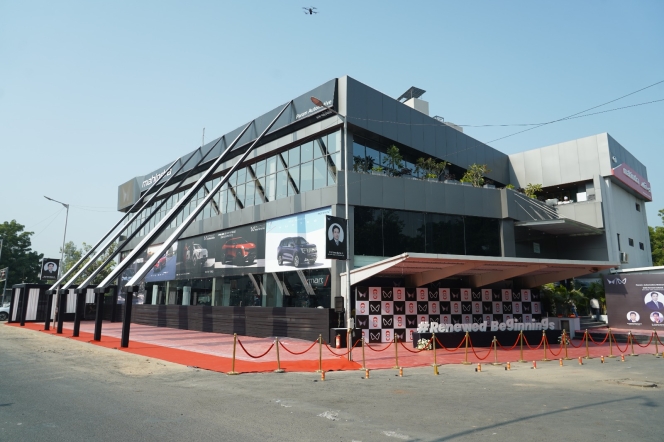
Param Automotive Group has inaugurated an upgraded dealership facility in Ahmedabad to mark its silver jubilee year.
Located at the site established in 2002, the facility spans 40,000 square feet and features display space for 18 vehicles.
The showroom includes customer lounges, delivery zones, accessory bays, test-drive areas and hospitality spaces to support vehicle sales and customer service operations.
Comments (0)
ADD COMMENT