

2024 Altair Enlighten Award Winners Are From Diverse Fields
- By MT Bureau
- August 07, 2024
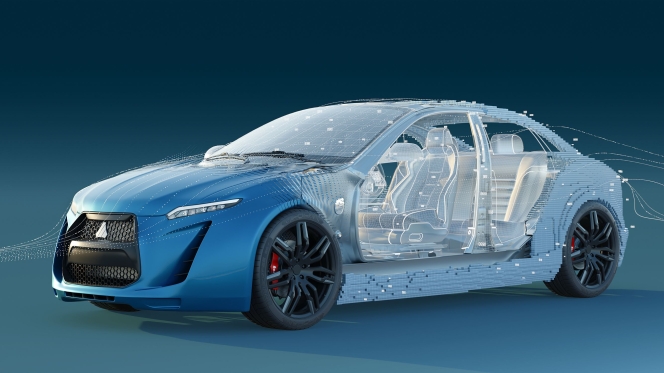
Altair has announced the winners of the 2024 Altair Enlighten Award, which is presented by it in association with the Center for Automotive Research (CAR).
The award winners are companies with diverse backgrounds such as DuPont, BMW M GmbH, Dow Inc., Toyota, General Motors, CompositeEdge GmbH, WEAV3D, Braskem and Clemson Composites Center and reflect sustainability and light weighting advancements that successfully reduce carbon footprint, mitigate water and energy consumption and leverage material reuse as well as recycling efforts.
The prestigious Enlighten Award have a 12-year history and have become a coveted prize for automotive industry’s most forward-thinking companies, according to Altair.
Recognised by EV Magazine as a top 10 sustainability award in 2024, the award looks at products, processes and organisations that are ushering in the next generation of groundbreaking automotive technology. “We are thrilled to once again recognise the organisations creating a more sustainable future. This year’s winners can consider themselves the best innovators meeting those challenging targets,” said James R. Scapa, Founder and Chief Executive Officer, Altair.
Alan Amici, President and Chief Executive Officer, Center for Automotive Research, averred, “We cannot wait to recognize this year’s winners, and we are once again thrilled to present this award in conjunction with Altair and the rest of our valued partners.”
Image for representative purpose only.
- BatX Energies
- Rocklink
- Neodymium
- Praseodymium
- Dysprosium
- Terbium
- Gadolinium
- Holmium
- Utkarsh Singh
- Leonard Ansorge
- recycling
BatX Energies, Germany’s Rocklink To Establish Integrated Rare Earth Magnet Recycling & Refining Ecosystem In India
- By MT Bureau
- July 18, 2025

BatX Energies, a critical material recovery and battery recycling company, has signed a Memorandum of Understanding with Rocklink, a Germany-based rare earth element (REE) and specialty metal recycling company to establish India’s first integrated rare earth magnet recycling and refining ecosystem.
The partners state that the collaboration is an outcome of the increasing alignment under the EU–India Trade and Technology Council (TTC), which will focus on fostering sustainable and secure critical mineral value chains between Europe and India.
As per the understanding, Rocklink India and BatX have initiated, what they claim is India’s first lithium-ion battery and permanent magnet recycling cluster in Sikandrabad, Uttar Pradesh. The idea is to build a robust, scalable and environmentally responsible rare earth magnet recycling ecosystem in India.
As per the understanding, Rocklink will deploy its proprietary Magcycle reverse logistics system across India, creating a traceable collection network for end-of-life permanent magnets, including NdFeB, SmCo and AlNiCo, sourced from motors, electronics and industrial waste.
The partnership will also jointly develop and commercialise advanced solvent extraction (SX) technologies to efficiently separate and purify high-value rare earth elements such as Neodymium, Praseodymium, Dysprosium, Terbium, Gadolinium and Holmium.
The aim is to commission India’s first fully integrated rare earth refining facility, designed to meet zero-liquid-discharge (ZLD) standards and export compliance benchmarks.
They will co-develop and file patents for the technologies in both India and Europe, creating a joint intellectual property portfolio.
The collaboration aims to enable a domestic rare earth supply chain in India while simultaneously strengthening Europe’s access to sustainable, transparent and circular sources of critical materials.
Utkarsh Singh, CEO, BatX Energies, said, “This partnership marks a defining moment in India's journey toward rare earth self-reliance. We are proud to lead this initiative alongside Rocklink and to carry forward the vision outlined in the EU TTC for building circular and transparent critical mineral value chains between India and Europe.”
Leonard Ansorge, Director, Rocklink, said, “Rocklink is committed to establishing vertically integrated long-loop recycling solutions to support government efforts to establish a functional rare earth magnet supply chain in India. Our alliance with BatX brings together our materials and refining expertise with BatX's innovative and practical approaches on refining to deliver tangible results in short development cycles.”
Parkobot Raises INR 21 Million in Seed Round
- By MT Bureau
- July 18, 2025

Parkobot, a startup offering an ‘Airbnb for parking’ using Internet of Things (IoT) smart barriers, has secured INR 20.9 million in seed funding led by Inflection Point Ventures and participation from high-net-worth individuals (HNIs).
The start-up aims to use the funds towards expanding infrastructure, new markets, strengthen backend and increase product portfolio.
Parkobot enables owners to monetise private parking spaces hourly. A mobile app provides real-time, location-based booking. The platform features an in-house tech stack, scalable IoT devices and automation.
Mitesh Shah, Co-Founder, Inflection Point Ventures, said, “Urban parking is a huge challenge facing today’s cities. Poor planning and lack of proper parking spaces lead to encroachment on roads, illegal parking and congestion. However, Parkobot is driving the change by bringing in technology and smart parking systems that provide real-time availability of parking spaces and making underutilised private parking spaces available to the public.”
At present, Parkobot operates in a market with a global total addressable market (TAM) of USD 114 billion and an Indian TAM of USD 9.5 billion, growing at 6.5 percent CAGR. In stealth mode, the startup has deployed spots at key locations.
Amrit Choudhury, Founder, Parkobot, said, “Parkobot envisions decongesting India’s streets by utilising underutilised private parking spaces, transforming them into revenue-generating assets via our IoT-enabled Parkobot barrier and app. Our goal is to create cleaner skies, less traffic congestion and seamless urban mobility for all.”
The start-up claims to have over 20,000 monthly bookings and uses a proprietary Parking Management System (PMS), smart boom barriers and pre-booking to boost parking revenue and reduce manual intervention.
- Ministry of Heavy Industries
- Narendra Modi
- Automotive Mission Plan 2047
- AMP 2047
- Viksit Bharat
- H D Kumaraswamy
- Dr Hanif Quereshi
- SIAM
- ACMA
- CII
- FICCI
India Begins Work on Automotive Mission Plan 2047
- By MT Bureau
- July 17, 2025
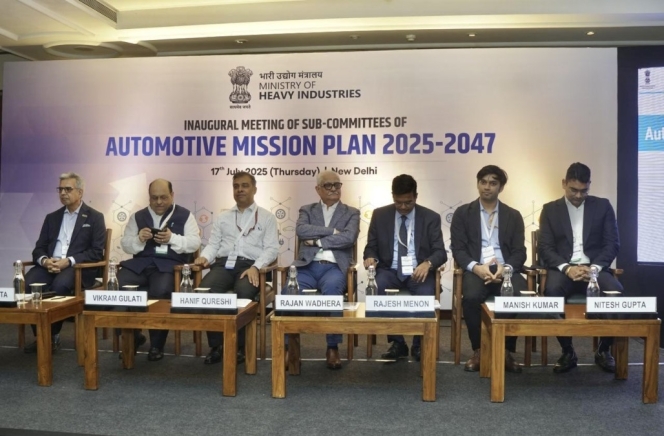
The Ministry of Heavy Industries, Government of India, has begun drafting the Automotive Mission Plan 2047 (AMP 2047) aligning with the ‘Viksit Bharat @2047’ vision under the leadership of Prime Minister Narendra Modi and guidance of Minister for Heavy Industries and Steel H D Kumaraswamy.
AMP 2047 aims to build on earlier Automotive Mission Plans, which supported the automotive sector's expansion through collaboration among stakeholders. The new plan seeks to improve innovation, global competitiveness and sustainable development. The goal is for India to be a global automotive leader by 2047.
The first meeting of the AMP 2047 Sub-Committees took place to set out objectives and a framework. Dr. Hanif Qureshi, Additional Secretary, MHI, spoke about the plan's importance. He stated, “The vision for 2047 is not an aspiration but a strategic roadmap backed by concrete targets for sector growth, exports, and industry advancement. We must think beyond specific technologies or companies and focus on India’s global standing in 2047, aiming to increase our share in global automotive trade through innovation and quality.”
Representatives from several ministries attended the meeting, including the Ministry of Power, Ministry of Road Transport and Highways, Ministry of Commerce, Ministry of Petroleum and Natural Gas, DPIIT and the Ministry of Environment Forest and Climate Change. Industry bodies such as SIAM, ACMA, CII and FICCI were also present, along with academic institutions, research think tanks and testing agencies. This marks an industry-led effort to shape AMP 2047.
AMP 2047 intends to bring together the views of stakeholders, including Original Equipment Manufacturers (OEMs), auto component makers, policymakers, academia and end users. It will address matters like technological advancements and charging infrastructure. Seven Sub-Committees, made up of experts from government, industry and academia, will guide the plan's development, with targets for 2030, 2037 and 2047.
The Ministry, under the guidance of Minister for Heavy Industries and Steel H D Kumaraswamy, is committed to building a self-reliant, innovative and sustainable automotive ecosystem. Further Sub-Committee meetings will gather ideas and data for presentation to the Apex Committee, chaired by Kamran Rizvi, Secretary, Ministry of Heavy Industries.
- Continental
- Bengaluru Metropolitan Transport Corporation
- BMTC
- IIT Delhi
- Raised Lines Foundation
- OnBoard Visually Impaired Passengers
Continental Collaborates With BMTC To Expand ‘OnBoard’ Solution For Visually Impaired
- By MT Bureau
- July 15, 2025
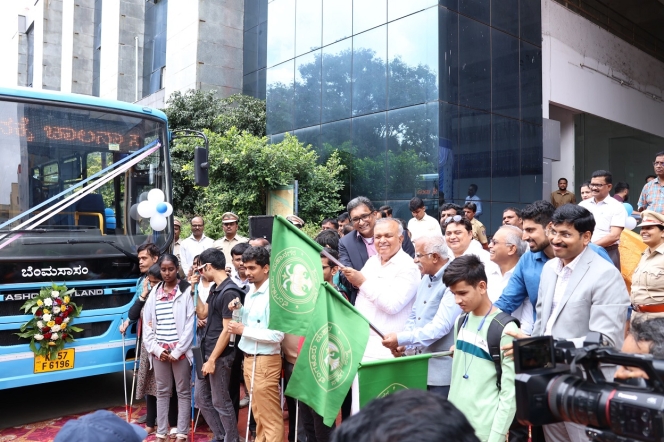
Continental, a global technology company, has partnered with the Bengaluru Metropolitan Transport Corporation (BMTC) to scale up OnBoard, an innovative solution designed to enhance mobility for visually impaired passengers. This initiative, launched in 2023 under Continental’s CSR programme Conscience, was developed in collaboration with IIT Delhi and the Raised Lines Foundation (RLF). The technology assists visually impaired individuals in safely boarding buses by providing real-time audio cues.
Following a successful pilot on 25 BMTC buses, the project has now expanded to an additional 100 buses, with plans to equip 500 buses across Bengaluru. The announcement was made during a press conference at the BMTC Central Office, attended by Karnataka’s Transport Minister, Ramalinga Reddy.
OnBoard was initially developed at IIT Delhi with support from the Ministry of Electronics and Information Technology (MeitY) and the Department of Science and Technology (DST). The technology was later transferred to RLF, an IIT Delhi-incubated nonprofit. The system uses bus-mounted speakers to announce route numbers and guide passengers to entry doors, ensuring a seamless boarding experience.
So far, installations have been completed on the 401K and 401R routes, with the next phase set to begin in mid-July. Production of additional units is underway, with full implementation expected by August 2024. Extensive field testing conducted by RLF and Enable India in Bengaluru confirmed the device’s effectiveness under various weather conditions, including rain, heat and dust while maintaining stable connectivity.
The launch event featured a live demonstration and media interactions, emphasising the importance of public-private partnerships in advancing inclusive mobility solutions. Continental and BMTC’s collaboration highlights a shared commitment to making public transportation accessible for all.
Prashanth Doreswamy, President and CEO, Continental, said, “At Continental, we believe that mobility must be inclusive and accessible, it should lie at the very core of innovation. Therefore, through our CSR initiative, we aim to empower every individual with the freedom of movement. Technology has opened up a world of possibilities, and this is just a steppingstone. As a technology company, we see it as our responsibility to help shape the future of mobility, which is not just connected, autonomous, shared and electric but also inclusive. We are proud to work with BMTC in supporting the vision of a more connected and accessible Bengaluru.”
Ramachandran R, Managing Director, Bengaluru Metropolitan Transport Corporation (BMTC), said, “This project is a flagship initiative for inclusive urban mobility in Bengaluru. BMTC recognises that OnBoard is a crucial step towards making the city’s public transport system more accessible and inclusive, bringing it on par with other leading global cities. At BMTC, we are fully committed to this initiative and are aligning all internal efforts to ensure its smooth and timely deployment across our fleet.”
Prof M Balakrishnan, Honorary Professor, IIT Delhi and Chairman, Raised Lines Foundation, said, “Industry-academia collaboration has always been crucial while addressing any real-world challenges, and the OnBoard solution is a testament to that. Its deployment across the BMTC network will allow visually impaired individuals to navigate public transport. At IIT Delhi, we are excited and very proud to see a technology we have contributed to making such a meaningful difference in people’s lives, bringing the benefits of inclusive design to the heart of urban mobility. At Raised Lines Foundation, our mission has been empowerment of persons with visual impairment by providing access to inclusive solutions with focus on mobility, education and independent living.”


Comments (0)
ADD COMMENT