

Cars24 And OpenAI Partner To Integrate AI into Automotive Commerce
- By MT Bureau
- March 02, 2026
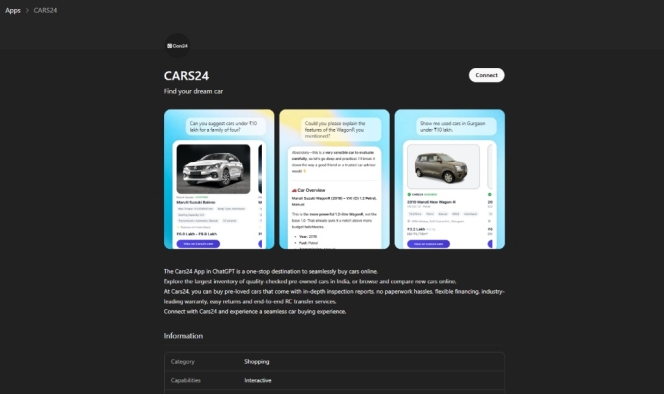
Cars24 has announced a strategic partnership with OpenAI to deploy artificial intelligence (AI) models and agents across its business operations. The collaboration focuses on embedding AI into vehicle discovery, sales, financing and post-purchase engagement across all markets where the company operates.
Unlike traditional pilot programmes, the initiative involves the integration of OpenAI’s technology into production environments to manage high-volume workflows. The partnership aims to transition the platform from manual automation to systems that assist in decision-making and data retrieval.
Cars24 has already deployed OpenAI’s Enterprise APIs across several internal and customer-facing functions. According to company data, the integration has resulted in a 50 percent increase in support resolution through assisted troubleshooting and an 80 percent reduction in turnaround time for service workflows.
Current deployment statistics include:
- Customer Outreach: AI agents now manage 20 percent of outbound conversations.
- Internal Adoption: 85 percent daily active usage of ChatGPT Enterprise among the central workforce.
- Functionality: Teams utilise the tools for data analysis, code development, and the summarisation of operational cases.
- Accessibility: The Cars24 application is now available on the ChatGPT Store for conversational vehicle discovery.
The partnership is designed to reduce dependencies on manual processes in automotive transactions. By embedding models into core workflows, the company intends to shorten decision cycles for buyers and sellers. Future phases of the rollout will include expanding these AI experiences to additional languages and product lines.
Vikram Chopra, CEO and Founder, Cars24, said, “Automotive commerce is operationally heavy by nature with multiple checkpoints, fragmented information and high-consideration decisions. Over time, we’ve realised that incremental improvements aren’t enough; the system itself needs to become more intelligent. Our collaboration with OpenAI is a step in that direction. By embedding AI into core workflows rather than layering it on top, we can reduce manual dependencies, improve consistency and shorten decision cycles. We don’t see this as a short-term advantage, but as foundational infrastructure that will compound in efficiency and trust over the years.”
- ToneTag
- TATA.CARS
- DrivePay
- Global Fintech Fest 2026
- Indian Oil Corporation
- National Payments Corporation of India
- UPI
- XTRAREWARDS
- Vivek Kumar Singh
ToneTag Launches In-Car Fuel Payment Solution DrivePay With IndianOil And TATA.CARS
- By MT Bureau
- September 11, 2026

Digital payment infrastructure company ToneTag has launched an in-car fuel payment system at the Global Fintech Fest 2026.
The solution is developed for TATA.CARS under the name DrivePay and integrates National Payments Corporation of India's UPI Circle framework for Internet of Things devices to enable direct fuel payments at IndianOil retail outlets.
The DrivePay platform integrates payment capabilities into connected vehicle infotainment screens. Drivers can simply pay at fuel stations from the vehicle dashboard without using mobile applications, physical cards, or external payment terminals.
The service also incorporates IndianOil’s XTRAREWARDS loyalty scheme, automatically crediting reward points to customer accounts without requiring mobile number inputs during checkout. Following the initial demonstration at GFF 2026, deployment will begin across IndianOil outlets ahead of a wider rollout.
Vivek Kumar Singh, Co-Founder and Director – Labs, ToneTag, said, "Payments are rapidly moving beyond traditional interfaces such as cards and smartphones, and connected devices are emerging as the next frontier for commerce. With DrivePay, powered by ToneTag, we are bringing an IoT-based UPI Circle payment experience directly into the connected vehicle. This initiative with IndianOil, TATA.CARS and NPCI demonstrates how payment infrastructure can seamlessly extend into connected devices, enabling the vehicle itself to become a secure payment interface. We believe this is an important step towards a future where mobility, payments and commerce are seamlessly connected."
The project combines IndianOil's retail distribution network, TATA.CARS' vehicle hardware, ToneTag's payment processing software and NPCI's UPI transaction network. ToneTag plans to extend its connected vehicle payment systems to additional automotive original equipment manufacturers and mobility providers.
Hyundai Motor India Rolls Out Remote Immobiliser Feature For Venue SUVs
- By MT Bureau
- September 11, 2026

Hyundai Motor India, one of the leading passenger vehicle manufacturers, has introduced the Hyundai Bluelink Remote Immobiliser security feature for the Hyundai Venue and Venue N Line models.
The feature is available on the connected-car-Navigation-Cockpit equipped HX10 variant of the Venue and the N10 variant of the Venue N Line.
The security system allows vehicle owners to immobilise a parked car via the Hyundai Bluelink mobile application, preventing engine restart in scenarios involving key cloning or unauthorised access.
In cases of suspected theft, users can trigger the immobiliser remotely, locking the engine start capability once the ignition is turned off. The system operates alongside network-dependent live location tracking to assist vehicle recovery. For safety reasons, the software does not cut power or shut down an active engine while the vehicle is in motion.
The feature is being deployed via a Controller Over-the-Air update leveraging Hyundai's Software-Defined Vehicle (SDV) architecture. Eligible Venue and Venue N Line models sold since November 2025 will receive the update automatically without requiring physical service centre visits. The ccNC system allows over-the-air updates across up to 19 individual vehicle controllers.
Furthermore, From September 2026, the remote immobiliser will be standard equipment on HX10 and N10 variants, with plans for phased implementation across other Bluelink-enabled models.
Tarun Garg, MD and CEO, Hyundai Motor India, said, “With Hyundai Bluelink now powering over eight lakh connected vehicles in India, we continue to strengthen our connected mobility ecosystem by delivering meaningful innovations that address evolving customer needs. Hyundai Bluelink Remote Immobiliser offers customers greater control and peace of mind by enabling them to remotely secure their parked Hyundai VENUE or VENUE N Line and respond quickly in the event of suspected theft, while incorporating safeguards that prioritise customer safety. Importantly, this feature also demonstrates the future-ready potential of Hyundai’s Software-Defined-Vehicle architecture. Through a seamless Controller Over-the-Air update, we are introducing an important new capability to eligible model variants without requiring customers to visit a workshop.”
At present, Hyundai Motor India offers the Bluelink connected car system across 11 of its 15 vehicle lines in the country, providing functions including emergency crash notifications, vehicle diagnostics, remote telemetry and voice command controls.
Bosch SDS, Dassault Systèmes Join Forces To Accelerate Digital Transformation For Indian Manufacturers
- By MT Bureau
- September 10, 2026
Bosch Software and Digital Solutions (Bosch SDS) has entered into a collaboration with Dassault Systèmes in India, aimed at helping manufacturing enterprises accelerate digital transformation across product engineering, manufacturing operations and industrial value chains.
The partnership combines Dassault Systèmes’ capabilities in Virtual Twin Experiences, Product Lifecycle Management, Digital Manufacturing and Manufacturing Operations Management with Bosch SDS’ expertise in contextualised data products, manufacturing transformation, energy optimisation, IT/OT integration and machine-level intelligence. It also draws on both companies’ global industrial AI expertise. Early momentum has been demonstrated through an engagement with a leading Indian electric vehicle manufacturer, where Dassault Systèmes’ DELMIA Apriso MES platform and Bosch SDS’ manufacturing transformation capabilities are being deployed to enable intelligent, real-time connected operations, yielding improvements in production efficiency, quality and digital traceability.
Under the collaboration, the two organisations will jointly work across several identified areas. These include AI-enabled manufacturing transformation and Agentic AI orchestration through the Bosch Cognitive Factory platform; Digital Thread and traceability across engineering, manufacturing and lifecycle operations; contextualised data products and enterprise intelligence; energy management, sustainability transformation and an Energy Management Platform; smart factory, connected operations and IT/OT convergence with machine-level intelligence and Digital Product Passport and regulatory compliance readiness. Joint market engagement will extend into heavy engineering and process sectors, leveraging the complementary domain strength and technology depth of both organisations.
Bosch SDS will serve as a Consulting and System Integration partner to Dassault Systèmes across the identified transformation areas, spanning engineering, manufacturing and enterprise operations. Both organisations will jointly innovate and develop solutions to support customers in deploying end-to-end AI, Digital Thread and AI-enabled Digital Product Passports across product and manufacturing value chains.
Dattatreya Gaur, MD & CEO, Bosch Software and Digital Solutions, said, “Manufacturing enterprises today are looking beyond isolated digitisation initiatives towards connected, intelligent and autonomous operations. Our collaboration with Dassault Systèmes brings together two highly complementary strengths in Industrial AI: Bosch SDS’s deep expertise as a technology partner and practitioner across manufacturing, operational technology integration along with the Bosch Cognitive Factory platform, and Dassault Systèmes’ leadership in Virtual Twin Experience and Digital Thread capabilities. Together, we are uniquely positioned to help manufacturers accelerate AI-led transformation across the entire product and manufacturing value chain with greater speed, intelligence and scale.”
Ramesh Ramaswamy, Global Sales Head, Bosch Software and Digital Solutions, said, “The future of manufacturing will be defined by how seamlessly enterprises connect engineering, operations, data and AI across the value chain. Through this collaboration, Bosch SDS and Dassault Systèmes are bringing together complementary strengths to help manufacturers move from fragmented transformation efforts to truly connected, software-defined and intelligent operations. This creates a far stronger foundation for manufacturers to scale innovation, resilience and operational agility in the AI era.”
Deepak NG, Managing Director, India, Dassault Systèmes, said, "Our collaboration with Bosch SDS marks a major milestone for the manufacturing industry. By connecting our virtual twin technology with their industrial expertise, we are helping factories adopt AI much faster. This will create highly connected and sustainable operations. Together, we look forward to helping companies innovate and grow in the digital era.”
Tata Motors Partners PETRONAS Lubricants India For Used-Oil Recycling Pilot
- By MT Bureau
- September 09, 2026
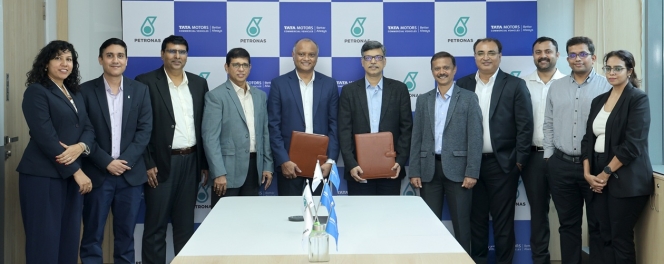
Tata Motors and PETRONAS Lubricants India have inked a Memorandum of Understanding (MoU) to establish a collection and recycling program for used automotive lubricants.
The two companies will launch the pilot project simultaneously across Maharashtra and Tamil Nadu to evaluate a scalable model for lubricant waste management.
The initiative creates a traceable system for collecting, storing and processing used lubricants through registered recycling channels, with the goal of converting collected waste into re-refined base oil.
Tata Motors will utilise its authorised service centre network to facilitate collection, while PETRONAS Lubricants India will oversee the logistics and transfer of used oil to certified re-refiners. The collaboration aligns with India's Extended Producer Responsibility regulations governing hazardous waste disposal.
Binu Chandy, India Managing Director at PETRONAS Lubricants India, said, "Achieving true circularity in used oil begins when re-refined base oil is reintegrated into finished lubricants. Our collaboration with Tata Motors marks an important step toward building a scalable model for used oil circularity and reflects the strength of our channel network as we work to significantly reduce our carbon footprint across operations."
Vikram Agrawal, Head of Spares and Non-Vehicle Business, Tata Motors, said, "At Tata Motors, practices and partnerships promoting sustainability are integral to advancing circular economy principles and creating meaningful environmental impact across the automotive value chain. Through our collaboration with PETRONAS Lubricants India, we are taking a significant step towards establishing a structured framework for the collection, recovery, and recycling of used automotive lubricants. This pilot initiative aligns closely with our commitment to responsible resource stewardship and supports India's broader sustainability ambitions. By bringing together the complementary strengths and expertise of our two organisations, we aim to assess the viability of a scalable used-oil recycling model that can drive long-term value and contribute to industry-wide progress."
Comments (0)
ADD COMMENT