

- Visteon Corporation
- Mahindra & Mahindra
- Mahindra XUV7X0
- Francis Km
- Adreonx+
- Qualcomm Technologies
- Auto Shanghai 2025
- CES 2026
- Snapdragon
- Uday Dodla
- Mark Granger
Visteon Showcases High-Performance Cockpit Computing, Expands Partnership With Mahindra & Mahindra Too
- By MT Bureau
- January 09, 2026
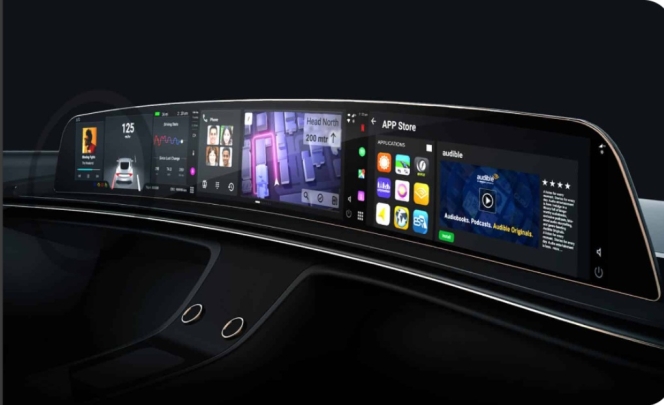
Visteon Corporation has announced an expanded technology partnership with Mahindra & Mahindra that will see its next-generation SmartCore Pro cockpit domain controller deployed in Mahindra’s XUV7X0 SUV lineup.
Unveiled at CES 2026, the SmartCore Pro builds on the SmartCore system introduced in the Mahindra XUV700 in 2021. The new system integrates cockpit electronics, surround view camera technology and telematics on Mahindra’s Adrenox+ platform. It features a three-display configuration supporting vehicle information, infotainment, ADAS visualisation and connectivity, alongside an integrated 360-degree camera system.
Francis Kim, Vice-President of Global Sales & Commercial Excellence and General Manager for Rest of Asia, Visteon, said, “The automotive industry is shifting from discrete systems to fully integrated digital platforms, and India is among the fastest-moving markets in this transition. This partnership demonstrates how strategic OEM collaboration can accelerate time-to-market for complex technologies while laying the foundation for software-defined vehicles.”
Alongside the Mahindra announcement, Visteon also showcased the production specifications and OEM implementations of its High-Performance Compute solution built on the Snapdragon Cockpit Elite platform. The solution follows Visteon’s collaboration with Qualcomm Technologies announced at Auto Shanghai 2025 and is now being demonstrated with multiple global OEMs.
The High-Performance Compute platform supports centralised vehicle architectures and software-defined vehicle strategies. It enables on-device AI processing, multi-display support, multi-user experiences and personalised cockpit features. The system uses the Qualcomm Oryon CPU, Qualcomm Adreno GPU and enhanced NPU AI performance, while Visteon’s cognitoAI Concierge digital assistant operates using the company’s QWEN 7B model.
Uday Dodla, Vice-President, Product Management, Visteon, said, “This High-Performance Compute solution addresses a critical challenge our OEM partners face as they transition to centralized architectures. By consolidating multiple ECUs into a single, powerful platform, we're enabling automakers to reduce complexity and costs while delivering the sophisticated AI-driven experiences that consumers increasingly expect.”
Mark Granger, VP, Product Management at Qualcomm Technologies, said, “Visteon's demonstration of its High-Performance Compute solution on the Snapdragon Cockpit Elite platform highlights the momentum toward centralized, software-defined architectures that will power the next era of intelligent, connected vehicles.”
Visteon said the platform is designed to support a common architecture across vehicle segments, allowing OEMs to scale features while consolidating electronic control units and supporting long-term cost efficiencies.
- KPIT Technologies
- Technica Engineering
- Volkswagen
- Dennis Weilmann
- Maik Roßdeutscher
- Timo Dudel
- CARIAD
- Sachin Tikekar
KPIT And Technica Engineering Inaugurate Joint Office In Wolfsburg
- By MT Bureau
- November 27, 2026
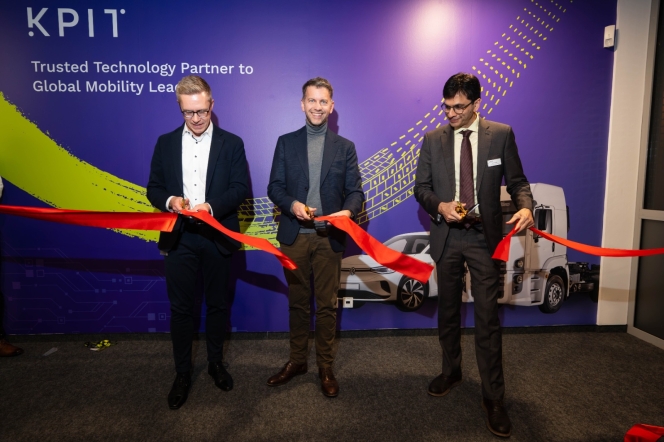
KPIT Technologies and its group company Technica Engineering inaugurated a joint office in Wolfsburg on 25 November 2026, to expand engineering collaboration with Volkswagen.
Operating alongside CYMOTIVE's presence in the city, the facility brings capabilities across software, electrical and electronic (E/E) architecture, systems integration, validation and cybersecurity closer to Volkswagen's engineering teams to support the development of software-defined and AI-defined vehicles.
The opening ceremony was attended by Dennis Weilmann, Mayor of Wolfsburg; Kai Grunitz, Member of the Volkswagen Brand Board of Management responsible for Technical Development; Maik Roßdeutscher, Executive Vice President Procurement General; Timo Dudel, Head of Procurement at CARIAD and Sachin Tikekar, President and Joint Managing Director of KPIT Technologies, alongside representatives from KPIT, Technica Engineering and CYMOTIVE. Weilmann, Tikekar, and Grünitz participated in a ribbon cutting and lamp-lighting ceremony to mark the launch.
With over 25 years of experience in the mobility sector, KPIT has supported more than 2,000 vehicle production programmes and deployed its software across over 20 million vehicles worldwide.
Sachin Tikekar said, “Our investment in Wolfsburg reflects our long-term commitment to Volkswagen and the European automotive industry. By combining our Group’s capabilities, local engineering presence and global scale, we aim to deepen collaboration with Volkswagen and help accelerate the next generation of mobility solutions.”
Kai Grunitz said, “Our ambition at Volkswagen is clear: we want to develop better cars faster, with technology that creates real value for our customers. Software and electronics are key to achieving this, but so is the way we work together. Having KPIT’s engineering expertise close to our teams in Wolfsburg makes collaboration more direct and efficient and supports us in bringing the next generation of Volkswagen vehicles to the road.”
Dennis Weilmann said, “Wolfsburg thrives on the close connection between automotive excellence, technology and innovation. We are therefore delighted that KPIT and Technica Engineering are strengthening their presence in our city. Their investment adds further expertise to our growing mobility and technology ecosystem and underlines Wolfsburg’s international relevance as an automotive location.”
MAHLE Develops Autonomous Park And Charge System For Electric Vehicles
- By MT Bureau
- November 27, 2026
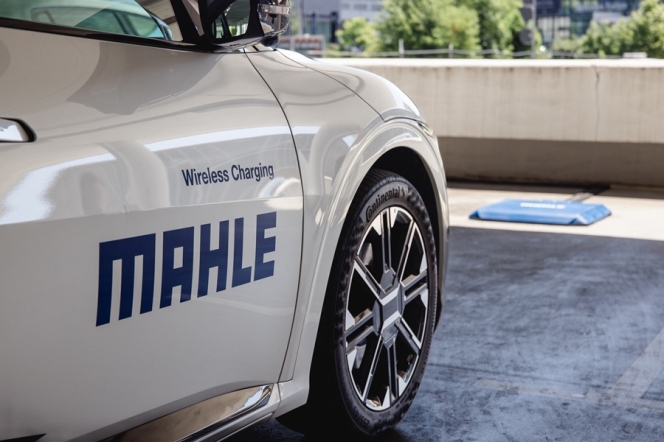
German automotive component supplier MAHLE has introduced a Park & Charge pilot for vehicle manufacturers that pairs autonomous parking with wireless charging for drivers and fleet operators, including car rental companies, logistics providers and delivery services.
The system utilises the vehicle camera and algorithms without requiring sensors, by identifying parking spaces equipped with charging infrastructure it guides the vehicle over a ground-mounted charging pad using the Differential Inductive Positioning System (DIPS), a standard set by SAE International.
Once positioned, the system initiates energy transfer up to 11 kW at an efficiency exceeding 92 percent, while supporting bidirectional charging to return electricity from the vehicle to the power grid.
MAHLE is evaluating the technology alongside the BMW Group in a BMW iX3 and has converted a combustion engine test facility in Stuttgart into a test bench rated for capacities up to 30 kW to validate object detection in the air gap, magnetic field measurements, and coil integration across vehicle architectures including the BMW Neue Klasse platform.
Dr. Marco Warth, Vice President of Corporate Research and Advanced Engineering at MAHLE, said, “Wireless charging has the potential to make electric mobility much easier in everyday life. Key to acceptance is high efficiency, maximum ease of use, the ability to automate the process, and seamless integration into existing vehicle and infrastructure concepts. With our Park & Charge pilot, we are taking the next step by laying the foundation for an automated charging process that not only enhances convenience for users but also opens up new application opportunities for fleet operators.”
“By setting up this state-of-the-art system test bench in a former combustion-engine test cell, we are making transformation tangible. Through the close integration of development, software engineering, validation, and maintenance, we bring together our full expertise within a single team and deliver end-to-end solutions, from system know-how to the final product,” added Dr. Warth.
- Detroit Engineered Products
- DEP
- DEP MeshWorks
- DEP AIWorks Platforms
- IntelliNXT Learning & Technologies
- IntelliNXT
- CAE
- Radha Krishnan
- Karaiadiselvan
DEP and IntelliNXT Partner To Build Computer-Aided Engineering Talent In India
- By MT Bureau
- November 26, 2026
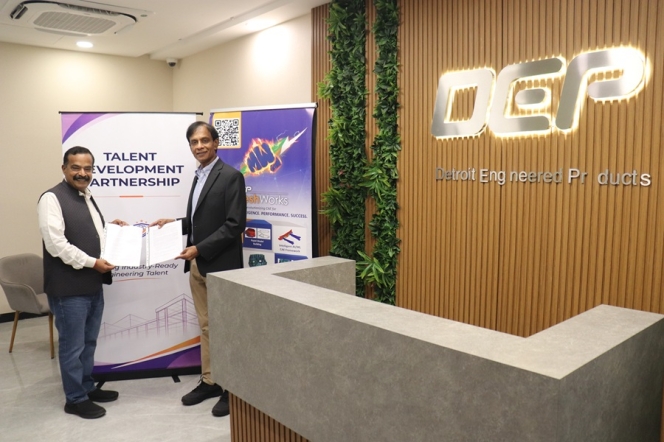
Detroit Engineered Products (DEP), developer of the DEP MeshWorks and DEP AIWorks platforms, has entered into a Talent Development Partnership with IntelliNXT Learning & Technologies (IntelliNXT) to build a pipeline of Computer-Aided Engineering (CAE) talent in India.
As per the agreement, IntelliNXT will design and deliver a training programme in association with DEP to develop participants' skills in CAE and DEP MeshWorks, a platform used by engineering teams to build element models from CAD data, parameterise them, and run optimisation studies.
Delivered through sessions, labs and projects, the curriculum will also introduce engineering workflows enabled by artificial intelligence (AI), an area where DEP AIWorks combines machine learning with simulation to shorten product development cycles. IntelliNXT will assess participants, certify graduates, and coordinate placement activities with DEP by recommending candidates based on assessment performance, streamlining recruitment and onboarding for the software developer.
Radha Krishnan, Founder & President, DEP, said, “Industry-ready engineers are the foundation of every successful CAE adoption. Partnering with IntelliNXT lets us bring DEP MeshWorks to a new generation of engineers in India and build a lasting talent pipeline.”
Karaiadiselvan, Chief Mentor, IntelliNXT Learning & Technologies, said, “Access to DEP MeshWorks lets us train our learners on a tool that industry actually uses, and helps companies find job-ready talent.”
- Hindustan Zinc
- Indian Institute of Technology Madras
- IIT Madras
- zinc-air battery
- Amarendu Prakash
- Praveen Chakravarthy
- Dr. Aravind Kmar Chandiran
- Prof Manu Santhanam
- Prrof. V Kamakoti
- HZL 2.0
Hindustan Zinc, IIT Madras Unveil Three-Wheeler Prototype With 1 kWh Zinc-Air Range Extender
- By MT Bureau
- November 26, 2026
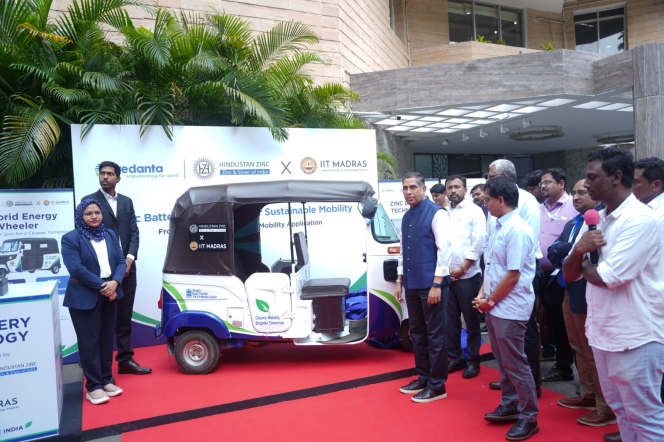
Hindustan Zinc, in collaboration with the Indian Institute of Technology Madras (IIT Madras), has unveiled a three-wheeler prototype fitted with an approximately 1 kWh zinc-air battery acting as a range extender.
The partners presented the prototype during the IIT Madras Energy Summit 2026 in the presence of Praveen Chakravarthy, Member of Parliament (Rajya Sabha), Amarendu Prakash, CEO and Whole-time Director, Hindustan Zinc, IIT Madras Dean (ICSR) Prof. Manu Santhanam and project lead Dr. Aravind Kumar Chandiran from the Department of Chemical Engineering.
Initiated in 2024, the research partnership has progressed from laboratory testing to vehicle demonstration under Hindustan Zinc's HZL 2.0 growth strategy. The vehicle utilises a dual-battery architecture in which the zinc-air unit supplies nearly 10 percent of the vehicle's energy requirements during operation, while a lithium-ion battery handles acceleration and power demands. Operating with a water-based electrolyte, zinc and oxygen from the air, the technology leverages India's zinc reserves to advance energy storage capabilities.
Amarendu Prakash said, “At Hindustan Zinc, we are constantly exploring opportunities to expand the applications of zinc and unlock greater value from this versatile metal. With zinc being abundantly available in India, there is an opportunity to explore indigenous energy storage solutions that can contribute to the vision of Viksit Bharat. Our collaboration with IIT Madras reflects our commitment to translating scientific research into practical applications, creating new demand avenues for zinc and strengthening its role in the global clean energy transition.”
Prof. V. Kamakoti, Director, IIT Madras, said, “Energy is the major focus of discussion globally, be it artificial intelligence, agriculture all the way to advanced manufacturing. Ensuring generation, storage and distribution of energy from different sources, specifically the renewable ones is the most important topic for research, development and commercialisation. Our collaboration with Hindustan Zinc is yet another important effort towards this goal.”
Comments (0)
ADD COMMENT