

KTM Duke 160: Pocket Rocket Or A Short-Fall?
- By Biplab Das
- August 28, 2025
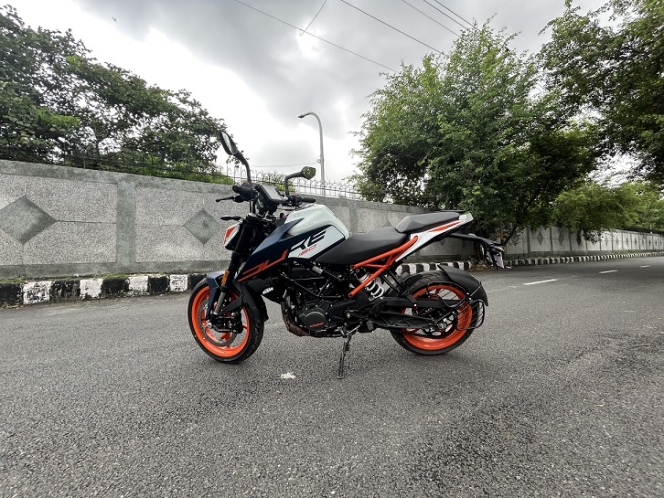
Thumb the starter on the KTM Duke 160 and the first impression is of familiarity – those tense lines, sculpted tank and sit-in stance that signal ‘Duke’ before the wheels even turn – yet there’s also a welcome lightness to how it picks up and changes direction at parking speeds and in the first hundred metres. That easy agility is backed by a chassis brief that reads serious on paper – trellis frame with bolt-on subframe, lighter five-spoke wheels, hollow axles and geometry that’s a shade sharper than the bigger siblings – so the bike feels eager without getting nervous when the pace rises.
Within a few blocks, two things set the tone for daily life: a clutch that’s genuinely light and progressive and a gearbox that slips through ratios cleanly, letting short, tidy shifts replace the usual 160cc thrash – helped by a slipper clutch that takes the drama out of hurried downshifts when traffic opens and closes without warning.
What stands out
The Duke 160 looks and feels like a proper Duke – tense lines, sculpted tank, sit-in stance – and backs it up with a genuinely light and eager front end thanks to the trellis frame, lighter five-spoke wheels and sharper geometry. The motor’s real-world strength is tractability and in-gear urge rather than fireworks off the line; timed roll-ons of 30–70 kmph in 6.8s (4th) and 9.1s (5th) make short overtakes easy without constant downshifts, echoing the sentiment that it feels brisk between gaps more than it feels explosive from a standstill.
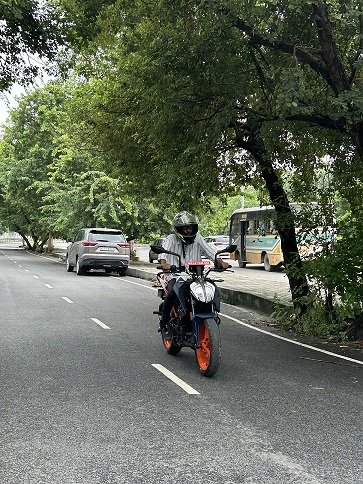 Braking hardware is a headline win: a 320mm front disc with braided lines and dual-channel ABS (rear channel switchable) gives bite and progression few 160s can match and it shows when hustling or panic-stopping in town.
The everyday reality
At 815mm, the seat is on the taller side for an average-height rider; those around 5ft 8in may tip-toe at awkward cambers, though the wide bar and neutral pegs help low-speed balance and leverage in traffic. The clutch and gearbox pairing is excellent – light, smooth and confidence-inspiring – so creeping traffic and quick, clean shifts become second nature within minutes of riding. Lever placement is not perfect from the crate; both the gear and brake pedals could use a quick adjustment during PDI to better match different boot sizes and ankle angles, which takes the edge off initial niggles.
Ride and features
Suspension tuning leans towards control with acceptable compliance: the Duke stays planted and keen to turn, yet retains enough travel to keep sharp edges from jarring too much in the city, though rougher patches still remind that it’s set up to feel taut rather than plush. Thermal management is a positive: a larger radiator surface area helps in slow-moving traffic and while the fan cycles in dense conditions, heat never tips into discomfort during typical urban use in this test window. The monochrome LCD with a dot-matrix pane is clear in bright light, offers all the basics at a glance and the microswitch cubes feel a cut above the class; Bluetooth navigation remains an accessory, which keeps base weight and price in check.
Verdict
Against the Yamaha MT-15 V2, the Duke 160 trades efficiency for feel: the Yamaha is lighter and significantly more frugal (users often report 50+ km/l), while the KTM bites harder on the brakes, feels more planted at the front and pulls stronger in mid-gear bursts on paper and in practice. The KTM’s 19PS and 15.5Nm edge the Yamaha’s 18.4PS and 14.1Nm and its 320mm rotor dwarfs the MT’s 282mm, but the MT-15 counters with lower kerb weight and everyday economy advantages that matter to commuters. If weekly highway runs and traffic sprints define the brief, the Duke’s chassis feedback, brake feel and roll-on pace make a compelling case; if fuel economy and a lower seat are top priorities, the MT-15 remains the pragmatic pick and price positioning in on-road terms still favours the Yamaha in many cities.
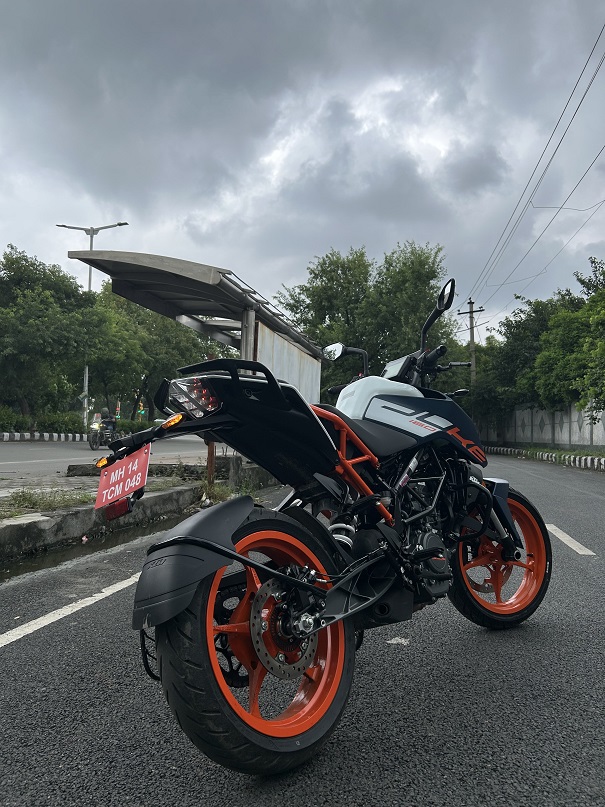
In short, the Duke 160 is not the outright quickest feeling 160 off the mark, nor the most frugal, but it is the most ‘KTM’ in the way that matters: front-end feel, braking confidence and mid-gear urge that make real-world riding more engaging and assured than the spec sheet alone suggests. It could do with lower seat options from the factory and cleaner lever ergonomics out of the box; sort those and it becomes an easy recommendation for riders who value control and character over kilometre-per-litre bragging rights.
- Aprilia Racing
- MotoGP
- Pertamina Mandalika International Circuit
- Grand Prix
- Raul Fernandez
- Marco Bezzecchi
- Jorge Martin
- Massimo Rivola
Aprilia RS-GP Sweeps Top 4 Positions At Mandalika MotoGP
- By MT Bureau
- October 15, 2026
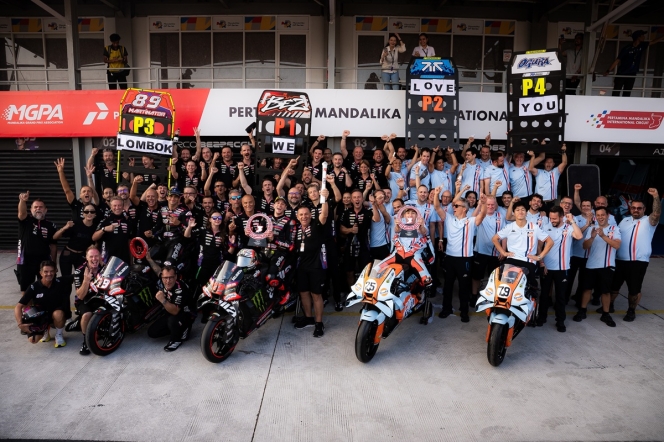
Aprilia Racing has secured its first top 4th sweep in MotoGP history at the Pertamina Mandalika International Circuit, with four RS-GP26 motorcycles occupying the leading positions at the finish line.
Marco Bezzecchi won the race from second on the grid, recording a lap time of 1:29.960. The victory marks Bezzecchi's 5th win of the season and his 11th in the top class, while representing the 300th premier class victory by an Italian rider in Grand Prix history.
Raúl Fernández of the SuperFile Trackhouse MotoGP Team finished 2nd, while Aprilia Racing's Jorge Martín completed the podium in 3rd place. Ai Ogura took 4th place to complete the sweep for the manufacturer. The result brings Aprilia Racing's season tally to 8 victories and 16 top-class wins overall, while moving Jorge Martín to the top of the riders' championship standings with 355 points.
"I’m happy with my race. I really wanted to leave Mandalika with a good result, and I’d been chasing this win since my injury at the Sachsenring. It felt really good. Clearly, with only five races left, the title is more lost than won. But that doesn’t change how I think or work, especially with my team. I’m not a rider who gives up. That’s who I am, and I’m happy to have met so many like-minded people along the way who I’m fortunate enough to work with," said Marco Bezzecchi.
"I’m happy with this podium because I achieved the best possible result. Marco and Raúl had something extra all weekend. I tried to close the gap, but they were faster. I’m still a little disappointed with yesterday’s result because I could have won, but I’m happy with today’s. As for the championship, the most important thing is to stay in the title fight and, above all, arrive in Valencia with a chance," said Jorge Martín.
Massimo Rivola, CEO, Aprilia Racing, said, "Once again, Aprilia means high drama, for better and for worse. Saturday started in the best possible way with pole position for Raúl Fernández, but the sprint was marred by a mistake at turn one and a serious error over Jorge’s front tyre pressure, for which we owe him an apology. At least Ai’s superb ride through the field salvaged something from it. Sunday, on the other hand, has been a day to remember, with four RS-GP bikes in the top four for the first time. We know it will be tough right to the end, but just as we don’t get disheartened when things go badly, we don’t get carried away when they go well. I want to congratulate everyone at Noale on their commitment and dedication, which are proving so valuable in this hard-fought season."
The result marks Aprilia's fourth podium lockout of the season, following previous finishes at Le Mans, Assen, and Silverstone, taking the Noale-based manufacturer to 310 total wins across all Grand Prix motorcycle classes.
TVS Motor Co Introduces Traction Controls System For Raider Motorcycle
- By MT Bureau
- October 15, 2026
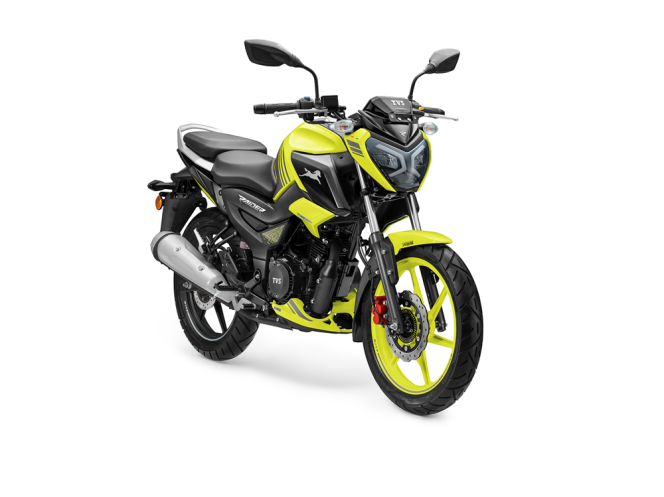
Chennai-headquartered two-wheeler and three-wheeler major TVS Motor Company has launched updated variants of its TVS Raider motorcycle, introducing active safety features to the 125cc segment.
The TVS Raider TFT DD and TVS Raider SXC DD models now feature a Traction Control System and Emergency Brake Warning functionality.
The Traction Control System manages rear-wheel power output during traction loss over wet surfaces, loose gravel or road hazards. The Emergency Brake Warning system flashes rear lighting signals during deceleration to alert trailing traffic.
Additional hardware updates include a wider rear tyre, a 27W USB Type-C device charger and established powertrain features including a 3-valve engine with iGO Assist boost functionality, Glide Through Technology for low-speed manoeuvring and a TFT display supporting connectivity software.
The TVS Raider SXC DD variant is priced at INR 100,330 ex-showroom Delhi, while the TVS Raider TFT DD variant is available at INR 103,170 across TVS Motor dealerships nationwide.
- BSA Motorcycles
- Classic Legends
- Brooklands Black Legacy Edition
- Birmingham Blue Edition
- Anupam Thareja
BSA Motorcycles Expands Gold Star 650 Range With Brooklands Black & Birmingham Blue Editions
- By MT Bureau
- October 15, 2026
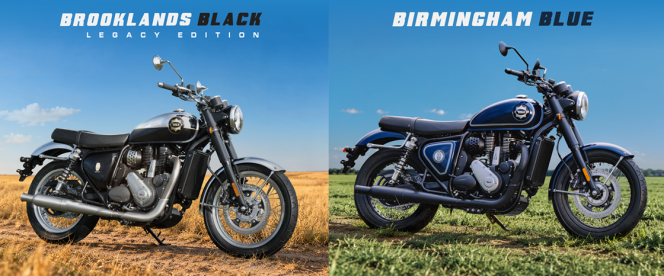
BSA Motorcycles, part of Classic Legends, has expanded its Gold Star 650 lineup in India with the introduction of the Brooklands Black Legacy Edition and Birmingham Blue Edition. The launch increases the colourways and trim options available for the retro-roadster model across the country.
The Birmingham Blue Edition is priced at INR 355,950 ex-showroom New Delhi, while the Brooklands Black Legacy Edition is available at INR 364,950. Retail and service coverage spans over 450 touchpoints across India, supported by a standard four-year or 50,000-kilometre warranty package.
The Brooklands Black Legacy Edition incorporates black body paint with gold pinstriping, chrome fenders, a chrome-accented fuel tank and a quilted seat layout. The Birmingham Blue Edition introduces a blue paint scheme paired with a silver side-panel badge and a revised engine surface finish.
Both editions retain the underlying technical platform, powered by a 652cc liquid-cooled single-cylinder engine producing 45 hp of power and 55 Nm of torque. Chassis hardware includes Brembo braking components, dual-channel anti-lock braking systems and wire-spoke wheels.
Anupam Thareja, Co-Founder, Classic Legends, said, "The Gold Star embodies everything we believe a modern retro-roadster should be. From its authentic British design to the distinctive experience of its big-single engine, every element reflects the craftsmanship, engineering and attention to detail that have defined the Gold Star for generations. The Brooklands Black Legacy Edition honours the moment when the Gold Star earned its legendary name, while Birmingham Blue offers a contemporary expression of the Gold Star, reinterpreting its iconic DNA for today's rider. Together, they represent two distinct chapters of the Gold Star story, united by the heritage and individuality that remain central to BSA."
Motohaus Partners With Italjet To Bring Italian Two-Wheeler Brand To India
- By MT Bureau
- October 15, 2026
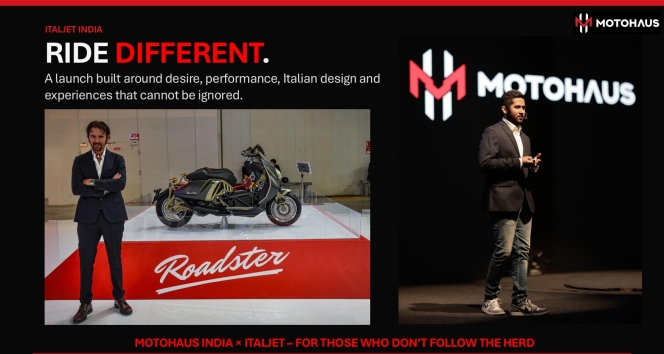
Motohaus India has announced a strategic partnership with Italian two-wheeler manufacturer Italjet, confirming the brand's formal entry into the Indian market.
Operating under KAW Veloce Motors – a subsidiary of the KAW Group – Motohaus currently manages the distribution and local manufacturing operations for international brands, including Brixton Motorcycles and VLF, from its production plant in Kolhapur, Maharashtra.
The agreement with Bologna-based Italjet adds the Italian manufacturer's scooter and motorcycle lineup to Motohaus's distribution portfolio in India.
The partnership intends to leverage Italjet's engineering and design platform alongside Motohaus's assembly infrastructure and dealership network across the country. Specific details regarding the product portfolio, pricing, assembly arrangements and commercial rollout timelines for India will be formally presented at the EICMA 2026 motorcycle exhibition in Milan.
Comments (0)
ADD COMMENT