

- FORVIA
- Anand Group
- Gabriel India
- Faurecia ANand Seating India
- Jaisal Singh
- Anjali Singh
- Martin Fischer
FORVIA, Anand Group Form JV For Automotive Seating In India
- By MT Bureau
- October 07, 2026
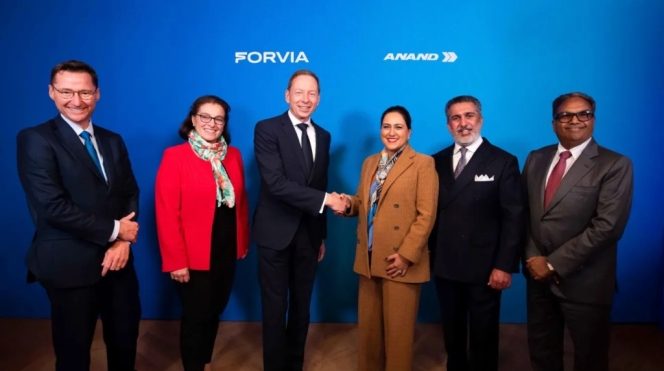
Automotive tier 1 suppliers FORVIA and Anand Group have established a new joint venture to manufacture seat frames and complete seats for the Indian automotive market.
The new entity, named Faurecia Anand Seating India, will be controlled by FORVIA with a 50 percent plus one share stake, while Gabriel India, Anand Group’s flagship listed firm, will hold 50 percent less one share.
The partnership aims to combine FORVIA’s seating technologies and engineering portfolio with Anand Group’s operational network and customer relationships with domestic automotive manufacturers.
The JV aims for a 10 percent market share in India over the next five years as part of its regional expansion strategy. The collaboration expands on an existing relationship between the two companies that began in 1991 in the clean mobility segment.
The joint venture will utilise localised manufacturing footprints to support supply chain, industrial and talent capabilities for supply contracts across Indian vehicle manufacturers.
Jaisal Singh, Vice-Chairman, Anand Group, said, "This partnership is a natural extension of Gabriel India’s transformation into a broader mobility solutions enterprise. As vehicle systems become more integrated and technology-intensive, the ability to participate across a wider spectrum of the automotive value chain assumes strategic importance. The venture strengthens our portfolio with a globally proven capability, while reinforcing our commitment to building scalable, technology-led businesses that create enduring value."
Anjali Singh, Executive Chairperson, Anand Group and Gabriel India, said, "At Anand, we have always believed that long-term relevance is built through thoughtful partnerships, technological excellence, and a deep understanding of customer needs. This venture strengthens our longstanding partnership with FORVIA, building on complementary strengths and a shared commitment to innovation. By bringing together FORVIA’s global expertise and Gabriel India’s strong market presence, it creates a platform that is both strategically significant and future-ready."
Martin Fischer, CEO, FORVIA, said, "When we unveiled our IGNITE strategy earlier this year, we highlighted India as a key growth driver for FORVIA. Following the award of our first complete-seat program a few months ago, today’s agreement marks another important milestone in our development in the country. Building on our long-standing relationship with Anand Group, the joint venture will help accelerate FORVIA Seating’s growth in India."
Indo Autotech Targets INR 50 Billion Revenue Milestone By 2030
- By Nilesh Wadhwa
- November 23, 2026
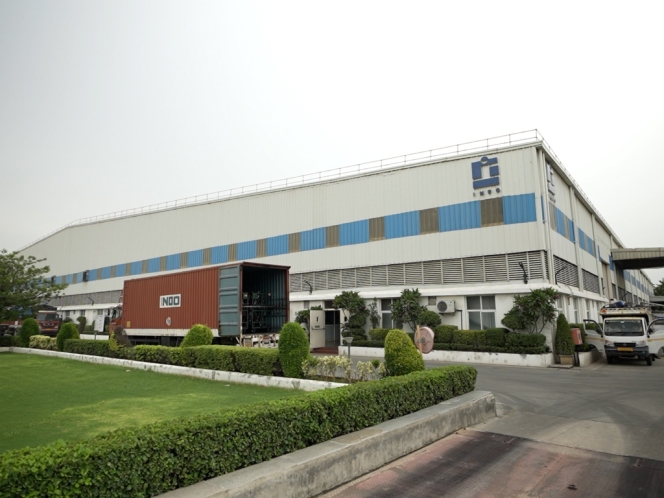
From a single lathe in Faridabad in 1974 to nine plants across Haryana, Rajasthan, Karnataka, Gujarat and Tamil Nadu, Indo Autotech has become a key supplier of sheet-metal components, sub-assemblies and fabricated parts for two-wheelers, passenger vehicles, tractors and earth-moving equipment.
With further plants planned in Chhatrapati Sambhaji Nagar, Maharashtra and the Jaipur SEZ, and a workforce approaching 6,000 employees, the company is positioning itself for the next phase of growth – one defined by shorter development cycles, higher material strength and rising export ambition.
Managing Director Anand Jain is clear about the foundation that has carried the business this far. “We started small but with a strong focus on quality, customer satisfaction and continuous improvement. Over the years, we expanded step by step to support the growing needs of the automotive industry,” he says.
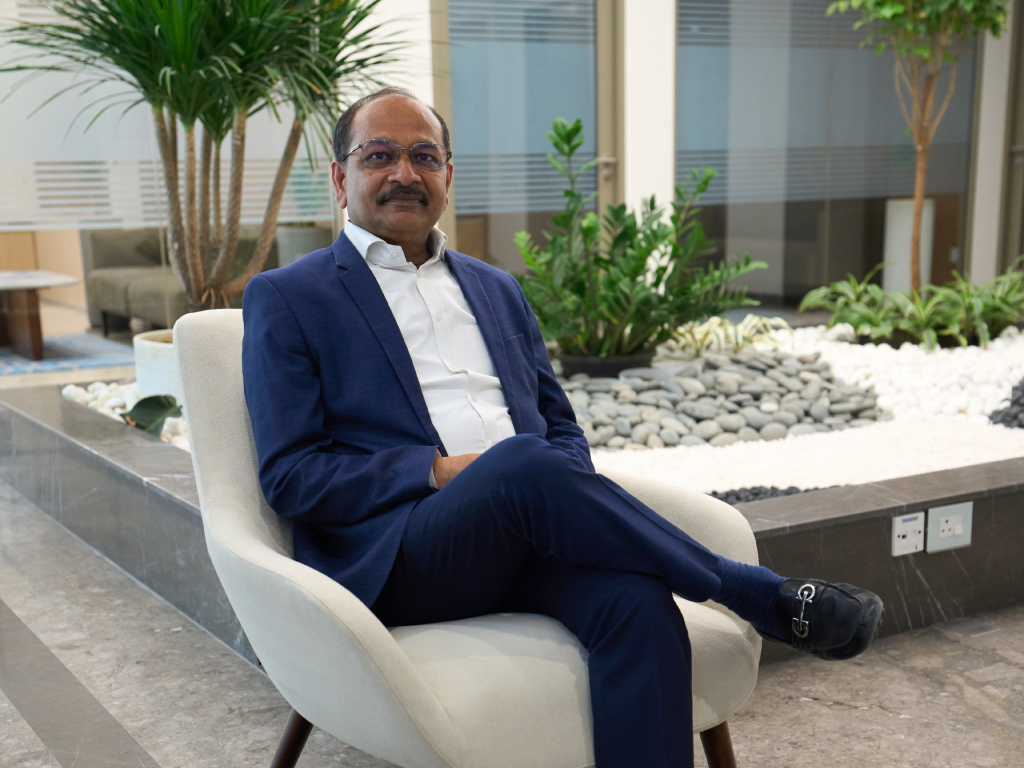 It is interesting to note that despite its humble beginnings, the company has rapidly scaled up and enhanced its business proposition. In FY 2025-26, Indo Autotech crossed INR 25 billion in revenue, with exports contributing INR 760 million, and has set its sights on surpassing the INR 50 billion mark by 2030. That trajectory, Jain emphasises, rests on engineering depth rather than sheer production volume.
Engineering control as competitive advantage
One of Indo Autotech’s defining strengths is its fully integrated design-and-tooling capability. “I believe one of our biggest strengths is the dedicated in-house design and development. We have a highly skilled and qualified design and development team equipped with state-of-the-art CAD/CAM facilities, CMMs and CNC machines. Our design department has 42 members and specialises in the design and manufacturing of stage-wise progressive tools, gauges and fixtures for assemblies,” Jain explains.
The company manufactures roughly 1,500 tools a year entirely in-house. That vertical integration delivers tighter control over quality, lead times and process optimisation. Combined with a broad manufacturing envelope under one roof, it allows Indo Autotech to supply complete solutions rather than individual components – an approach that has underpinned long-term partnerships with major OEMs.
Yet the external environment is changing. Product development cycles are shortening, model launches and facelifts are more frequent and demand for lighter, safer vehicles is driving greater use of high-tensile materials.
“With shorter development times and quicker new model launches and facelifts, the overall production and time-to-market timelines are shorter than before. This means we have to be ready much earlier in the process. Engineering, tooling, production and quality teams need to work together closely from day one,” Jain observes.
Process stability through advanced press technology
Meeting those demands requires process stability that can hold tight tolerances across long production runs, particularly with the higher-strength steels now common in safety-critical and lightweight structures.
Indo Autotech has invested heavily in Japanese manufacturing technology, including laser systems, welding robots and projection welding equipment. The company has also placed strong emphasis on developing its metal stamping capabilities, with its longstanding partnership with Japan’s AIDA.
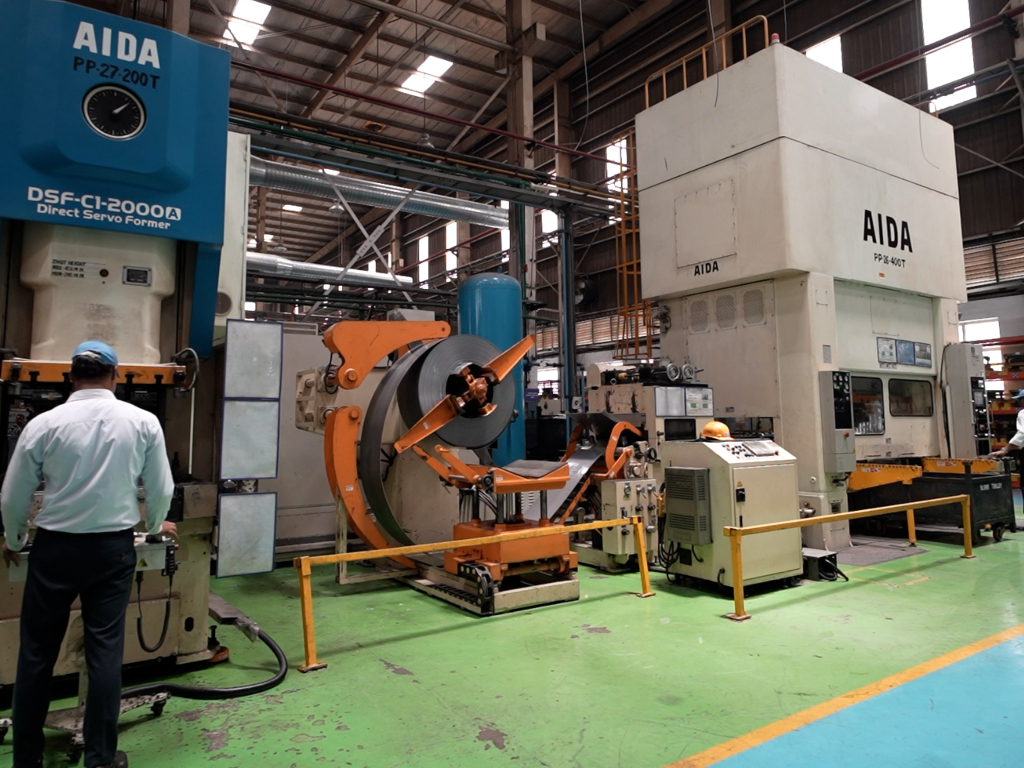 “In the automotive industry, even a small variation can affect final assembly and product performance. That is why we focus heavily on machine stability. We are using mainly Japanese equipment. For example, in presses, we invested in AIDA’s PMX Series for the progressive stamping process because it maintains high product accuracies, especially with high-tensile materials,” Jain says.
He adds that AIDA’s reliability has supported smoother production flow and helped the company consistently meet or exceed customer expectations during extended operating hours.
The DSF servo technology has further strengthened Indo Autotech’s competitiveness. DSF (Direct Servo Former) is AIDA’s proprietary servo technology developed to maximise the productivity by optimising the slide motion profile for each application.
“By adopting DSF Servo technology, we are able to run certain applications at higher operating speeds while maintaining stable forming conditions. This is especially important in the high-volume two-wheeler industry,” Jain notes.
Press energy efficiency has also significantly improved. The low-torque, high-speed servo motor designed by AIDA efficiently stores energy in capacitor system for up to 30 percent energy savings compared to mechanical presses. “From a customer perspective, when we’re producing millions of parts annually, even small improvements can translate into higher customer benefits,” Jain observes.
In a market where consistent quality from the first production shot is non-negotiable, these gains in accuracy, reliability and energy efficiency have become a practical differentiator.
These metal forming capabilities work alongside a broader push for digitalisation. The goal is not simply higher output but more responsive, data-driven manufacturing that can absorb shorter lead times and tighter quality windows.
Looking ahead: Capacity, capability and sustainable growth
Jain sees the next stage of Indo Autotech’s growth as a balance between expansion and strengthening the foundation.
Two new plants will soon be operational – one in Maharashtra to support growing customers in India and another in the Jaipur SEZ to support increasing export volume to markets such as the UK, US and Germany.
With these new facilities, the company will continue to expand capacity, strengthen its operations and be better positioned to support customers in both domestic and international markets.
At the same time, the company is reinforcing engineering and manufacturing depth so that growth does not outpace process control or talent development.
“Going forward, we will continue strengthening our manufacturing and engineering capabilities. We are making significant investments, especially in digitalisation, AI, PLM (product-life cycle management), MES (Manufacturing execution) systems and advanced manufacturing technology. We are also looking at Industry 5.0 to continuously improve processes to support and exceed future OEM requirements. At the same time, we want to continue to grow sustainably. Our focus is not only on growing the business but building stronger systems, teams and long-term competitiveness for the future,” Jain says.
The competitive pressures are real. Two-wheeler manufacturers continue to seek better fuel efficiency, improved safety, lower weight and more distinctive design. Electric platforms are emerging alongside conventional powertrains, adding another layer of complexity. Indo Autotech’s response centres on speed of development, consistency of quality and the ability to partner rather than merely supply.
In-house tooling, integrated design, process-stable stamping with AIDA press technology and progressive digitalisation form the practical means of delivering that partnership.
What has remained consistent throughout Indo Autotech’s journey is its focus on quality, customer and continuous improvement. These principles were important when the company started in Faridabad, and they remain just as important as the company expands today.
Indo Autotech continues to adopt the right manufacturing technologies to improve productivity, precision and energy efficiency. AIDA’s servo and mechanical press solutions are part of this effort, supporting the company’s need for higher output and stable quality – for Indo Autotech to remain the top supplier of choice as India’s automotive industry accelerates into its next phase of model renewal, material evolution and global engagement.
Jain added, “Growth is not only about increasing turnover or adding new plants. It is about producing good quality parts consistently, responding quickly to customers and being able to take a new product from development to production smoothly.” As the Indian automotive industry moves towards faster model changes and increasing global requirements, success is not only achieved in revenue milestones but in the reliability of the parts it ships and the speed with which it can turn a customer concept into production reality.
- Federation of Automobile Dealers Associations
- FADA
- Sai Giridhar
- Festival 2026
- Diwali
- Navratri
- Dhanteras
Festive Demand Powers India Auto Retail Sales To Clock Record Performance
- By MT Bureau
- November 23, 2026
The Federation of Automobile Dealers Associations (FADA), the apex body representing automotive dealership in India, has released the 42-day sales data for the festive period (11 October 2026 to 21 November 2026) which saw a total of 5.52 million vehicles registered, which marks a 2.21 percent YoY (albeit a high base).
Interestingly, barring the passenger vehicle segment with 748,616 units (-7.16 percent), all segments registered a healthy growth. The industry body attributed the robust performance to the continued tailwind of GST 2.0, festivities, new product launches and positive sentiment.
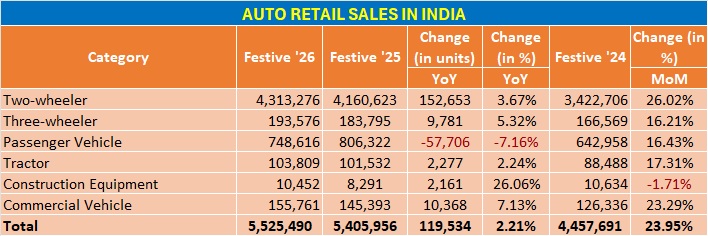
Sai Giridhar, President, FADA, said: “The 42-day festive season of 2026 will be remembered as the year Indian auto retail set a record on top of a record. Against last year’s extraordinary base, which got amplified by GST 2.0, the twin festivals delivered an all-time high — festive retails this year still grew 2.21 percent to 55,25,490 units, the highest-ever 42-day festive in our history. Measured over two years, against the clean festive of 2024, that is a remarkable 23.95 percent rise — proof that the demand step-up unleashed by the Government’s GST 2.0 reforms has not merely held, but deepened.”
“The festive season opened quietly through Navratri, when the shadow of last year’s towering base was at its longest; but as Dhanteras and Deepawali arrived, demand found its stride and built into a powerful crescendo. The turnaround is written in the numbers – a passenger vehicle segment that was down over 18 percent at the Navratri stage closed the full festive with its deficit more than halved and the overall market swung from negative at Navratri into positive territory. India’s festive spirit, once again, delivered when it mattered most,” he said.
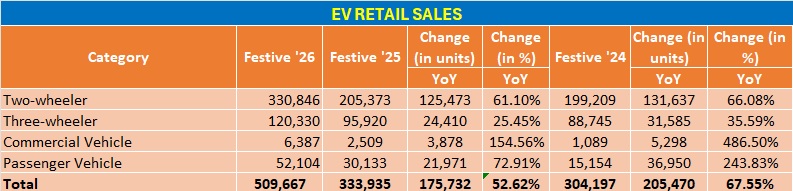
On the other hand, electric vehicle retails surged 52.62 percent to cross 500,000 units in a single festive for the first time ever — an all-time high — led by electric two-wheelers (61.10 percent) and electric passenger vehicles (72.91 percent), with electric commercial vehicles more than doubling.
“Close to one in 10 festive vehicles sold this season was electric. This is India embracing cleaner mobility on its own merit — on running-cost economics, better range and widening choice — a decisive, demand-led shift, with festive EV retails up a stunning 67.55 percent over two years. The energy transition in Indian mobility has arrived,” said the executive.
The industry body is of the belief that the fundamentals of Indian auto retail continue to remain strong with improved affordability, rural demand, expanding multi-powertrain choice and rising youth aspiration.
“As we step out of the festive and into the final stretch of the year, India stands on the cusp of a historic milestone — its first-ever year of over 3 crore vehicle retails. This festive season has set the stage for it. It is a fitting reflection of the wider India Growth Story and the nation’s march towards a Viksit Bharat — a country on the move, and an auto retail sector proud to remain its most honest and most hopeful barometer,” concluded Giridhar.
- VinFast
- VinFast India
- Vingroup
- Tapan Ghosh
- Anurag Saxena
- V-Creator All Star Summit 2026
- Anurag Saxena
VinFast To Launch 2 New Products Annually In India, Two-Wheeler Offensive Soon
- By Nilesh Wadhwa
- November 22, 2026
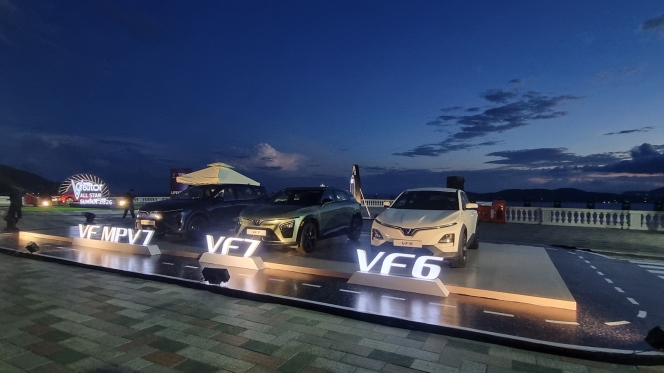
Vietnam-headquartered automotive company VinFast, part of Vingroup, is preparing to strengthen its presence in India with an expansion across electric passenger vehicles and two-wheelers, India-specific product development and manufacturing capacity, as the company looks to capitalise on the country's growing electric mobility market.
Speaking at a recent media roundtable at the sidelines of the V-Creator All Star Summit 2026 in at Vinpearl Resort Nha Trang, Vietnam, Tapan Ghosh, CEO, VinFast Asia, said the company intends to introduce around two new passenger vehicle products annually, while its electric two-wheeler business is expected to enter the market early next year with products developed specifically for Indian customer requirements.
“We don't want to rush. We want to make the foundation very strong,” Ghosh said, emphasising the importance of building the sales, service, charging and customer-support ecosystem alongside product expansion.
Product portfolio and volumes
VinFast has introduced four products in India since beginning retail operations in September last year – the VF6, VF7, MPV7 and Limo Green – spanning personal mobility, family transportation and commercial applications.
Ghosh said registrations had increased from around 300 cars per month during the initial phase to approximately 2,500–3,000 vehicles monthly, based on Vahan data. He attributed the growth to the company's presence across multiple customer segments.
“We have got different products, and we will be keeping on developing products,” he said, adding that the company conducts market research and segment assessments to determine which products would be commercially viable in India.
VinFast plans to introduce approximately two products annually, although the timing and segments will depend on customer demand and the company's assessment of market opportunities.
Electric two-wheelers to be tailored for India
VinFast is preparing a separate manufacturing line for electric two-wheelers at its Indian facility. The company said its two-wheeler manufacturing capability could eventually reach a maximum capacity of one million vehicles annually, although this is not an immediate production target.
Anurag Saxena, Market CEO – 2W, VinFast India, said the company was developing products around Indian road conditions, traffic and customer requirements.
“Indian products would be substantially different in terms of size, space and specifications,” Saxena said, adding that the products would retain elements of the company's global design and engineering expertise while being adapted for the domestic market.
VinFast is targeting a broad range of two-wheeler customers, including families, individual commuters, younger buyers and performance-oriented users. Multiple models are planned, although the company is initially prioritising the scooter segment, which accounts for the majority of the two-wheeler market.
The company expects its Indian electric two-wheeler products to enter the market early next year.
Dealer network and customer ecosystem
VinFast has already identified 34 dealers across 15 states and signed contracts with more than 50 dealers, who are currently being developed for operations.
Saxena said the focus was not only on establishing dealerships but also on training local manpower and creating systems to ensure a consistent customer experience.
The company is also exploring battery swapping alongside other charging solutions for its electric two-wheelers to address range anxiety and different usage requirements.
“VinFast is not evaluating product alone. VinFast is coming up with an ecosystem that addresses the needs and pain points of the customer,” Saxena said.
Manufacturing capacity and investment
The company's existing manufacturing facility in Tamil Nadu has an annual capacity of 50,000 vehicles. VinFast said the facility could initially be scaled up to 100,000 units and subsequently to 150,000 units, depending on demand.
The company has already invested approximately USD 500 million in India and has committed a broader investment of USD 2 billion over a period of years, covering its manufacturing and expansion plans, including two-wheelers.
The existing facility is spread across approximately 450 acres, while VinFast has signed a memorandum of understanding with the Tamil Nadu government for another 500 acres.
Ghosh said the company would progressively expand capacity rather than invest upfront in large volumes. “We are not just going by the target; it is the capacity which is correct. We will see how the customer's response is, and accordingly we will try to move forward,” he said.
Localisation and exports
At present, VinFast has approximately 15 percent localisation for the electric four-wheelers in India and intends to increase this as volumes grow and supplier partnerships develop.
Ghosh said localisation would depend on scale, supplier capabilities and the development of a domestic vendor ecosystem. The company has already begun discussions with suppliers as it looks to build its sourcing base.
Exports from India are also part of the long-term plan. VinFast intends to prioritise the domestic market initially while exploring export opportunities, particularly in right-hand-drive markets, before considering broader export destinations.
The company said it would continue to assess its product portfolio, manufacturing investments and network expansion based on customer response, rather than committing to aggressive volume targets at this stage.
- Society of Indian Automobile Manufacturers
- SIAM
- Ministry of Heavy Industries
- National EV Charging Day
- Readiness for EV Infrastructure Dialogue
- GRID 2026
SIAM Hosts First National EV Charging Day To Address Charging Infrastructure Readiness
- By MT Bureau
- November 21, 2026
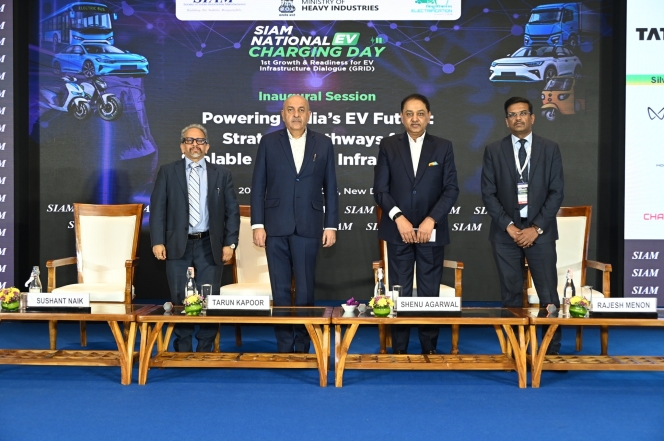
The Society of Indian Automobile Manufacturers (SIAM), with support from the Ministry of Heavy Industries, organised its first National EV Charging Day and the first Growth and Readiness for EV Infrastructure Dialogue (GRID 2026) in New Delhi under its Electrification initiative.
Held under the theme ‘Powering India’s EV Future: Strategic Pathways for Scalable Charging Infrastructure’, the event also marked the launch of the SIAM National EV Charging Day logo and brought together policymakers, government officials, state representatives and industry executives.
H. D. Kumaraswamy, Union Minister, Ministry of Heavy Industries and Ministry of Steel, Government of India, said, “Accessible charging infrastructure is the backbone of electric mobility. We must be clear about how progress is measured. The number of charging stations sanctioned or installed is important, but it cannot be the only measure of success. A charging station must be operational, provide the required capacity, be easy to locate and access, and ensure convenient payments. Infrastructure that remains unavailable does not build confidence among users. Our ambition must extend beyond major metropolitan areas to smaller towns, rural areas, industrial districts, tourism circuits and emerging economic corridors. Let us work together to make India's EV ecosystem accessible, reliable, inclusive and globally competitive.”
Tarun Kapoor, Advisor to Prime Minister of India, Government of India, said, “The launch of SIAM National EV Charging Day marks an important step in recognising the growing significance of charging infrastructure in India's electric mobility transition. As the charging network expands across the country, the focus must remain on reliability, regular maintenance and reasonable tariffs to encourage wider consumer adoption. This will require close collaboration among vehicle manufacturers, charging point operators, Oil Marketing Companies, distribution companies and other stakeholders, alongside infrastructure development for passenger and commercial vehicles, including electric trucks, three-wheelers and buses. Through sustained collaboration, innovation and appropriate policy interventions, India can build a robust, accessible and commercially sustainable EV charging network.”
Sushant Naik, Chairman, SIAM Electric Mobility Group and Global Head Government and Corporate Affairs, Chief Corporate Affairs Officer, Tata Motors, said, “India is at an exciting moment in the electrification journey of the mobility ecosystem. Electric mobility has moved from the margins to mainstream. The focus now must extend beyond EV adoption to charging infrastructure, which will accelerate the EV ecosystem. We are celebrating National EV Charging Day, which marks the beginning of a movement that will power India’s EV future. The opportunity for EV charging is huge, and with greater collaboration between industry, government and infrastructure players, we can build a robust, accessible and sustainable charging ecosystem that will drive India’s electric mobility journey forward.”
Shenu Agarwal, President, SIAM and MD & CEO, Ashok Leyland, said, “India’s mobility story begins with India’s growth story. As the nation moves towards Viksit Bharat, every kilometre driven on a charging supply powered by a greener grid supports decarbonisation and energy security. EV adoption has moved from early adoption to mainstream momentum, with penetration rising from 0.7% in FY20 to 8.2% in FY26. Every new EV on the road creates a new charging need, so infrastructure must move in step with demand. India has the policy direction, clean power base and market momentum. The focus now must be on five key areas—Power, Space, Segments, Platform and Partnerships—to rapidly scale up a dependable charging ecosystem.”
A fireside chat on central policy measures, moderated by Prakash Rao, Co-Chair, SIAM Electric Mobility Group and Head Product Development: Powertrain, COEs and Facilities, Mahindra & Mahindra, reviewed deployment targets and grid readiness.
Dr. Hanif Qureshi, Additional Secretary, Ministry of Heavy Industries, Government of India, said, “The Ministry of Power guidelines stipulate that there should be a car charging station every 25 km on highways and a charging station for buses and trucks every 100 km. We are progressing towards achieving this, and the journey is becoming smoother. In the truck segment many vehicles are deployed in sectors such as mining, steel and ports. Charging infrastructure must also evolve to cater to these requirements as well, alongside strengthening the grid and distribution infrastructure. Charging infrastructure requires coordination between various levels of government, particularly state governments. Under the PM E-DRIVE scheme, about 9,000 chargers are being set up, and approximately INR 9 billion has been sanctioned to various state governments for charging infrastructure. Local bodies and private entities must also coordinate to organise land and connections. In most states, policies have helped in smoothening the journey of identifying sites and providing chargers, making the overall exercise of deploying charging infrastructure more seamless.”
Ravi Dhawan, Director, Ministry of Power, Government of India, said, “What used to be a bottleneck in the distribution sector is now gradually improving. We are transitioning towards better outcomes, and the number of outages and their duration have improved significantly over the last few years. There is continued emphasis on strengthening infrastructure and building the network capacity required at the local level. As electrification increases, distribution companies must prepare for emerging demand and strengthen their infrastructure to support it. The Government of India has recently sanctioned Viability Gap Funding for 92 GWh of energy storage capacity. This is expected to provide significant support to DISCOMs in managing their power requirements. AI-enabled solutions are also being developed to help distribution companies better utilise infrastructure, manage demand and shift peak loads.”
The programme also featured a panel on state-led strategies moderated by Omkar Shaligram, Head – EV Charging and Ecosystem Development, Tata Motors, with participation from Dr. Nidhi Sarohe, Joint Commissioner (Transport), Government of NCT of Delhi; Ravinder Singh, Chief Executive Officer, UPREV, Uttar Pradesh; Sooraj E.M., Guidance Tamil Nadu; Dennis Rajan, Sector Lead, KSEBL, Kerala; and Kulbhushan Kumar, Partner, Grant Thornton. A panel on investments, business models, and partnerships moderated by Ashim Sharma, Partner, NRI India, followed, alongside discussions featuring SIAM Director General Rajesh Menon, SIAM Executive Director (Technical) Atanu Ganguli, Chargezone Founder and Chief Executive Officer Kartikey Hariyani, Statiq Founder and Chief Executive Officer Akshit Bansal, Tata Power Head – EV Charging Virendra Goyal, Bharat Heavy Electricals Ltd. General Manager and Head – New and Renewable Business Sutripto De, Ather Energy Head – Charging Infrastructure Aravind Prasad, and JSW MG Motor India Head – Strategy, EV and Innovation Neha Jain.
Comments (0)
ADD COMMENT