

Panasonic Automotive Systems To Rebrand As Mobitera Inc.
- By MT Bureau
- March 01, 2026

Japanese tier 1 supplier Panasonic Automotive Systems Co., has announced it will change its corporate name and brand to Mobitera Inc., effective 1 April 2027. The rebranding follows a strategic partnership formed in December 2024 with the Apollo Group, aimed at strengthening software development and optimising the company's business portfolio.
The transition to Mobitera represents the company's focus on the evolution of the in-vehicle cockpit space. The new name combines ‘mobility’ with the Latin ‘iter’ (path) and the Japanese ‘terasu’ (to illuminate).
The organisation is pivoting to meet market demands by prioritising software capabilities alongside its hardware legacy. The company’s mission has been defined as creating a sustainable mobility society, supported by a vision titled ‘Joy in Motion.’
The new logo features a central ‘I’ intended to symbolise a focus on individuals. The corporate colour, ‘Mobitera Blue-Green,’ has been selected to represent the harmonisation of society and the environment.
Masashi Nagayasu, Chief Executive Officer, Panasonic Automotive Systems, said, “Mobitera reflects our vision to power the future of mobility with our high-quality technologies that elevate and enrich the human experience. As we evolve our organisation to meet the needs of today’s rapidly changing market, we are committed to staying true to the core values that have long defined who we are.”
| Before change: | After change: |
| Panasonic ITS Co., Ltd. | Mobitera ITS Inc. |
| Panasonic Automotive Systems India Pvt. Ltd. | Mobitera India Pvt. Ltd. |
| Panasonic Automotive Electronics Co., Ltd. | Mobitera Solutions Inc. |
| Panasonic System Networks Evaluation Technology Co., Ltd. | Mobitera Evaluation Technologies Inc. |
| Harima SANYO Industries Co., Ltd. | Mobitera Wel Inc. |
| Panasonic Automotive Systems America, LLC | Mobitera America, LLC |
| Panasonic Automotive Systems de Mexico S.A. de C.V. | Mobitera De Mexico, S.A de C.V. |
| Panasonic Automotive Systems Reynosa Mexico S.A. de C.V. | Mobitera Reynosa Mexico, S.A de C.V. |
| Panasonic Automotive Systems Monterrey Mexico S.A. de C.V. | Mobitera Monterrey Mexico, S.A. de C.V. |
| Panasonic Automotive Sales Company de Mexico, S.A. de C.V. | Mobitera Sales Company de Mexico, S.A. de C.V. |
| Panasonic Automotive Shared Services Company Mexico, S.A. de C.V. | Mobitera Shared Service Company Mexico, S.A. de C.V. |
| Panasonic Automotive Systems Europe GmbH | Mobitera Europe GmbH |
| Panasonic Automotive Systems Czech, s.r.o. | Mobitera Czech, s.r.o. |
| OpenSynergy GmbH | No change |
| Panasonic Automotive Systems Asia Pacific Co., Ltd. | Mobitera Asia Pacific Co., Ltd. |
| Panasonic Automotive Systems Malaysia Sdn. Bhd. | Mobitera Malaysia Sdn. Bhd. |

Toyoda Gosei To Invest INR 5.7 Billion For New Factory In Maharashtra
- By MT Bureau
- September 25, 2026
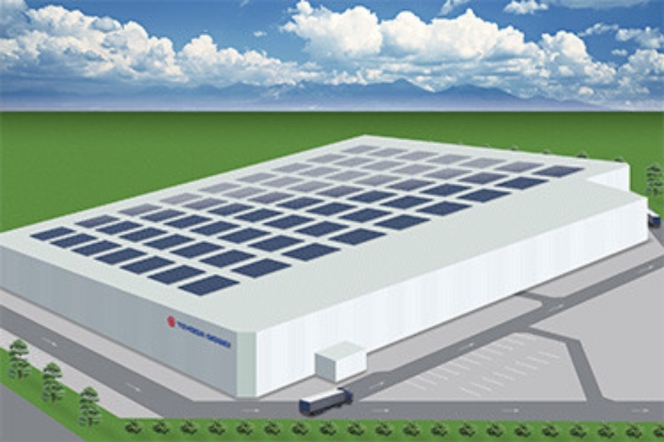
Japanese automotive component supplier Toyoda Gosei Co has announced plans to establish a new manufacturing facility in the Bidkin Industrial Area in Maharashtra.
The plant will produce interior and exterior components, including bumpers and instrument panels, alongside safety systems such as airbags and steering wheels and functional components like plastic fuel filler pipes.
It will commence operations in the first half of 2029 to supply Japanese car manufacturers operating in the country, including Toyota Kirloskar Motor, which is constructing a vehicle plant in the same industrial zone.
The development represents Toyoda Gosei’s eighth location in India and will operate as a branch plant under its subsidiary, Toyoda Gosei South India.
The site covers approximately 78,400 square metres of land with a planned building area of 29,200 square metres. Toyoda Gosei plans an investment of approximately INR 5.758 billion (JPY 9.3 billion) for the project, with projected workforce numbers reaching around 570 employees by 2030.
The facility will incorporate equipment including electric injection moulding machines with automated mould-changing systems, a bumper painting booth, automated guided vehicles and rooftop solar panels.
Production processes will integrate Internet of Things technology, digital transformation systems, collaborative robots, and mechanical mechanisms derived from Karakuri design principles.
The expansion comes as product demand in India shifts from compact cars toward sport utility vehicles. Toyoda Gosei intends to utilise the new facility to expand its local development and manufacturing network across the region.
Kinetic Engineering Plots INR 570 Million Investment For Expansion
- By MT Bureau
- September 24, 2026
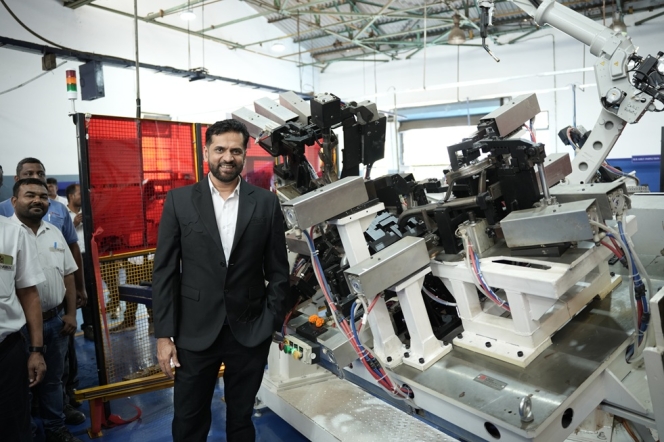
Pune-headquartered automotive company Kinetic Engineering has announced an investment of approximately INR 570 million to support its capital expenditure requirements and expand its electric two-wheeler segment.
The company shared that it intends to deploy INR 170 million toward CAPEX, while INR 400 million will be directed toward electric vehicle manufacturing and distribution. The capital injection is being executed through the final tranche conversion of 4,451,000 warrants issued to promoters in March 2025.
The investment follows an increase in the company's dealer network and product distribution footprint. Kinetic Engineering has signed letters of intent with over 150 dealers across India, with 60 dealerships operational featuring sales, service and spare parts operations. Promoter shareholding in Kinetic Engineering has increased from 50 percent to 69.27 percent over the past four years.
In its electric two-wheeler business, the company is focusing on its Kinetic DX and DX+ scooter models, which incorporate 3.1 kWh lithium iron phosphate battery packs that deliver a range of up to 132 kilometres under Indian Driving Cycle test conditions.
Ajinkya Firodia, Vice-Chairman and Managing Director, Kinetic Engineering, said, "Kinetic Engineering is entering an exciting phase of growth, with strong momentum across both our automotive components and electric mobility businesses. Our auto-components business is seeing a healthy pipeline of new orders, which will support growth and help us work towards our target of improving EBITDA margins to around 12%. At the same time, the response to our Kinetic DX electric scooter has been encouraging, giving us confidence to expand our presence across markets. With continued investments in capacity, technology and our retail network, we are focused on scaling both businesses and building Kinetic into a leading and enduring player in India’s electric mobility segment."
The company aims to secure a position among the top ten electric vehicle brands in India as industry projections indicate electric two-wheeler market volumes could expand from 1.8 million units to 7 million units by FY2030.
Imperial Auto Inaugurates Global Technology Centre In Germany
- By MT Bureau
- September 23, 2026
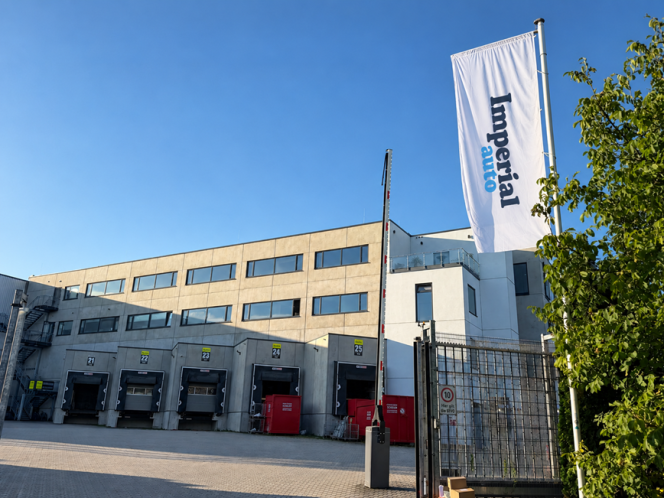
Fluid transmission solutions provider Imperial Auto has opened its new Global Technology Centre in Backnang, Germany, expanding its engineering footprint within the European automotive sector.
Situated in the Stuttgart metropolitan area, the facility will function as a hub for technology development, engineering and customer collaboration. The centre is designed to support OEMs and Tier-1 suppliers across passenger cars, commercial vehicles, agricultural machinery, off-highway equipment and mobility applications by integrating European client requirements with Imperial Auto's global manufacturing infrastructure.
Vikram Wagh, Managing Director and CEO, Imperial Auto, said, “Europe is an important market for Imperial Auto, and establishing a dedicated technology centre in Germany is a significant step in our global growth journey. The centre will strengthen our ability to work closely with customers, understand their evolving technology and product requirements, and translate these insights into innovative solutions. Being closer to our customers will enable faster technical responses, more effective collaboration and stronger product development. The Backnang centre will also facilitate the exchange of engineering knowledge, technologies and best practices across our global network, helping us accelerate innovation and deliver reliable, future-ready solutions to customers across markets.”
The Backnang facility will house teams dedicated to product development and technical support, aiming to accelerate decision-making cycles and facilitate joint engineering initiatives between regional clients and the company's central development units.
Saudi Arabia's CEER Unveils EXOBOT Electric Sedan And SUV Flagship Vehicles
- By MT Bureau
- September 22, 2026
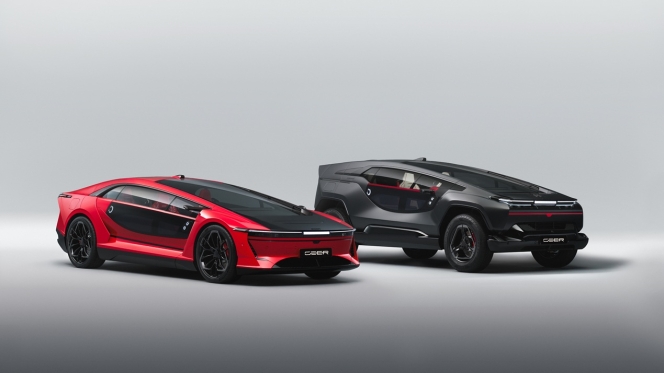
Saudi Arabia’s first homegrown brand CEER has revealed its first flagship vehicles, the EXOBOT e-sedan and SUV, during a ceremony led by Crown Prince Mohammed bin Salman bin Abdulaziz Al Saud.
The EVs were showcased at the CEER Manufacturing Complex located in King Abdullah Economic City, marking the initial step in a planned portfolio of 7 vehicle models scheduled for release by 2030.
The EXOBOT models are built on a tri-motor all-wheel-drive electric powertrain architecture. In its highest specification, the powertrain produces 1,111 horsepower and 1,500 Nm of torque.
The e-sedan accelerates from standstill to 100 kmph in a claimed 2.1 seconds with a top speed of 250 kmph, while the SUV reaches 100 kmph in 2.4 seconds with a maximum speed of 210 kmph.
Thermal management systems, termed Halo Cooling, is designed to lower cabin temperatures from 65deg C to 32deg C within 10 minutes. The EV incorporate steer-by-wire technology, reducing steering input angles from 400 degrees to 160 degrees, alongside rear-wheel steering capabilities.
In terms of dimension, the EXOBOT sedan measures 5.26 metres in length, 2.1 metres in width and 1.43 metres in height. The SUV measures 5.02 metres in length, 2.1 metres in width and 1.69 metres in height.
On the outside, it features include a 2.4-metre windshield angled at a 15-degree inclination, three-metre-long Shahin Wing doors that open in a 60cm arc and light signatures comprising 32 individual light elements.
Inside, the cabin contains a 48-inch curved digital display operating at 8K resolution, a 10.4-inch central control screen and an eight-inch rear display screen.
Commercial roll-out will begin with the EXOBOT First Edition, offered in sedan and SUV configurations powered by an 850-horsepower tri-motor setup producing 1,000 Nm of torque.
The EXOBOT utilises a 112 kWh battery pack and an 800-volt electrical architecture, the First Edition delivers an estimated range of up to 670 kilometres for the sedan and 560 kilometres for the SUV, with 10 to 80 percent charging achieved in under 30 minutes.
CEER is targeting a local content ratio of 45 percent for its vehicle supply chain by 2034.
Comments (1)
ADD COMMENT