

- Bugatti
- Veyron 16.4 Super Sport World Record Edition
- Veyron 16.4 Grand Sport Vitesse World Record Edition
- Chiron Super Sport 300+
- W16 Mistral
Four Bugattis Represent Pure Automotive Innovation
- By Bhushan Mhapralkar
- January 16, 2025
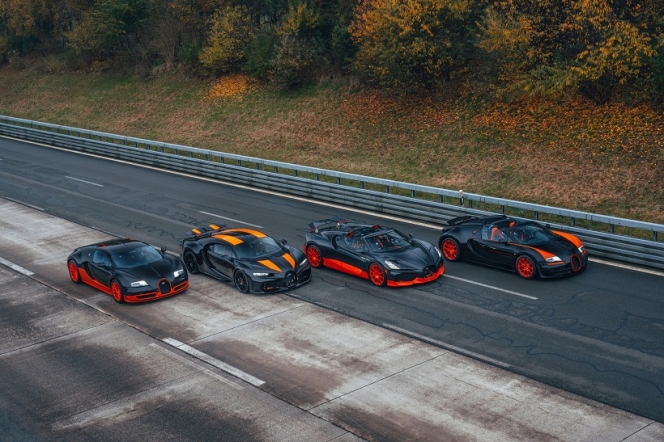
There are four Bugatti sports cars that represent automotive innovation like no others cars do.
It would come as a surprise that the four cars that represent innovation in automobiles in its purest form are all Bugatti sports cars. Showcasing the evolution of automobiles in a way that is unique and amounts to flexing the boundaries of what machines can really be or do what they are expected to do to the fullest, the four Bugatti cars are the Veyron 16.4 Super Sport World Record Edition, Veyron 16.4 Grand Sport Vitesse World Record Edition, Chiron Super Sport 300+ and the W16 Mistral World Record Car.
Successful in carving out a niche, each of the four cars – ultra super cars – have come to represent Bugatti’s incomparable legacy. The Veyron 16.4 Super Sport World Record Edition, on a beautiful day of April 2010, achieved a new land speed world record for production cars on the proving grounds of the Volkswagen Group at Ehra-Lessien (nearby its headquarters at Wolfsburg). In the presence of the German Technical Inspection Agency (TÜV) and a representative of Guinness Book of Records, the Super Sport achieved an average top speed of 431 kmph!
Bugatti’s Pilote Officiel Pierre Henri Raphanel put his helmet and gloves on, pulled the safety belts tight whilst the engineers checked the car a very last time for tyre pressure, temperature and all the systems.
The orange-black Super Sport crossed the light barrier within one hour by driving from South to North and then in the opposite direction. The driver being the only one to touch the car during the record run, the description of the Veyron as its headlights appeared at a certain point of the track was of a jumbo jet coming closer and simply jetting by.
The GPS-tachometer recorded a speed of as much as 933 kmph. The average speed generated by the TUV and Guinness representatives was a whopping 431.072 kmph, which surprised even the Bugatti team.
The roadster version of Veyron 16.4 Super Sport World Record Edition, Veyron 16.4 Grand Sport Vitesse World Record Edition, set the world speed record for open-top production sports cars at the Volkswagen Group’s proving grounds in Ehra-Lessien.
TÜV, the renowned independent German organisation for technical inspection and certification, officially confirmed that a top speed of 408.84 kmph was achieved when the super car was driven by the Chinese racing driver Anthony Liu in 2013.
On the market since the spring of 2012, the open-top sports car is fitted with an 8.0 litre W16 engine that pours 1,200 PS and a torque of 1,500 Nm at 3,000 to 5,000 rpm on the road. Its high-performance handling can be attributed to a racing chassis, which together with extremely fast-acting shock absorbers and reinforced anti-roll bars, guarantees exact control of both the four-wheel drive system and the entire vehicle.
The other factors that enable such performance at the upper limits include a standard carbon monocoque with high torsional rigidity and an outer shell made entirely of carbon fibre. With wind noise and air turbulence a particular concern with open-top vehicles, the Vitesse is offered with a specially developed roof spoiler along with an intricately designed windbreak that guarantees calm open-top driving.
The Chiron Super Sport 300+ is the fastest Bugatti ever made, redefining what is possible when it comes to speed and aerodynamics. Piloted by Bugatti’s Pilote Officiel Andy Wallace, the hypercar smashed through the 482.803 kmph (300 mph) barrier in 2019. Never had a production car reached such speeds ever!
Occupying a spot in the history and standing as a marker in the quest for greater performance and speed, the hypercar was fitted with a re-engineered version of Bugatti’s legendary 8.0 litre W16 engine that produced 1,600 PS of power. A new thermal management system for the engine and gearbox were developed. Refinements to the software governing the engine, gearbox and turbochargers were also made.
To ensure top notch stability, the car was fitted with a ‘longtail’ that extended the car length by approximately 25 cm. This allowed the laminar flow to pass over the body for a longer period of time, reducing aerodynamic stall by more than 40 percent. Air curtains adorning the hyper sports car’s front corners dispersed excess air pressure towards the car’s sides. Simultaneously, air outlets at the wheel arches and behind the front wheels guided excess pressure away from each wheel arch, reducing drag by also producing a small amount of negative lift. Liberal use of exposed carbon fibre – flowing through into the car’s engine cover and the windscreen wiper, thereby contributing to crucial weight-saving that helps the hyper sports car push the envelope of performance – was resorted to. Extremely light and strong magnesium alloy wheels were deployed.
Andy Wallace – Bugatti Pilote Officiel and winner of the Le Mans 24 Hours – assumed the controls of the one-off W16 Mistral World Record Car, warming up the vehicle’s bespoke high-performance tyres on a first anticipatory lap. Ascending to a specified speed of 200 kmph into the banking of the track (of ATP Automotive Testing Papenburg GmbH), he increased the speed before unleashing the full power of the vehicle as the straight opened up coming off the banking, taking it to new heights of record speed in November 2024. Under the meticulous control of SGS-TÜV Saar GmbH, the achievement of a new world top-speed record for an open-top car was officially confirmed at the end of the run, with Andy reaching an incredible 453.91 kmph.
The EUR 14 million hypercar is powered by an 8.0-litre, quad-turbo, W16 engine that does an impressive 1,578 bhp. Innovative is the W16 Mistral’s X-taillight arrangement, which channels hot air from the radiators through ducts towards the rear of the vehicle. The air is expelled through the vents in the X-taillight arrangement.
The hypercar’s ramp-design diffuser accelerates the air’s journey from the rear of the vehicle, which increases downforce and helps the model excel at high speeds. Contributing to the vehicle’s excellent stability are bespoke high-performance tyres.
MT
Maruti Suzuki India Launches Victoris Aurum Edition To Mark Sales Milestone
- By MT Bureau
- October 24, 2026
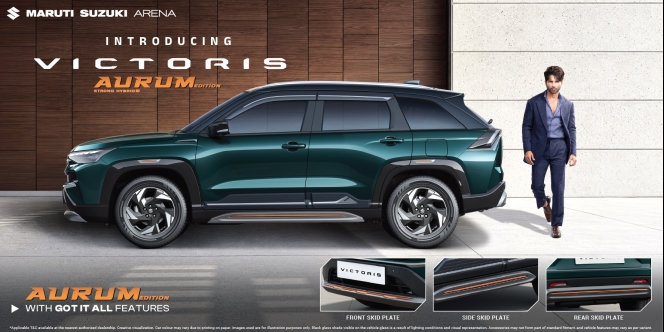
Maruti Suzuki India, the country’s largest carmaker, has introduced the Victoris Aurum Edition Strong Hybrid to mark the first anniversary of the Victoris SUV, featuring an accessory kit priced at INR 22,990.
The launch follows the model reaching sales of 100,000 and 150,000 units within its initial year of production. The Aurum Edition incorporates copper-coloured inserts on the front, side and rear skid plates, along with revised wheel arch trim.
On the outside, it gets chrome garnishes across the front grille, fenders, bumpers, body side mouldings and door visors. Interior additions comprise all-weather 3D cabin mats, a 3D boot mat and a trunk sill guard.
Furthermore, the company has partnered with actor Shahid Kapoor to lead the promotional campaign for the variant.
Partho Banerjee, Senior Executive Officer – Marketing and Sales, Maruti Suzuki India, said, "Conceptualised as a ‘Got it All’ SUV for today’s dynamic young go-getters who ‘want it all’, the Victoris has truly won the hearts of buyers. As we celebrate its first anniversary, it’s worth noting that the Victoris has become the fastest-selling PV to clock both the 150,000- and 100,000-unit sales milestones, going on to achieve the highest sales for any car in India during its 1st year of launch. Recognising these extraordinary achievements, we are introducing the Victoris Aurum Edition Strong Hybrid, with tasteful enhancements that are sure to grab eyeballs and make this festive season feel all the more special for our valuable customers. Our association with Shahid Kapoor, for the new Aurum Edition is also sure to complement the Victoris’ contemporary appeal."
Hyundai Bayon To Feature 69% High-Strength Steel Grade For Enhanced Safety
- By MT Bureau
- October 21, 2026
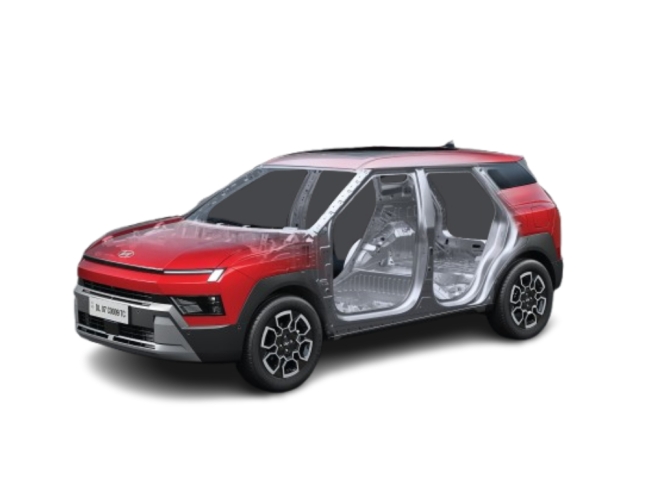
Hyundai Motor India, one of the leading passenger vehicle manufacturers, has detailed the safety specifications and platform architecture for its upcoming Bayon SUV model ahead of its official launch in India on 26 October 2026.
Built on the Global K Enhanced Platform, the Bayon utilises a body structure comprising of 69 percent high-strength steel grades, integrating hot-stamped components across the front apron, dashboard, rear floor and side reinforcements.
The vehicle incorporates Hyundai SmartSense Level 2 Pro ADAS, providing 23 driver assistance features supported by three radar units and 12 parking sensors. Over 35 safety features are fitted as standard across all variants, including six airbags, electronic stability control, hill-start assist control, a tyre pressure monitoring system (TPMS) and ISOFIX child seat anchors.
The Bayon will be powered by a 1.5-litre MPi four-cylinder petrol engine producing 84.4 kW (115 PS) and 143.8 Nm of torque, paired with a six-speed manual or an Intelligent Variable Transmission. Exterior options will span 10 colour configurations across monotone, dual-tone, and matte finishes.
Tarun Garg, Managing Director and Chief Executive Officer of Hyundai Motor India, said, "At Hyundai, we believe that true innovation is meaningful only when it enhances the everyday experiences of our customers. With the Hyundai BAYON, we have combined a robust body structure, advanced safety technologies, and intelligent driver assistance systems to deliver a comprehensive safety experience. From its reinforced chassis and high-strength steel construction to Hyundai SmartSense Level 2 Pro ADAS, the BAYON is engineered to inspire confidence not only in challenging situations, but throughout every journey. This reflects our commitment to delivering intelligent mobility solutions that are safe, connected, and progressive for modern India."
Mitsubishi Motors Launches All-New Pajero In Thailand Ahead Of Global Rollout
- By MT Bureau
- October 21, 2026
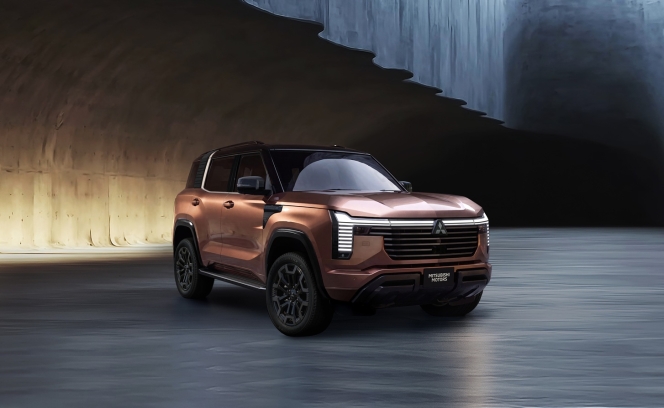
Japanese automotive major Mitsubishi Motors has commenced sales of the Pajero cross-country SUV in Thailand, serving as the initial market for the model’s international release.
The Pajero’s production takes place at the Laem Chabang facility operated by Mitsubishi Motors in Chonburi Province, which functions as a manufacturing hub for export operations.
Shipments to Australia and Japan are scheduled ahead of market releases in mid-December, followed by sequential introductions across approximately 100 countries and regions in the Middle East and Latin America starting in fiscal 2027.
The Pajero integrates four-wheel-drive capability with passenger car handling characteristics and positioning as a flagship offering.
Keisuke Kishiura, President and Chief Operating Officer, Mitsubishi Motors, said, "We are delighted to begin sales of the all-new Pajero in Thailand as the first market for its global rollout. Thailand is not only an important market for Mitsubishi Motors, but also a key hub for our production and exports. The all-new Pajero is a flagship model that embodies Mitsubishi Motors and is positioned among the top-tier cross-country SUVs in the Thai market. We will continue to deliver appealing products from Thailand to customers around the world and provide value that exceeds expectations."
Param Automotive Inaugurates Upgraded Mahindra Showroom In Ahmedabad
- By MT Bureau
- October 20, 2026
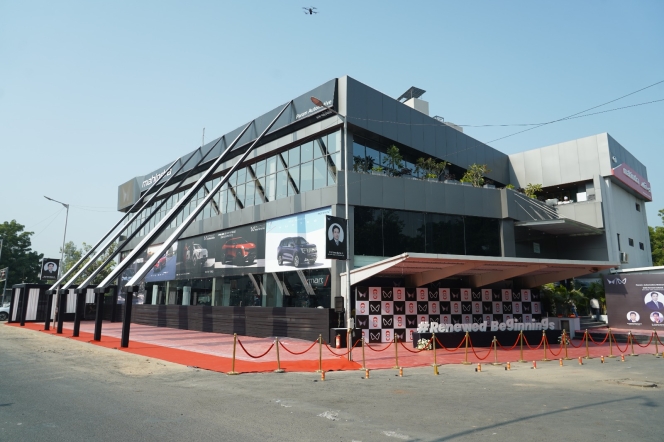
Param Automotive Group has inaugurated an upgraded dealership facility in Ahmedabad to mark its silver jubilee year.
Located at the site established in 2002, the facility spans 40,000 square feet and features display space for 18 vehicles.
The showroom includes customer lounges, delivery zones, accessory bays, test-drive areas and hospitality spaces to support vehicle sales and customer service operations.

Comments (0)
ADD COMMENT